
Recently, a study in the journal Chemosphere caused a stir with its findings, which indicate that kitchen tools made from black plastic could be leaching harmful chemicals into your food. This is not the first study to pinpoint the issue—there have been other studies with similar findings (check out this study from Environment International or this study from Science of the Total Environment).
As food journalists and product testers covering the kitchen space, we on the ATK Reviews team were concerned. We’ve tested and recommended many black plastic tools over the years, and we use our favorites in the test kitchen (and often at home) every day. How worried should we be? Is all black plastic unsafe for use? Do we need to throw out all our plastic ladles and spoons? (And what’s the safest way for us to do that if so?)
We decided to dig into the newest study to get some answers.
Sign up for the Well-Equipped Cook newsletter
Shop smarter with our ATK Reviews team's expert guides and recommendations.
What Are the Health Risks Associated with Black Plastic?
The study published in October found that 85 percent of all black plastic household products tested, including kitchen utensils, contained at least one of two types of flame retardants: brominated flame retardants (BFRs) and organophosphate flame retardants (OPFRs).
These chemicals can migrate out of the plastic under certain conditions, including when the plastic is heated—as when you use a ladle to serve or stir hot soup. That’s when the chemicals can cause harm: exposure to these flame retardants has been linked to higher risk of certain cancers, endocrine disruption, and different neurological and reproductive disorders.
Why Black Plastic? And How Was It Contaminated in the First Place?
This study, and others we looked at, indicates that the products at fault were made with recycled plastic.
Black plastic is difficult for recycling facilities to sort because the lasers used for that sorting can’t register the color properly. As a result, much of it is discarded instead of being repurposed. But recycled black plastic is in high demand—consumers are more eco-conscious than ever before, and black is a convenient color for many kitchenwares, as it won’t show any stains that might occur if you were to leave a white plastic ladle in a vat of hot tomato soup, for example. So manufacturers turn to less desirable sources to accommodate the market for recycled black plastic, using electronic waste (e-waste)—old computer housings, circuit boards, and other parts—which often contain the flame retardants in question. (In theory, the chemicals help to keep your laptop or tablet from fire ignition.)
Companies can do this in part because there isn’t much federal oversight or regulation of recycled plastic manufacturing, and no clear-cut standards of purity exist in the United States for a recycled plastic product.
Moreover, there’s just as little regulation when it comes to the use of flame retardants in electronics to begin with, though some states are now enacting or considering new measures. There’s considerable debate about whether flame retardants are even appropriate or necessary in electronics. But one thing is for sure: These chemicals are harmful when they make their way into plastic food-contact materials.

The Best Wooden Spoons
This old-school kitchen tool is sprouting all kinds of new bells and whistles. But do any improve on the classic design?
Read Our ReviewDoes the Type of Recycled Plastic Matter?
The most recent study does make distinctions in the risk posed by kitchen goods made from different types of recycled plastic, with products made from acrylonitrile butadiene styrene (ABS) seeing much higher rates of flame retardant contamination than products made from nylon, another type of plastic.
Unfortunately, the same study found that manufacturers often incorrectly identify the type of plastic used for their housewares, so it isn’t always sufficient to trust that the type of plastic written on the label is a good indicator of its safety.

So, Should I Throw Out My Black Plastic Spoon or Ladle?
Not necessarily. A review of the study in Chemosphere by scientists at McGill University identified a math error in the results published within the study. The scientists at McGill note that the volume of flame retardants migrating out of the recycled black plastic utensils is within safe limits,. As a result, they say, it might be fine to keep your recycled black plastic kitchen tools.
While this may be true, we think most people are better off with kitchen tools that don’t contain flame retardants at all.
Currently, we recommend getting rid of any kitchen utensil made from recycled black plastic.
If your kitchen utensil is made from virgin (new) black plastic, however, it might still be fine to use since new plastic is unlikely to have the contaminants associated with recycled products.
We’ve contacted the manufacturers of our winning plastic tools—OXO, Matfer Bourgeat, and Cuisinart—and have confirmed that none of those companies use recycled plastic. As a result, our favorite plastic nonstick-safe spatula, slotted spoon, ladle, pie server, and pasta fork should all be safe to use. (OXO tells us that while they are committed to using more recycled materials generally, they use no recycled plastic in food-contact applications.)
While appliances are not covered in the study mentioned above, we’ve also confirmed that our favorite automatic coffee machines by Moccamaster, OXO, and Zojirushi are made from virgin black plastic. (Like kitchen utensils, the black plastic filter holders come into contact with hot liquids that we drink, so recycled plastic there would also pose a risk to our health.)
If you own a black plastic utensil not covered in this article, call the manufacturer’s customer service and ask if the product is made with recycled plastic. If it is, or the company says they don’t know, get rid of it. Same thing goes if you can’t actually reach anyone at the company.
The Best Metal Spatulas
This essential tool can be a cook's best friend—but only if you choose the right one.
Read Our ReviewIs It Better to Throw Out or Recycle My Black Plastic Utensil?
Here, again, it depends. Unfortunately, there are no perfect solutions.
In theory, as Senior Science Research Editor Paul Adams explains, it would probably be better to recycle any tainted black plastic tool than to simply throw it out. If you recycle the tool, there’s a chance it can still be correctly channeled into an appropriate recycling stream and used to make flame-resistant electronics or other goods where the presence of any flame retardants might not pose a risk. It’s also possible that the recycling facility may be able to capture and reclaim the problematic compounds. Contact your local recycling facility first to confirm that they’ll be able to recycle your item.
If you simply throw out a black plastic tool, it will likely end up in a landfill, where any chemicals will inevitably leach into the soil and water and back into our food system. But if your recycling facility doesn’t take kitchenwares, this may be the only option you have.
What Are Some Alternatives to Black Plastic Utensils?
If you want to avoid black plastic tools entirely, there are a host of other options available to you.
- Silicone Tools: Silicone is a type of synthetic rubber. Because it’s more inert than plastics like nylon or ABS, silicone is currently considered safer to use. How do you know if a tool is made from silicone? Silicone has a distinctive soft, rubbery, matte texture that’s quite unlike the hard and often shiny plastics you’ll see elsewhere. Spatulas, ladles, and spoons made from silicone usually have thicker edges than do nylon or ABS models too. Here are some of the silicone tools we recommend:
- Starpack Premium Silicone Spoonula
- GIR Ultimate Ladle
- DI ORO Design Series Classic Spatula
- OXO Good Grips Silicone Cookie Spatula
- Wood and Bamboo Tools: These natural materials aren’t at risk for flame retardant contamination, so they’re always a safe bet if you want a tool that will be gentle on your nonstick or enameled cookware. Just be aware that you’ll need to season and maintain that wood or bamboo with mineral oil or spoon butter, otherwise the natural material can dry out and crack. Here are a few of the wood and bamboo tools we recommend:
- Jonathan’s Spoons Spootle
- FAAY 13.5" Teak Cooking Spoon
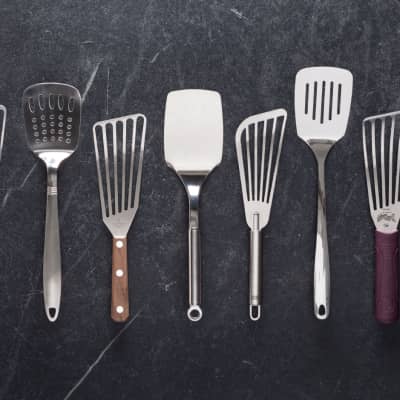
- Stainless-Steel Tools: We love tools made from stainless steel for most tasks—stainless steel is much more durable than any other type of material used for tools and requires no maintenance. Because stainless steel is so strong, you don’t need as much of it to create a ladle or spatula with a thin bowl or head, which is ideal for getting under and scooping up food. Unfortunately, metal tools aren’t great for use with nonstick or enameled cookware, as the metal can scrape the cookware’s delicate surface and damage it, so reserve your metal tools for your stainless-steel, cast-iron, and carbon-steel cookware. Here are some stainless-steel tools we love:
- WÜSTHOF Gourmet 7" Slotted Fish Spatula
- MIU France Flexible Fish Turner–Slotted
- Dexter Russell Steak Turner
- Mercer Culinary Hell’s Handle Perforated Turner
- Rösle Hook Ladle with Pouring Rim
- Cuisinart Stainless Steel Ladle
- Cuisinart Stainless Steel Slotted Spoon
What’s Next?
This is a developing story. We’ll continue to update this article as we learn more about the risks associated with plastic and particularly with recycled plastic. And we’ll also be updating all reviews of kitchenwares involving black plastic in food-contact applications. In the meantime, we urge you to reach out to your local legislator and any companies that make your favorite household goods and voice your concerns about the use and regulation of flame retardants and recycled plastic. As awareness of the issues grows, we hope that companies will make their products safer and better for humans and the environment and that the government will create better standards for product safety.