For the Coquille Indian Tribe of southwest Oregon, the return of the first spring salmon has long been cause for great celebration and appreciation.
“Salmon is our number one first food,” says Chief Jason Younker, recounting stories of the tribe’s centuries-long history with the fish. “The first run would come in the spring. Thousands upon thousands of salmon coming up the rivers to the spawning grounds. You’ve been in the longhouse all winter long with your kids, maybe even your extended family. The first salmon come in, and everybody comes shooting out of that longhouse, especially at the mouth of the Coquille River. Now, you may have used all of your resources during the winter; and you may be really, really hungry; and it’s really tempting to go out and catch a whole bunch; but you catch just one salmon. As you start the fire [to cook the salmon], and the salmon continue heading upstream, the smoke billowing up from that fire lets everybody know upstream that the salmon have returned.”
Sign up for the Cook's Country Watch and Cook newsletter
Latest recipes, episodes, and behind-the-scenes stories from the CC team.
The Coquille Tribe commemorates the wild salmon run each year with the Mill-Luck Salmon Celebration in North Bend, Oregon. The ceremony features salmon cooked in two ways. One is whole Chinook salmon stuffed with lemon and bay leaves, wrapped in foil and buried beneath hot embers to cook.
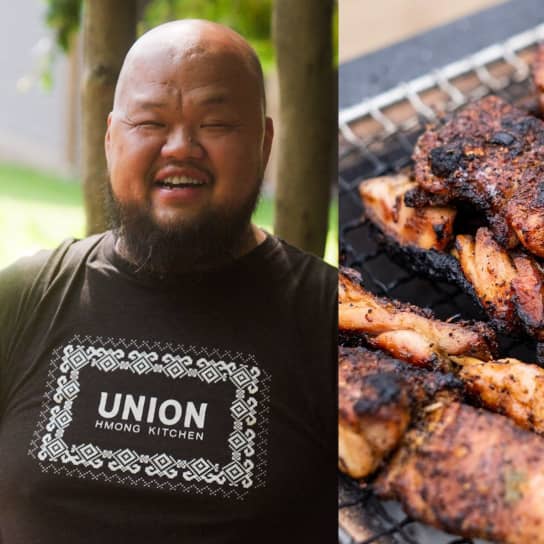
The other, the inspiration for our recipe, involves full sides of salmon suspended with cedar stakes, brushed with huckleberry glaze, and propped over a roaring fire until the glaze is caramelized and lightly charred. Along with the salmon, cooks offer a variety of other traditional dishes, such as local clams, fry bread, and rice salad with cranberries and hazelnuts.
The celebration also includes drumming, dancing, and crafts, all serving to educate attendees about Coquille culture.


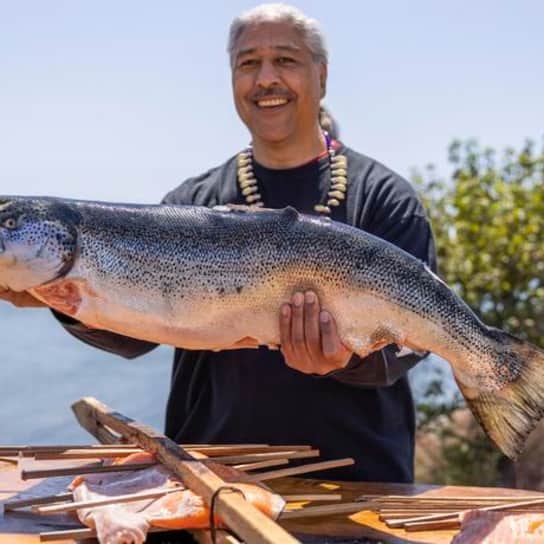
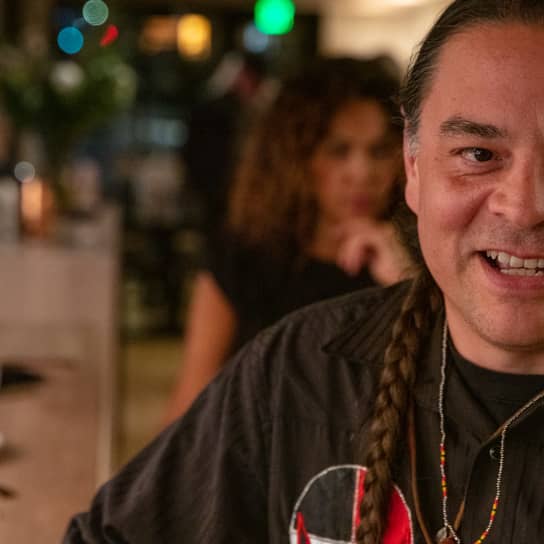
Coquille Chief Jason Younker presides over the annual Mill-Luck Salmon Celebration in North Bend, Oregon (left). Wild salmon from the Columbia River, prepped and ready for the fire pit (right). (Photos by Leesa Morales.)
An integral part of the ceremony is returning the salmon bones to the water. “We look at [salmon] with admiration because of the sacrifices they make on our behalf, and we thank them and hope for their return, and that’s really what we’re doing when we return the bones,” Chief Younker says.
According to Chief Younker, when the tribe first encountered Spanish settlers in the 1780s, they traded peacefully. But by the 1850s, European settlers (and later Americans) began to encroach on Coquille lands, seizing property and forcibly relocating Indigenous people to reservations.
The violence was brutal: Entire villages were destroyed, and settlers placed bounties on Indigenous lives, demanding scalps as proof of death. Soon, nearly all of the Coquille people had been moved to reservations. Only those who were married to white settlers were allowed to remain. Over the years, many tribal members began to escape their reservation confinement, finding refuge in places like Coos Bay and North Bend, where they worked in timber and picked cranberries and hops.
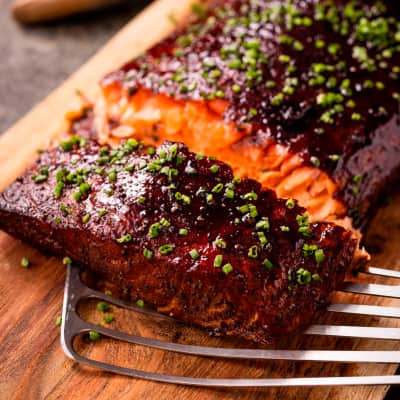
Grill-Smoked Salmon with Huckleberry Glaze
Roaring fires and wild fish anchor an annual celebration of land and legacy.
Get the RecipeIt wasn’t until the 1930s that the tribe successfully sued the federal government for formal recognition and compensation; however, the return they received for their lands was minimal—just a nickel per acre, which many rejected as inadequate.
In 1954, the tribe was officially terminated by Congress. But the termination didn’t last; after the Siletz Tribe became the first in Oregon to be restored in 1977, the Coquille tribe followed suit in 1989. The government granted the tribe “a service district” in five counties, allowing them to reconnect with their land.
After the tribe’s restoration in 1989, there was a mix of frustration and pain among the Coquille people. The scars from the 35 years of termination still lingered. Chief Younker says, “For me, yeah, I’m the last generation that will be able to say I was a terminated Indian, but the pain is still there. There’s just so much embedded that wells up in you. We are still here.”

We look at [salmon] with admiration because of the sacrifices they make on our behalf, and we thank them and hope for their return, and that’s really what we’re doing when we return the bones.
—Chief Jason Younker
Chief Younker feels a deep responsibility to maintain and share Coquille traditions. “One of the things that has concerned me since restoration is, Will anybody remember? Will the next generation remember how painful it was for us? Because we can’t ever give that up. Whenever I’m cooking fish, I make sure that I have [tribal] youths around me. It’s actually my responsibility to make sure that somebody behind me knows how to cook, knows how to tend the fire, use the winds, bless the pit, return the bones to the river.”