


Can a pot of soup unify a nation? When it’s soup joumou, the answer is a resounding yes.
Every year on January 1, Haitians gather over the hearty squash soup, each batch brimming with vegetables, often beef (many sources say the soup was originally vegetarian), and pasta that soaks up the meaty, earthy-sweet broth. The idea isn’t just to consume it—or drink it, as Haitians affectionately say.
As Nadege Fleurimond, the Haitian-born chef and entrepreneur, said when we spoke about the dish, making and sharing it symbolizes Haiti’s liberty from French colonial rule more than 200 years ago and is one of the world’s most joyful cooking rituals.
Sign up for the Cook's Insider newsletter
The latest recipes, tips, and tricks, plus behind-the-scenes stories from the Cook's Illustrated team.
Soup joumou represents more than just a meal to us,” she said. “It represents freedom, it represents resilience. It’s the dish that unites us as a people.”
Momentum around the dish builds in the days leading up to the holiday as cooks pour themselves into its preparation.
They marinate chunks of beef in epis, Haiti’s sofrito-like paste that infuses deep savor into so much of the cuisine, and then boil them in highly seasoned broth until they’re tender and suffuse the pot with rich flavor.

Soup joumou represents more than just a meal to us. It represents freedom.
—Nadege Fleurimond, chef and entrepreneur
Meanwhile, they simmer and puree Caribbean pumpkin—either Haiti’s native joumou or calabaza, the brawny, tam-o’-shanter-shaped gourd that’s long been cultivated in the region’s rich soil and is more widely available to expats.
The two components are merged, along with root vegetables and green cabbage, to build a soup that is both rib-sticking yet remarkably light. And when everything is nearly tender, cooks toss in pasta that ratchets up the soup’s heartiness even more.
No two pots are exactly alike, which makes the sharing fun. (“You want to see who’s the better cook in the family,” Fleurimond joked.)
And despite the sheer volume of food to prep—every batch is built for a crowd—there are natural break points and work-ahead opportunities throughout that make it eminently doable.
Here’s a component-by-component breakdown of my recipe and how I prep each one strategically.
From Forbidden to Celebrated

Soup joumou, like so much of Haitian cooking, has undergone a remarkable revolution.
Some of its components were introduced to the island through the West African slave trade and enslaved Haitians were forced to prepare the dish for their French oppressors while forbidden to eat it themselves.
But ever since they revolted in 1804 and formed the first free Black republic, Haitians have reclaimed the hearty squash soup as their own and the preparation, sharing, and drinking of it as a relished ritual.
“It’s become this thing of great connecting and honoring,” said Dr. Myron M. Beasley, associate professor of American Studies at Bates College who’s written extensively about Haiti’s foodways. “It’s an archive that helps us remember.”
It’s also about pride, says chef, restaurateur, and Haitian expat Nadege Fleurimond. The soup and the independence day holiday, she added, “are just another opportunity for us to be like, ‘yeah, we did that!’”
Recognition for soup joumou has finally surged in the food world, too, most notably in 2021 when it was awarded protected status by the United Nations Educational, Scientific and Cultural Organization (UNESCO). So has Haitian cuisine and culture in general—and that, Beasley said, “is an amazing sign of what’s to come.”
Epis: Refrigerate for up to 1 week; freeze for up to 1 month
Epis—the foundation of virtually all savory Haitian cooking—almost always starts with green pepper, onion, garlic, parsley, scallion, and thyme. I process everything into a wet paste, loosening it with lime juice (a common addition when epis is used to marinate meat) and oil and seasoning it further with ultrasavory chicken bouillon and habanero for a hint of fruity burn.
Beef: Marinate between 1 and 12 hours
Chuck roast is ideal here: It’s easy to cut into chunks, and during cooking its abundant fat (I don’t trim any away) and collagen melt so the meat turns fork-tender. When it’s time to prepare the soup, all you do is massage the epis into the beef and let it marinate anywhere from 1 to 12 hours. The lime juice gently tenderizes the meat’s surface, while the salt and some glutamate flavor seep in a little deeper.
Squash puree: Refrigerate for up to 2 days
Caribbean squash such as calabaza is the heart of soup joumou, and it’s tailor-made for blending into a smooth puree thanks to its relatively high soluble fiber content. The key, I found, is to minimize the amount of cooking water, using just enough to submerge the squash chunks. Less liquid cuts down on the time spent waiting for the water to boil and results in a naturally concentrated puree that adds earthy sweetness and velvety body to the soup.
Calabaza Squash

Native to tropical and subtropical regions of the Americas as well as to the Caribbean where it has thrived for millennia, calabaza is a squat gourd with ridged skin and nutty-sweet, bright yellow-orange flesh. Many Haitian cooks use it as the foundation of the nation’s beloved soup (“joumou” is Haitian Kreyòl for “pumpkin” or “squash”; calabaza and joumou are different cultivars of the same species) and also commonly roast or sauté it or bake it into sweets.
Shopping: Calabaza size ranges widely: Some are as compact as a cantaloupe, but many grow to be as big as watermelons and are sold precut by the wedge.
Prepping: Lay a wedge on its flat side and use a knife to cut off the skin down to its orange flesh (or use a peeler). Scoop out the seeds and cut the squash into pieces.
Soup: Boil 1 hour; serve immediately
After marinating, the beef braises for about an hour in chicken broth seasoned with loads of softened onions and celery, garlic, tomato paste, and a bouquet garni of habanero chile, cloves, and thyme that adds fruity, aromatic warmth.
Once it’s tender and the broth has reduced and concentrated, I add the squash puree and the vegetables—twice as much by weight compared to the meat as a nod to soup joumou’s possible vegetarian origins. The last addition is pasta (often rigatoni), which likely became a fixture in the dish when the United States occupied Haiti in the early 20th century. To avoid overcooking it, I parboil the pasta in the soup and then let it finish softening as the pot sits covered off heat.
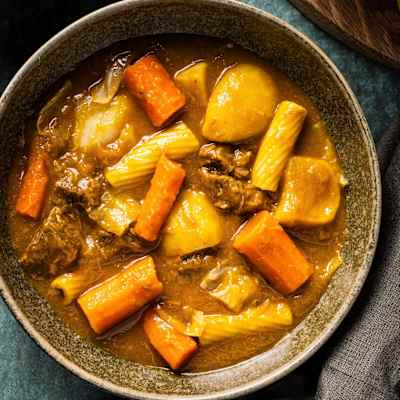
Soup Joumou (Haitian Squash Soup)
Velvety broth chock-full of vegetables, beef, and pasta, soup joumou is Haiti’s New Year’s ritual.
Get the Recipe