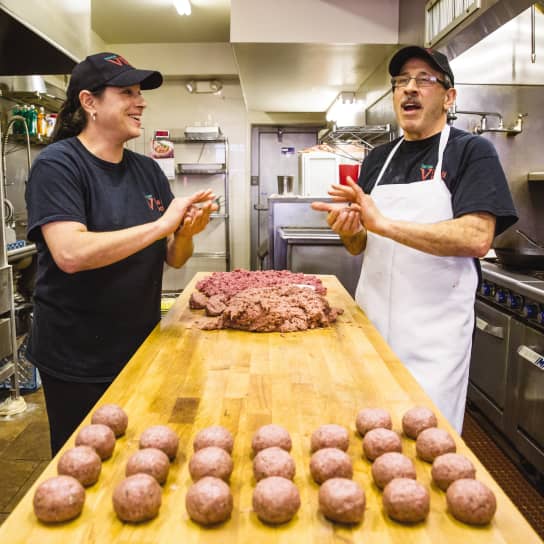
It’s the summer of 2023, and I’m standing with Minneapolis chef Yia Vang, talking about the menu. His restaurant, Union Hmong Kitchen (previously Mee-Ka), features a variety of Hmong-American dishes, such as a meatloaf of beef, pork, and glass noodles topped with a fried egg and oyster sauce–ketchup; smash cheeseburgers with fermented radishes and kua txob (pronounced “kuwah-tsaw”) ranch dressing; and the more traditional nqaij tsaws (pronounced “ngai chah-uh”), braised pork and mustard greens with roasted vegetables and pickled onions.

Vang, who also owns a second location of Union Hmong Kitchen in Minneapolis’s North Loop, says the inspiration for the menu was about “digging into these dishes that we grew up eating. So it was Hmong sausage that my dad made, or the way he grilled pork, or the way he grilled chicken. A lot of the side dishes are stuff that was inspired by Mom. Our very basic hot sauce, kua txob, which literally translates to ‘pepper sauce,’ is from my mom.”

Today, Minnesota boasts one of the largest Hmong populations in the United States, due in large part to the Vietnam war, when many people from Southeast Asia’s Hmong ethnic group aided American soldiers and took part in the covert, CIA-operated Secret War in Laos. Because of their participation, they were labeled traitors by communist leaders throughout Southeast Asia. Fearing for their lives, many fled to the Ban Vinai refugee camp in Thailand, which is where Vang was born. “Vinai” is also the name of Vang’s forthcoming restaurant, which he says will be a “love letter to my mom and dad.”

After the war, many Hmong refugees resettled in Minnesota, and over the years family members and friends joined them stateside.
“When you have a group of people that does not have a land of their own, a home of their own, a country of their own, or an anthem of their own; when war determines where your next location’s gonna be, no matter where you are in the world, if there’s another Hmong person there, that’s home,” Vang says. “Our cultural DNA is intricately woven into the foods that we eat. If you want to know our people, then you gotta know our food, because our food is actually our story.”
A typical Hmong meal consists of meat, vegetables, rice, and hot sauce, and grilling plays a primary role. “That’s one thing that I really love about the way that Hmong food is done, even the way that my mom and dad does food: You can put whatever you want on the grill.”

In the kitchen, Vang seasons a chicken with a mixture of salt, pepper, smoked paprika, and granulated garlic. Although the chicken is butterflied, the backbone has been left intact rather than removed. Nothing is wasted; he calls the bony, fat-laden bits of the backbone “chef snacks.” He sandwiches the splayed chicken in a grill basket, and we head to the narrow back patio where he fires up a small charcoal grill and stokes the coals with a bamboo fan.
He casually grills the chicken, flipping it every so often for even cooking, fanning the coals when he wants to kick up the heat. The dish isn’t on his menu, but the preparation is similar to how his father likes to cook chicken and exemplifies something he feels encapsulates Hmong cooking: straightforward preparations with powerful flavors.

When the chicken comes off the grill, the skin is perfectly char-streaked and crisp. After the chicken has rested, Vang breaks it down into 10 pieces and arranges them on a platter. He drops a handful of fermented mustard greens on one side of the platter and scatters another handful of pickled red onions over the chicken. Just before he brings it to the table, he showers the chicken with scallions and torn leaves of cilantro and mint. He serves it with a jar of kua txob—Vang’s take on the cilantro, garlic, chile, lime, and fish sauce condiment inspired by his mother’s version—and we douse bites of chicken with the sauce. The bold, simple dish is pure comfort.
He calls it “Grilled Hilltribe Chicken,” explaining, “‘Hilltribe’ to us is not a description of tribes in the hills, but it’s a people group who has embraced who they are.”

Grilled Hilltribe Chicken with Kua Txob
A Hmong menu in Minneapolis tells a flavorful tale.
Get the RecipeVang says that for the last year, he’s been inspired by a Mark Twain quote: “The two most important days in your life are the day you are born and the day you find out why.”
“I know why I’m here and what I was created for. The moment you realize that … you become unstoppable.”