


If there’s anything cozier than a warm scone, it’s a warm cheese scone.
In it you get all the pleasures of the golden, craggy-crusted pastry and its cushiony crumb along with the sharp, nutty depth and richness of a good cheddar toastie. Scones are a snap to make, too, which gives them the snug appeal of fresh-from-the-oven bread anytime the mood strikes.
You can casually knock out the dough and pop them in the oven as you’re whipping up a pot of soup or boil water for tea as you wait for them to bake.
Sign up for the Cook's Insider newsletter
The latest recipes, tips, and tricks, plus behind-the-scenes stories from the Cook's Illustrated team.
For big cheesy savor, you might be inclined to cram as much cheddar (a cheese-scone standard) as possible into the dough. But I found that tons of cheese doesn’t make a great cheese scone; with cheddar, it makes a fragile, cloying, greasy pastry that barely holds itself together. That’s because cheese—especially a rich type like cheddar—is a source of fat, and it must be factored into the dough formula just as the butter is.
The more strategic approach: Reduce the butter to accommodate as much cheese as possible, and use the boldest-tasting cheddar you can get.
I spent a few tests fiddling with the cheddar-to-butter ratio. After pulsing cold butter into the dry ingredients (flour, baking powder, salt, and dry mustard to underscore the cheesy depth), I worked varying amounts of shredded cheddar (initially a basic variety) into the mix by hand before moistening it with a mixture of milk and egg.
I briefly kneaded the dough into a round, cut wedges that I brushed with some reserved milk-egg mixture to encourage a golden sheen, and baked them for about 15 minutes.
An Extra-Cheesy Formula

Cheddar is classic in cheese scones, but there’s only so much you can pack into the pastry before it turns greasy or the ratio of flour to fat dips so low that the crumb can’t hold together. That’s why these scones call for aged cheddar and Parmesan. Both are concentrated sources of nutty complexity, so ounce for ounce we get maximum cheese flavor, and they work in tandem: Cheddar adds richness while Parmesan disperses throughout the dough like a dry ingredient so that its savor is pervasive. We also minimize the amount of butter in the mix to allow for as much cheese as possible—8 ounces total to 10 ounces of flour.
Eventually, I landed on 6 ounces of cheddar and 2 ounces of butter—enough combined richness to make the crumb both tender and structurally sound. Then I went cheddar shopping, targeting a well-aged block that had racked up big tang and toasty, sweet, caramelized notes as it matured.
Really good cheddar made strikingly more complex-tasting scones—but even that batch lacked depth.
So I supplemented the cheddar with a couple ounces of grated Parmesan. Its robust, saline complexity bolstered the scone’s savor, and because it’s low-moisture I was able to grind it into the flour mixture like a dry ingredient so that its complexity suffused every bite. (The relatively modest amount I was adding didn’t throw off the dough’s ratio of fat to flour.)
Go mix up a batch right now. Get a pot of soup going. Break open a scone while it’s still warm. Maximum coziness awaits.
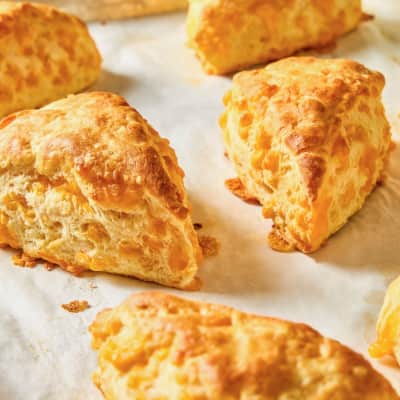
Double Cheese Scones
How do you maximize cheesy depth without compromising the crumb? It starts with teamwork and maturity.
Get the Recipe


