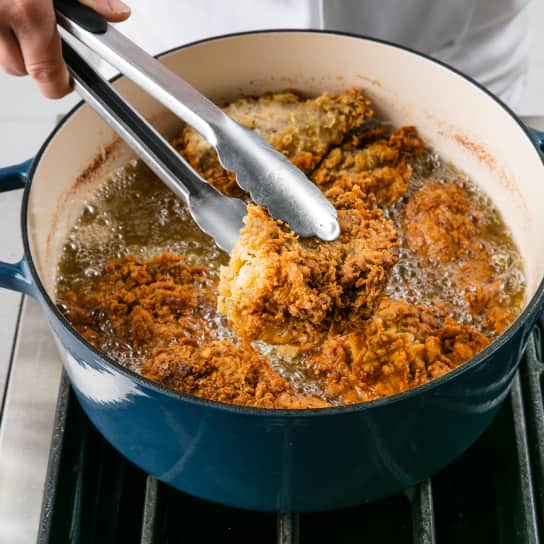

Fried chicken. It’s universal comfort food, the laid-back centerpiece of social gatherings, and many a home cook’s pride and joy.
In the archives of this magazine, you’ll find numerous recipes for the iconic poultry preparation. Each one charms with a wrinkly, crinkly, golden-brown coating; salty, peppery, chicken-y savor; and homespun vibes.
But now I’ve gone back into the kitchen to reexamine every aspect of the all-American approach, and after weeks of frying, I’m throwing down my grease-stained apron with a recipe that, I’m proud to say, is our crispiest, crunchiest yet.
In the guide that follows, I’ll walk you through the optimal ways to butcher, brine, and season the parts; explain my nifty double-dip coating that promises to deliver the absolute crunchiest chicken you’ve ever had (you can hear its phenomenal texture when you take a bite); tell you exactly when to pull the pieces from the bubbling oil; and explain the surprising benefit to letting the chicken rest before you feast.
Whether you’re new to the process or a frequent fryer, you’re guaranteed to end up with a gold-star crowd-pleaser.
Sign up for the Cook's Insider newsletter
The latest recipes, tips, and tricks, plus behind-the-scenes stories from the Cook's Illustrated team.
Crispy and Crunchy Sound Bites

Your sense of taste, of course, is key for assessing food, but did you know that your hearing can also play a critical role? When we bite into something brittle, the volume (measured in decibels) and frequency (measured in kilohertz) of the sound that’s transmitted to our ears affects whether we consider the food to be crunchy or crispy.
Crunchy foods (like a raw carrot) emit audible frequencies around 1.5 kilohertz, whereas crispy foods (like thin, crackly potato chips) are higher-pitched, at around 5 kilohertz.
To get an acoustic evaluation of the crenellated crust of our chicken, we toted a freshly fried batch into an audio booth and flipped on the recorder, keeping the tape rolling as we took one delightfully noisy bite after another. Thanks to our unique double-dip method, the crust is full of rugged, heavily textured patches along with thinner, more delicate ones, so the sound waves were accordingly varied.
1. Proper Prep Ensures Maximum Crunch Per Bite

Whether you choose to fry white or dark meat or both, be diligent about trimming since large pockets of fat won’t be fully rendered during frying. Also, keep in mind that smaller pieces are preferable for a high ratio of crust to meat. Drumsticks and thighs are just the right size, but breasts should be halved.
We split them on the diagonal to evenly divide their tapered shape.
2. A Flavored Brine Delivers Moist, Savory Meat

The test kitchen’s usual highly concentrated brine seasons poultry and helps it retain moisture in just 30 minutes. Here, we wanted other water-soluble flavorings—sugar, garlic, cayenne—to have enough time to work their way into the surface of the chicken. So we extended the soaking time to at least 2 hours or up to 24 hours, and we diluted the concentration of the brine so that the chicken didn’t get too salty.
While it sits, the chicken soaks up lots of sweet and spicy savoriness, and it fries up amazingly juicy too.
3. Double-Dip for a Superior, Extra-Crunchy Coating

There are two common coating styles for fried chicken: battered and dredged. The former produces a relatively smooth, thick crust with deep crunch; the latter, a wrinklier, crispier one. We found that a double dip—batter, then dredge—creates a multitextured crust that’s the best of both worlds.
Start by blending flour, cornstarch, and baking powder together with signature savory, peppery fried chicken seasonings: garlic and onion powders, dried thyme, black pepper, and cayenne pepper.
After reserving some of the dry mixture, moisten the remainder with buttermilk, which adds tang. Dip the chicken into the viscous batter and then into the dry mixture. The starch in the dredge will absorb the liquid in the batter, forming small, uneven clumps that fry up craggy and crunchy.
Both the flour and the cornstarch play important roles. Proteins in the flour absorb water, thickening the batter and helping it cling. But the proteins incorporate water into their structure and also absorb oil, leading to only modestly crunchy—or even slightly greasy—fried chicken. That’s where the cornstarch comes in.
When heated, the pure starch absorbs water and forms a gel; then, when the water boils, it flashes off, leaving behind an airy, crispy structure.
4. Fry Low and Slow for Perfectly Cooked Parts

Most fried chicken recipes call for 325- to 375-degree oil, but we prefer a lower temperature: Aim for 305 to 315 degrees while frying. If the temperature dips any lower, the coating won’t set quickly enough and will separate from the flesh.
If the temperature climbs much higher, you risk scorching the crust before the meat cooks through.
5. For the Juiciest Meat and Crispiest Crust, Rely on Carryover Cooking

You can expect a lot of carryover cooking here because the hearty crust is a terrific insulator. For the juiciest possible chicken, pull the white meat out of the oil when it hits just 145 degrees, and the dark meat at 160. The breasts will slowly coast to 165 while they rest for 20 minutes; the dark meat rises to a succulent 180 to 190 degrees.
This resting period, we found, not only keeps the meat supermoist but also improves the crust: As it sits, the gelled starch in the coating firms up, turning it maximally crunchy.
Why We Love Peanut Oil

Peanut oil is our choice for frying chicken since it tastes clean and fresh, even after multiple batches. That’s because peanut oil has a high proportion of monounsaturated fatty acids, which improves its stability against rancidity.
What’s more, peanut oil imparts a subtle nutty richness that nicely complements the crust and chicken. (Vegetable oil, which has a similar smoke point, is acceptable if peanut oil is unavailable.)
Temp the Smallest Piece First

Two to 3 minutes before the end of the frying time or when the chicken is deep golden brown, check its temperature, starting with the smallest white meat piece. Use tongs to remove it from the pot so that if juices drip when the thermometer pierces it, they don't land in the hot oil and splatter.
Check the temperature in multiple spots. If any spot is too low, return the piece to the oil and continue frying. (If you have dark meat in the same batch, start checking it once the white meat is cooked through.)

Supercrunchy Buttermilk Fried Chicken
Some styles are battered, others are dredged. For the crispiest, crunchiest, all-around yummiest fried chicken, do both.
Get the Recipe