


Carlos Olaechea wrapped his arms around himself and smiled as he mused on the comforts of tallarines verdes. “[When] I’m away from my family and I just need a hug, I make tallarines verdes,” the Peruvian American food writer said during a video call about the lush, spinach-sauced pasta. “It’s cozy.”
The homey, incredibly popular recipe is the result of a merger of foodways from two cultures.
After the unification of Italy in 1861, waves of impoverished Italians, many from Liguria, left the country in search of a better livelihood and made their way to Lima, Peru. As they settled into their new Andean home, Italian Peruvian fusion recipes began to take shape, including tallarines verdes, or “green noodles.”
Sign up for the Cook's Insider newsletter
The latest recipes, tips, and tricks, plus behind-the-scenes stories from the Cook's Illustrated team.

Tallarines verdes is a warm hug.
—Peruvian American food writer Carlos Olaechea
The dish, which is often thought of as a take on pesto Genovese, showcases ingredients more readily available in Peru.
Instead of the basil that is pounded in a mortar and pestle with garlic, pine nuts, and Parmesan cheese to make a coarse Italian pesto, the green sauce gets its enticing color primarily from fresh spinach.
The leafy vegetable doesn’t oxidize as readily as basil, so the sauce isn’t prone to darkening like pesto. To make it, lots of spinach and a few other ingredients (more on those in a moment) are whizzed in a blender with just a hint of fresh basil. (Some attribute the restrained use of herb to the notion that basil grown in Peru is particularly strong; others say that inhabitants of Lima, or Limeños, believed that too much basil was unhealthy.)
A Smoother Sauce

When we connected to discuss tallarines verdes, Peruvian American food writer Carlos Olaechea pointed out that a satiny texture is characteristic of the dish.
“We [Peruvians] don’t like chunks,” he quipped, recalling that his grandmother passed her green sauce through a sieve for a flawless consistency.
We found that blanching the greens helped ensure a smooth sauce: Heat breaks down the pectin and hemicellulose in the cell walls of the spinach, which allows the cells to separate from each other and yield a finer texture.
The sauce’s rich, creamy body comes from the addition of evaporated milk, a cherished ingredient in the Peruvian pantry since its introduction into the country sometime in the late 1800s to early 1900s.
Also featured in the sauce are queso fresco or queso blanco crafted by alpine cheesemakers, pecans or walnuts (pecan trees thrive in the Ica valley), and lightly sautéed red onion and garlic.
Pureed until velvety smooth; tossed with freshly boiled fettuccine; and served, as it traditionally is, with thin, seared steaks, the verdant pasta makes a satisfying, soothing meal.

Going Green
Enthralled by the concept, I set to work creating my own recipe. A 6:1 ratio of spinach to basil produced a vivid green sauce that tasted mainly of earthy, mineral-y spinach with just a hint of anisey basil.
Different recipes take different approaches to prepping the greens: Some call for blanching, others for sautéing, and some go the simplest route—blending them raw. The sauce with raw spinach had a slight grittiness, while both cooking methods fully tenderized the spinach and basil leaves, resulting in a silky texture. And silkiness is key, said Olaechea, as Peruvians have a particular fondness for foods with a “super, super smooth” consistency.
Blanching would be the most convenient method since I could use the same big pot of boiling water to cook the fettuccine.
From Liguria to Lima: Pesto Gets a Creamy Makeover
When a surge of Ligurians settled in Lima, Peru, in the mid-19th century, some of the ingredients for their beloved pesto were difficult to source. With a few clever substitutions of local ingredients, the rustic basil blend was transformed into a velvety spinach sauce with a character all its own.
Pesto: Basil, Extra-virgin olive oil, Pine nuts, Parmesan cheese, Raw garlic
Green Sauce: Spinach and basil, Evaporated milk, Pecans or walnuts, Queso fresco, Sautéed red onion and garlic
Milking It
With the spinach and basil sorted, I turned my attention to the dairy.
Evaporated milk adds character to the sauce that fresh milk can’t match: It’s slightly creamy, with a tawny color that hints at its subtle toasty flavor. And since evaporated milk is made by reducing fresh milk, it’s naturally richer, with about 6.5 percent milk fat compared to just 3.25 percent in whole milk.
The mild, lightly salty taste of the queso fresco reinforces the concentrated milkiness of the sauce. After a string of tests where too much of the firm, crumbly dairy rendered the sauce clumpy and gritty, I finally landed on the ideal balance of milk and cheese. Half a cup of each produced a luxuriously smooth finish.
Finally, I prepared the aromatics, which are always briefly sautéed to soften their sharp sulfurous compounds. Half a red onion and two cloves of garlic yielded just enough savory depth without overpowering the spinach.
Why Peru (and Latin America) Loves Evaporated Milk

Like many in Latin America, Peruvians revere evaporated (and sweetened condensed) milk.
Canned evaporated milk was first produced in the United States in 1885 by the Helvetia Milk Condensing Company, and by the early 1900s numerous manufacturers were canning their own brands. They found a ready market in Latin America, where dairy farming was historically limited, with the company that is now known as Carnation setting up its first factory in Peru around 1940.
Made by evaporating fresh whole milk under vacuum at a lowish temperature (under 150 degrees) to increase its shelf-stability, with a separate pasteurization step at a higher temperature to kill off microbes, the creamy, lightly caramelized milk became an essential ingredient in Peru and throughout Latin America.
Not perceived as an alternative to fresh milk but an ingredient in its own right, today it is stirred into soups, stews, and pasta sauces; used as the base for custards and flans; splashed into coffee and tea; and diluted with water for drinking straight.
With the ingredients ready, everything just needed a quick whirl in the blender: I squeezed the blanched spinach and basil to remove any excess water and added them to the blender jar along with the cooked alliums, evaporated milk, queso fresco, and a couple handfuls of pecans (my preference, though walnuts work well too) for even more richness and nutty undertones.
After 2 minutes of blending, the sauce was satiny smooth, so I set it aside while I boiled the pasta.
Using the same water from blanching the greens, I dropped in the fettuccine and boiled it until al dente. Back in the pot, the luscious sauce warmed through before I tossed in the fettuccine, adding just enough of the starchy pasta cooking water to slightly loosen the consistency.
I twirled the pasta onto plates, crowning each portion with a perfectly cooked steak. Each creamy bite was pure comfort—warm and deeply satisfying—just like a cozy embrace.

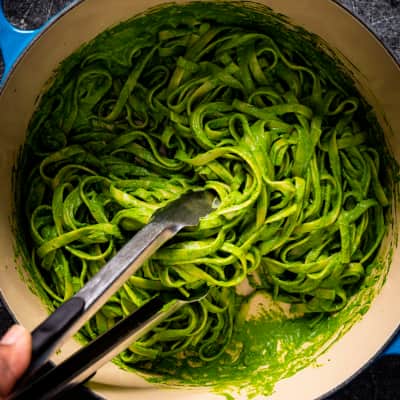
Tallarines Verdes (Peruvian Green Noodles)
Comfort meets cultural fusion in tallarines verdes, a creamier, greener twist on pesto Genovese.
Get the Recipe