


To my surprise and delight, I’ve recently become a person who makes candy.
Though I’ve always enjoyed the occasional sweet bite, crafting treats such as caramels and tempered chocolates is too time-consuming and fiddly to be a regular pursuit for me.
But the French confection called “pâte de fruit” (direct translation: “fruit paste”) has been a revelation. These jewels of gelled, sweetened fruit puree captivate with radiant color and then release a flood of bright fruit flavor that gently melts away.
Sign up for the Cook's Insider newsletter
The latest recipes, tips, and tricks, plus behind-the-scenes stories from the Cook's Illustrated team.
A single, glistening piece is a luxe way to wrap up a grand meal, which is why pâtes de fruit are so often included among the petits fours at posh restaurants. A collection of flavors packed into a small box makes a lovely gift too.
Comprised of only fruit, sugar, and pectin, the festive treats are suitable for everyone on your list.
Starting to Gel
Pâtes de fruit are also incredibly quick and simple to put together, which makes them the perfect entry into candy making.
The process is similar to that of making jam; in fact, early versions of the bonbons were referred to as “confitures sèches,” or “dry jams.”
It’s all about creating the right conditions for the pectin to gel. Start by bringing a mixture of sugar and fruit puree (thawed frozen raspberries work beautifully) to a boil. When enough water evaporates, the sugar concentration will be such that the pectin can form a soft but stable and sliceable gel.
The Gelling Power of Pectin

Pectin, a polysaccharide found in the cell walls of fruits, can thicken or—in the case of pâte de fruit—solidify a fruit puree, but it can’t do the job on its own: It requires the proper balance of water, sugar, and acid.
The pectin molecules must bond to each other to form a web-like structure that holds the fruit and water in place, producing the soft but set texture of pâte de fruit.
The problem? Pectin molecules are hydrophilic, meaning that they’d rather bond with water molecules than with each other. Enter sugar.
Sugar molecules actively pull the water away from the pectin. But even then, the pectin molecules won’t bond to each other because they’re negatively charged.
That’s where the acid (in liquid pectin and lemon juice) comes in. It neutralizes the electrical charge on the pectin molecules, encouraging them to join up and form the matrix that holds everything in place.
How do you know when the proper sugar concentration is reached?
Some recipes call for simmering for a prescribed amount of time or using a visual thickness cue such as the “thread stage,” but the most precise gauge is a thermometer.
Jams and jellies are typically cooked to about 220 degrees; for tender, yielding pâte de fruit, I determined that 230 degrees was just right. Cooked to this temperature, the candies held defined corners when cut, yet melted readily in my mouth.
Target temperature achieved, the next step is to stir in commercial pectin to supplement the natural pectin in the fruit. Then, boil the syrupy mixture hard for 60 seconds to help the pectin chains link to each other and form a network that traps the fruit and melted sugar.
Add a bit of fresh lemon juice, which sharpens the fruity flavor and strengthens the pectin, then pour it all into a mold—in my case, a loaf pan, which had the right dimensions for this amount of mixture to create bite-size morsels.
The Simple Art of Pâte de Fruit

Pâte de fruit is remarkably quick and easy to prepare, leaving you plenty of time to experiment with a variety of flavors.
- Boil fruit puree and sugar.
- Add liquid pectin and boil briefly.
- Add lemon juice.
- Transfer to pan and let set.
- Invert, cut into pieces, coat in sugar.
Set the mixture aside for an hour or so to cool and become a supple, semisolid gel, then turn it out and cut it into simple squares or decorative shapes. A coating of granulated sugar adds glitz and crunch while preventing the sweets from sticking together.

Fanciful Flavors
After fine-tuning my raspberry pâte de fruit formula, I diversified my confiserie collection.
Lime and passion fruit were standouts, with tart and floral notes. My pineapple candies feature the fruity heat of habanero chile, and I jazzed up familiar strawberry with a few grinds of black pepper. For adult spins, I added pleasantly bitter Campari to a pink grapefruit version and I made a mulled wine number that would elevate any holiday cheese board.
In versions that used a light-colored puree or juice, I added some applesauce for opacity and subtle texture, staying true to the “fruit paste” translation. In citrus variations such as lime and grapefruit, a bit of citric acid powder added to the dredging sugar accentuated the brightness without obscuring the fruitiness.
Are you ready to be a candymaker? It’ll take only half an hour and a handful of ingredients to find out.
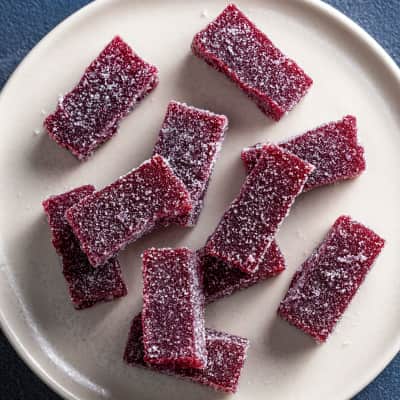
Raspberry Pâtes de Fruit
These fruity, sugar-crusted gems are fast, low-fuss, and perfect for gifting.
Get the Recipe
Lime Pâtes de Fruit
These fruity, sweet-tart gems are fast, low-fuss, and perfect for gifting.
Get the Recipe
Mulled Wine Pâtes de Fruit
These spiced, sugar-crusted gems are fast, low-fuss, and perfect for gifting.
Get the Recipe
Grapefruit-Campari Pâtes de Fruit
These fruity, cocktail-inspired gems are fast, low-fuss, and perfect for gifting.
Get the Recipe
Pineapple-Habanero Pâtes de Fruit
These punchy, tropical gems are fast, low-fuss, and perfect for gifting.
Get the Recipe
Strawberry–Black Pepper Pâtes de Fruit
These brightly hued gems are fast, low-fuss, and perfect for gifting.
Get the Recipe