


As a recipe developer, I get a lot of questions about new ways to riff on staple proteins such as chicken breasts.
Often, my impulse is to suggest a pan sauce—something with verve and gloss that the lean meat can swipe up bite by bite.
Searing chicken, deglazing the pan, and building a sauce is a sequence that’s easy to commit to muscle memory, and the package’s versatility can’t be beat. Once you’ve got cooked chicken and pan drippings, you can steer the flavor of the sauce in any direction by switching up the seasonings and cooking liquids.
Sign up for the Cook's Insider newsletter
The latest recipes, tips, and tricks, plus behind-the-scenes stories from the Cook's Illustrated team.
Trimming Bone-In Chicken Breasts

Butchers make bone-in chicken breasts, also known as split breasts, by removing the legs, wings, and back from a bird and then splitting the resulting crown in half. Typically, one piece will have the keel bone (the breastbone) running down its side while the other won’t.
Both pieces will have attached ribs as well as some excess fat and skin. Removing those bits makes the pieces easier to fit in a pan and prettier to serve; you also won’t need to defat the drippings.
- With breast skin side down and starting at tapered end, cut off ribs with kitchen shears or sharp knife (small portion of rib cage will remain; bone at top of breast will require more force to cut through).
- Trim away any bits of excess skin or fat that overhang edge of breast.
What I realized recently, though, is that I had more to offer than fresh pan sauce flavor combos; I also had lots to say about simplifying the whole chicken-and-pan-sauce process.
Because as ingrained as these motions are for those of us who rely on them to zhuzh up chicken parts, they come with pain points like knife-intensive prep, grease splatters, and the fuss of emulsifying butter that push this meal beyond the scope of busy weeknight cooking.
A really useful method—one that’s designed for the home cook’s dinner rush—would avoid all that and still deliver juicy meat and well-bronzed skin in a silky, bright sauce. So here’s my retooled, much simpler take.
I’ve broken it down by the two components to highlight the key steps for each, but ultimately it’s a two-part technique where the chicken and pan sauce work in tandem. Naturally, I’ve also included a slate of new sauces.
Low-Fuss Pan-Roasted Chicken Breasts
Pan-roasting—searing on the stove to build color and flavor and then slipping the pan into the oven to finish—is a great way to cook chicken parts. It’s gentle, so even delicate breast meat emerges tender and juicy; it’s mostly hands-off; and with proper time and temperature, the cooking is done in about 40 minutes.
Salt under the skin: Salt doesn’t move quickly through skin (remember, skin is a protective layer), so seasoning is much more effective if you pull back the skin and salt the meat directly. Plus, the skin holds the salt in place, preventing it from falling into the skillet, where it would make the sauce too salty.
Prick the skin: Before it can turn tender and brown, skin needs to shed water. Pricking it provides exit routes for liquid to drain.
Oil the chicken, not the pan: When chicken juices hit the hot pan, they rapidly heat and convert to steam; as steam leaves the pan, it lifts up droplets of oil, which rain back down as grease splatters. The fix is to minimize the fat in the pan by coating the chicken with vegetable oil spray. It introduces very little oil, and applying it to the skin rather than the pan means there’s less fat for the juices to interact with.
Start skin side down in a cold skillet: Chicken that starts in a cold (unheated) pan gradually heats up with the vessel, so the skin has time to render and brown thoroughly before the meat overcooks.
Finish in the oven: Oven heat cooks food relatively gently and evenly, so after searing the skin to develop color, it’s a great way to bring the meat up to temperature without overcooking the thinner end.
The Easiest Pan Sauce

Making a pan sauce usually involves sautéing minced aromatics, deglazing the fond and reducing the cooking liquid (often a combination of wine and stock), and whisking in butter until the mixture is emulsified. This approach delivers just as much savor and richness with less work.
Concentrate chicken-y flavor: The chicken sheds flavorful juices as it cooks, and it only takes a minute to reduce them down to a concentrated, deeply savory flavor base for the sauce. No need to supplement with commercial broth.
Increase butter for body: Emulsifying the butter by whisking it in piece by piece at the end of cooking adds silky body. But increasing the amount of butter and simply melting it in the pan all at once creates a similar effect. The sauce will be a tad richer and “broken” (not emulsified) but rustically elegant.
Maximize depth with less work: Rather than finely mincing aromatics such as garlic and herbs so they release lots of flavor and aroma, you can just use more and coarsely cut them to save time and effort. Also, cooking a portion of the aromatics and adding the rest off-heat creates depth as well as a last-minute burst of bright flavor and aroma.
Brighten and add volume with juice: Pan sauces often include wine for brightness, but the alcohol’s harsh edge needs to be mellowed with cooking. Juices are a great alternative: They’re naturally bright and balanced in flavor, so they can round out a sauce without any cooking. Plus, avoiding alcohol gives the sauce even broader appeal.

Skillet-Roasted Chicken Breasts with Rustic Orange-Thyme Sauce
Introducing your new favorite chicken recipe: cozy, low-effort, and full of bright, buttery flavor.
Get the Recipe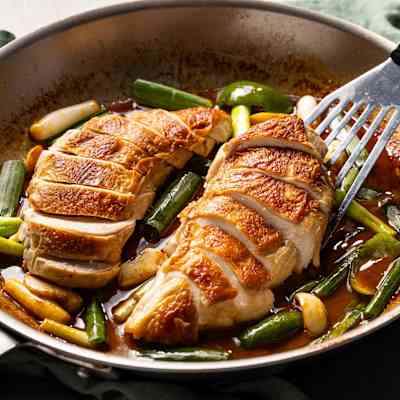
Skillet-Roasted Chicken Breasts with Rustic Lime-Hoisin Sauce
Introducing your new favorite chicken recipe: cozy, low-effort, and full of bright, buttery flavor.
Get the Recipe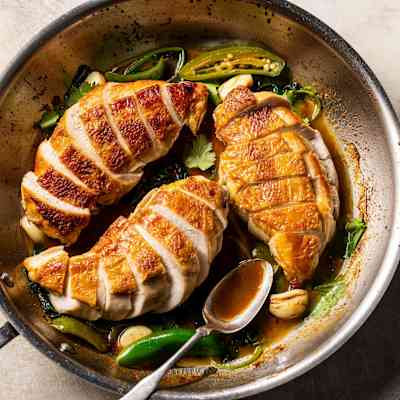
Skillet-Roasted Chicken Breasts with Rustic Pineapple-Cilantro Sauce
Introducing your new favorite chicken recipe: cozy, low-effort, and full of bright, buttery flavor.
Get the Recipe