


There are many styles of focaccia, and each has its charms, but to me, the most irresistible sort is crisp and well browned on the exterior, especially on the bottom and edges.
The bronzed outside encases a soft, light crumb that, when pulled apart with your fingers, stretches slightly before giving way. It’s tall enough that there’s plenty of delectable interior but not so statuesque that it won’t make a manageable sandwich.
It’s also graced with the flavor and richness of extra-virgin olive oil and the delicate crunch of flake sea salt.
Sign up for the Cook's Insider newsletter
The latest recipes, tips, and tricks, plus behind-the-scenes stories from the Cook's Illustrated team.
As yeasted breads go, focaccia’s effort-to-reward ratio is unmatched.
The high hydration level (lots of water is one of the keys to the bread’s archetypal bubbles) makes the dough slack and easy to knead by hand; once mixed, the soft dough is corralled by a pan while it rises, so there’s no need for complicated shaping.
And it can be made start-to-finish in a few hours because there’s no need to bother with overnight fermentation to develop complexity; the fruity olive oil that’s worked into the dough and drizzled on top, plus ample salt and the richly browned crust, add loads of flavor.
Building Strength
It’s perhaps counterintuitive, but to make bread with a soft, fluffy crumb, you need a strong dough. The gluten must be robust enough to retain the gases produced during fermentation and to expand without collapsing when the bread is baked.
I started with bread flour, which has more gluten-forming proteins than all-purpose flour, and mixed it with yeast, a bit of sugar for browning, good olive oil for tenderness and flavor, and quite a lot of water to create airiness via steam expansion.
Implementing another gluten-promoting technique, autolyse, I withheld the salt for 20 minutes. (Gluten forms best in fully hydrated flour, and salt is a water hog, diverting moisture to itself and away from the flour.)
After incorporating the salt—a higher amount than most recipes call for, to boost the flavor—I kneaded the dough right in the bowl by stretching it upward and folding it onto itself. Not only was manual kneading convenient (no need to haul out a stand mixer), but also it was sufficient to create a dough elastic enough to retain lots of bubbles.




Taking Shape
Focaccia, though coated with oil, has a maddening tendency to stick to the pan. In a high-hydration dough, excess water means that not all of the gluten-forming proteins can bond to each other—some wind up on the surface of the dough, bonding to the pan instead.
To prevent this, I pressed parchment paper into the pan. Then, I coated it with olive oil, not for its nonstick properties, but for joy: The dough would fry as it baked, creating an irresistible crisp crust.
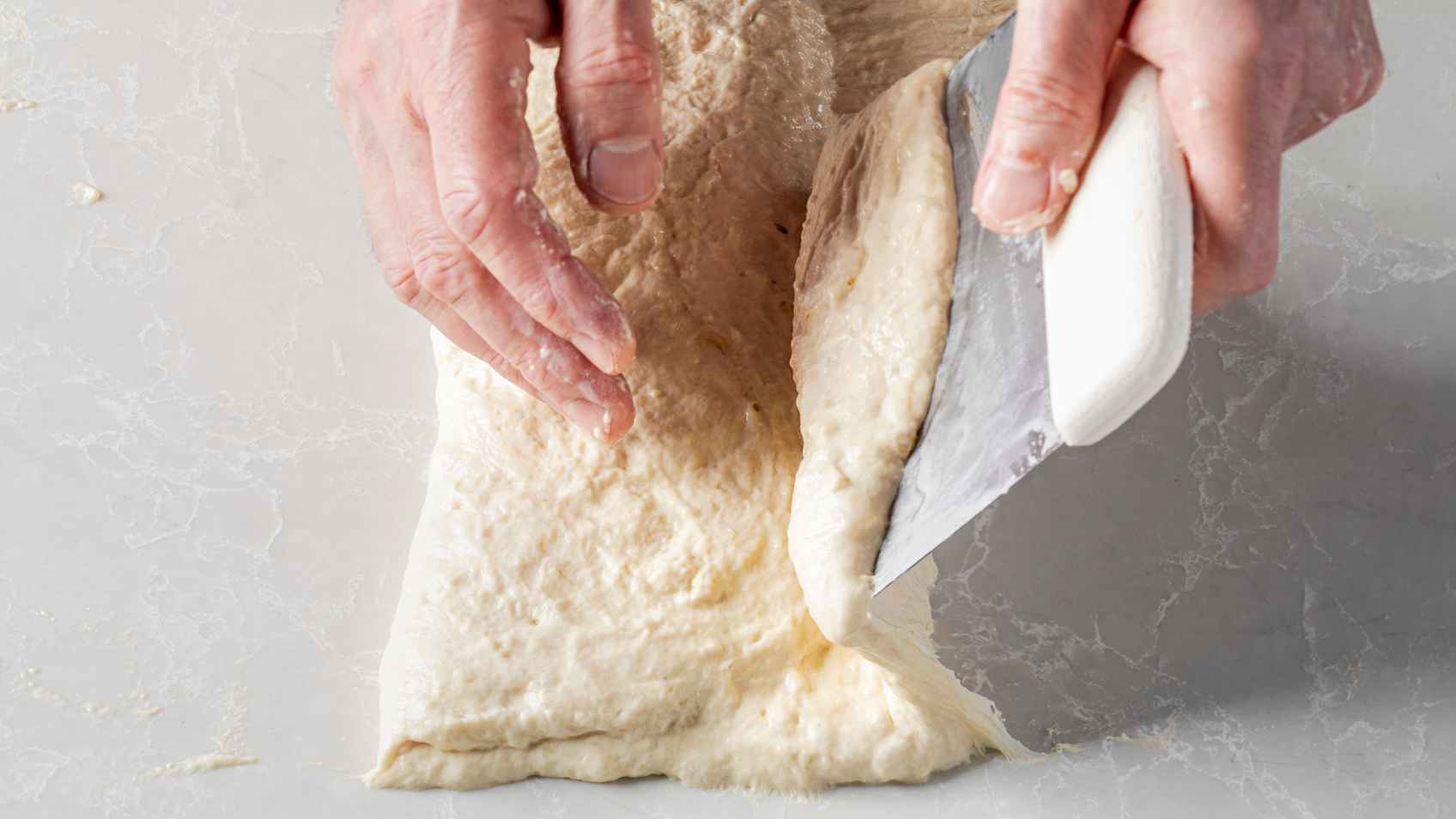
Most recipes call for simply plopping the dough into the pan at this point, but I decided to implement one more gluten-building measure and give myself a gift in the process: I stretched and patted the soft dough into a big rectangle, folded it in thirds, and transferred it to the pan.
The stretching bolstered the gluten, and the folds trapped air. The gift was that the dough ended up in a rectangular shape: As it rose, it grew toward the corners of the pan, making it easier for me to coax it into shape.
After 2½ hours, the dough was jiggly with air. I slicked the top with more olive oil for flavor and sheen; then, more joy: I pressed my fingers into the puffy mass, going deep to create divots for the oil to pool.
Using a liberal hand, I sprinkled on crunchy flake salt before baking the bread in a very hot oven to create the puffiest possible crumb, a crisp bottom, and a top that ranged from deep golden brown to the rich mahogany of a lye-dipped pretzel.
Any-Size Sandwiches

With its relatively slim profile and soft, fluffy crumb, our focaccia is tailor-made for sandwiches: The squishy bread hugs fillings so that they don’t squeeze out when you take a bite. Halve the entire bread horizontally to feed a crowd, or cut a modest square for lunch for one. Here are a few of our favorite combos:
- Mortadella, burrata, and arugula dressed with lemon juice, olive oil, and salt
- Goat cheese, fig jam, oil-cured olives, and parsley leaves dressed with lemon juice and salt
- Salami, tomato, and shaved fennel dressed with Dijon mustard, lemon juice, and salt

Light and Airy Focaccia
With its bronzed crust, pillowy crumb, and licks of fruity olive oil and crunchy salt, focaccia is easy to love. It’s also easy to make.
Get the Recipe