


Peer into the case of a Parisian pâtisserie in June and you’re sure to spot a gâteau fraisier.
With layers of golden sponge cake sandwiching creamy filling and perfect strawberries (“fraise” means strawberry), and often sporting a neat, pale-green marzipan lid, le fraisier heralds the arrival of summer.
Though it has much in common with the casual strawberry shortcake, a fraisier is a more refined affair, exemplifying the characteristics of not just France’s cuisine but also its fashion: visually simple, yes, but thoughtfully designed and meticulously constructed.
Sign up for the Cook's Insider newsletter
The latest recipes, tips, and tricks, plus behind-the-scenes stories from the Cook's Illustrated team.
Though the French have cultivated exquisite strawberries for centuries, the gâteau fraisier dates only to the 1960s, when chef Gaston Lenôtre devised a prototype that has been widely riffed upon.
It featured a Joconde cake, an almond sponge that relies solely on whipped egg whites for lift. Naturally firm and a bit dry, the cake is usually soaked with a syrup (often boozy) to boost its flavor and tenderness.
The cream filling is a cooked custard—either fluid crème anglaise or pudding-like crème pâtissière—that’s cooled and whipped with butter or cream. Only the best strawberries fill the gâteau: Some are halved and arranged cut side-out around its perimeter; those that fill the cake are left whole.
I’ve long admired the aesthetics of the gâteau fraisier, but its soaked sponge and rich custard filling seem a bit old-school. I wanted a nouveau version—easier, a little lighter—but with all the visual and textural appeal of the original.
Because as Coco Chanel famously said, “Fashion changes, but style endures.”
Bake a Fail-Safe Chiffon Cake

Instead of the traditional sponge cake, which relies on whipped egg whites alone for lift, we use a chiffon cake. It boasts three advantages: First, the egg whites used for lightening are assisted by baking powder, which ensures that the cake rises properly. Second, because a chiffon is made with oil instead of butter, it’s soft and tender at the cool temperatures that best suit strawberries and cream. Third, the oil makes the cake moist, eliminating the need for a soaking syrup.
For a Lighter, Faster Cream Filling, Use Yogurt

In search of something to lend our filling the same creaminess as the traditional cooked custard but with less work and time, we landed on plain Greek yogurt. With loads of body and a silky-smooth consistency, it turned out to be an ideal ready-made base. We whisked the yogurt together with a small amount of liquified gelatin for extra structure and then folded in sweetened whipped cream scented with vanilla. The result is a creamy, sliceable filling with just a hint of cultured dairy tang.
Macerate for Maximally Sweet and Tender Berries

Gâteau fraisier is a tribute to juicy seasonal strawberries. But even just-picked berries can be imperfect, so we took measures to ensure that every bite would be as fruity and tender as possible. Just toss whole berries with sugar, water, and a bit of salt; briefly zap them in the microwave; and let them sit. The maceration process breaks down some of the cell walls in the fruit, tenderizing it and releasing flavors and aromas. (If you’re lucky enough to have exquisite berries, this step will only improve them.)
Decorate with a Simple Strawberry Gelée

Rather than the usual, old-fashioned marzipan, a berry gelée is an easy, glitzy finish that makes use of the berry trimmings. It comes together by simmering the strawberry scraps and macerating juices until the fruit is soft. After straining the mixture, we stir in gelatin that’s been bloomed in lemon juice for extra brightness. The gelatin-infused juices firm up as the cake chills, forming a translucent ruby layer.
Slicing the Edge Berries

The unmacerated halved berries that are typically used to decorate the perimeter of the cake can be overly firm, so we opt for slices instead. Select 12 of the most attractive, mid-size strawberries. Place the berries broad side down on a cutting board and trim the left and right sides from each to create 1-inch thick slices. Next, cut the slices in half to create 1/2-inch slices.
Acetate: The Key to a Neat Finish

Fancy layer cakes, especially those with exposed layers sandwiching creamy fillings and fruit, often come wrapped in a plastic-like film that peels away cleanly, leaving the surface smooth and pristine. That collar is acetate, a wood- or cotton- based material that is food-safe and reusable; simply wash it with warm soapy water and air dry it before storing.
Pro tip: Before using acetate, give it a sniff. As the material breaks down (a possible result of prolonged exposure to heat, moisture, or acid) it releases acetic acid, or vinegar, the flavor of which can be transferred to food. If your acetate smells sour, discard it and use a fresh sheet.
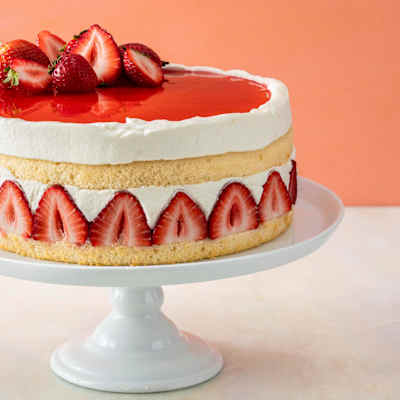
Modern Gâteau Fraisier (French Strawberry Cake)
Gâteau fraisier pays homage to peak-season berries with layers of golden cake and billowy cream. Our nouveau version packs the same appeal into a lighter, more failproof package.
Get the Recipe