


Every cuisine has its comfort-food heroes, but Japan’s oyakodon is a universal chart-topper.
Not only is it a beloved example of donburi, the family of rice bowls that merge a generous mound of stubby, tender grains with a saucy, highly seasoned topping, but this particular dish—where the rice is blanketed with chicken, egg, and onion that simmer together in seasoned dashi—conveys the soothing warmth of a parent-child bond.
It’s what oyakodon is named for (oya: “parent,” ko: “child,” don: “rice bowl”), and it’s what you experience when you’re eating it: softly set eggs knitting together the succulent, sweet-savory meat and onion, and all of it soaking into the cushiony rice like a snug embrace.
“Oyakodon is my ultimate comfort food!” declared Emiko Davies, the Australian Japanese food writer and author of cookbooks including Gohan: Everyday Japanese Cooking: Memories and Stories from My Family’s Kitchen (2023), when we spoke about donburi and this particular dish.
Sign up for the Cook's Insider newsletter
The latest recipes, tips, and tricks, plus behind-the-scenes stories from the Cook's Illustrated team.
Oyakodon is also Japanese home cooking at its best: a dish that comes together quickly in one pan and with very few ingredients.
You can’t beat its convenience when you’re rushed, low on groceries, or just craving something simple and cozy.
And while no two versions look or taste exactly alike (flexibility is another part of its ubiquitous appeal), the little bit of precision and calibration that goes into every bowl makes it cook up just right.
Donburi: The Original Rice Bowl
A bowl of steamed rice is the hub of virtually any Japanese meal; it’s the constant that anchors everything else on the table.
Usually, it’s a modest portion served in a bowl small enough to fit in the palm of your hand, and the rice is plain (or very lightly seasoned), with accompaniments such as soup, proteins, vegetables, and pickles kept separate so as not to soil the pristine grains.
But when the meal is donburi—the family of casual, complete-meal rice bowls that have been a fundamental part of Japanese cuisine for centuries—the portion of rice (and the bowl, also called donburi) is bigger and lavished with a bold topping.
That can be anything from quickly braised beef, tofu, or oyakodon’s sweet-savory chicken and egg; to crispy tempura or pork katsu; to grilled or raw seafood, and the bowl is typically finished with a sauce, pickles, and maybe a raw egg.
The point, according to food writer and cookbook author Emiko Davies, is to saturate the rice with flavor.
“Donburi is all about the rice and the sauce,” she said, noting that the typical portion of rice is usually doubled for soaking up the saucy topping.
“The best part,” she added, “is after you’ve finished the meat, and what you have left is all the rice that has soaked up the flavors. That saucy rice makes a donburi so satisfying.”
Chicken and Egg
Marinating the chicken is a good example of that calibration: Some cooks skip it and instead go right to simmering the meat (usually boneless, skinless thighs, cut into chunks) and onions (slivered) in dashi that’s seasoned with sake or mirin, soy sauce, and a little sugar.
But I found that giving the chicken a chance to soak in soy sauce and sake not only makes it more flavorful, but the salt also helps it cook up juicier and more tender.
Plus, I use that time to mix up and season the dashi (the instant stuff works great here) and also prepare the eggs, which feature two distinct hallmarks.
The first is a marbled pattern of the yolks and whites.
The two components should not look cohesive; instead, yellow ribbons should streak through the ivory backdrop. So rather than thoroughly beating the eggs as I would for a typical scramble, I use chopsticks to stir a tiny bit of the seasoned dashi into just the whites (the salt and liquid tenderize them) and then puncture the yolks and swirl them through the whites.

“Marbling” the Eggs
The eggs’ distinctive yellow-and-white marbled effect is easy to create with a simple swirling technique. After cracking them into a bowl and stirring a portion of the dashi mixture into just the whites to season and tenderize them, use chopsticks or a fork to puncture the yolks and gently stir them so that they resemble yellow ribbons running through the whites.
Second is the lovely textural contrast the eggs offer because they’re added to the pan in stages.
After rapidly simmering the onion and chicken so that they soften and cook through, I evenly distribute half of the eggs across the pan.
They surround the chicken and onion and simmer in the hot liquid, puffing into an airy, almost fluffy raft that fully sets.
Then I add the remaining eggs and cook until they’re only softly set, creating pockets that are jammy and even slightly runny.
On the Surface
Oyakodon’s other key variables—which are intertwined—are the liquid level in the pan and the diameter of the cooking surface.
Together, they affect how quickly the chicken and egg cook and the body and flavor concentration of the braising liquid that eventually becomes the sauce.
Traditionally, oyakodon cooks in a dedicated single-serving vessel called an oyako nabe.
It looks like a giant ladle with shallow walls and a vertical handle that make it easy to tip its contents into the rice bowl, and it has a snug, 6-inch cooking surface that helps the liquid pool deeply. That way, the onion and chicken are partially submerged as they simmer (stirring helps them cook evenly), but just enough of the liquid evaporates before the eggs are added, so the eggs aren’t flooded.
By the time everything is cooked, the liquid has reduced enough to become lightly saucy.

Perfectly Cooked Oyakodon Is All About Surface Area
Oyakodon’s cohesive jumble of juicy chicken, gently set eggs, crisp-tender onions, and light-bodied braising liquid is thanks in large part to the tight confines of the pan. Traditionally, that’s an oyako nabe pan, a roughly 6-inch vessel whose small surface area is specifically designed for corralling the components and minimizing evaporation. The partially submerged chicken and onions simmer briskly, leaving just enough liquid to cook the eggs without drowning them. The single-serving, modestly saucy raft is easy to tip onto a bowl of rice using its ladle-like handle. We use a conventional 8-inch skillet to achieve a similar effect—and make enough for two servings.
My equipment work-around for this recipe is a standard 8-inch skillet. Sizing up the pan by just 2 inches actually increases the surface area significantly (by 79 percent!), so the volume of the food must increase accordingly to prevent the liquid from evaporating too fast. But this is actually a perk, because it turns this into a recipe for two. Perfect for a parent and child to share.
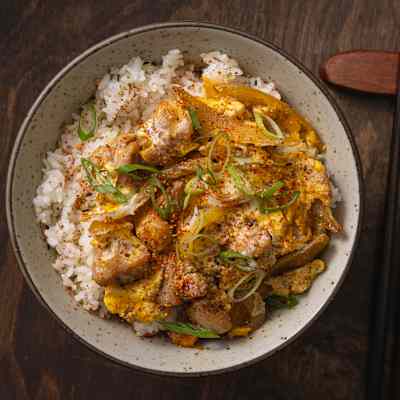
Oyakodon (Japanese Chicken and Egg Rice Bowl)
This is Japanese comfort food at its best: a deep bowl of steamed rice topped with chicken, egg, and onion that simmers together in sweet-savory dashi broth.
Get the Recipe