


 Buy at Amazon
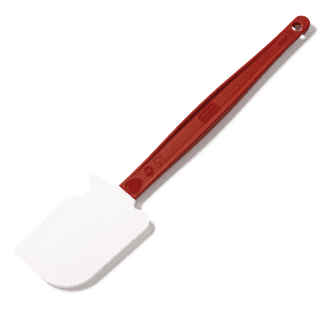
The best silicone spatulas are stiff enough for heavy-duty stirring and scraping, with heads sporting flexible edges that thoroughly squeegee the sides of bowls, leaving no traces of food behind. They’re also durable, comfortable to grip, and easy to clean. Both the Di Oro Living Seamless Silicone Spatula—Large and the OXO Good Grips Everyday Silicone Spatula check these boxes; they are our co-winners. We also recommend the Rubbermaid 13.5" High-Heat Scraper, which has a broad head that’s especially adept at folding ingredients into doughs or batters. It’s oversized for smaller applications, but its prowess with specific jobs merits its designation as our Best Large Spatula.

Silicone spatulas are some of the busiest tools in our kitchen. They’re designed to stir, scrape, fold, and spread food, with rigid handles that provide leverage when mixing dense doughs. Their flat, paddle-shaped heads excel at gently folding airy components such as meringue or whipped cream without deflating them. The heads usually have flexible edges, which conform to the sides of cookware to scrape the remnants of cake batter, melted chocolate, and similar foods. Made using food-grade silicone that can withstand high temperatures without damage, these spatulas are also useful for high-heat cooking. They’re ideal for scrambling eggs, stirring sticky sauces or hot caramel, or scraping every bit of soups or purees from cookware into servingware.


We use silicone spatulas to stir, spread, fold, and scrape all sorts of foods, using them to stir sticky caramel (left) and scrape fond from under caramelized onions (right).
All silicone spatulas share the same basic design. Each model has a solid internal frame made of nylon, steel, glass, or silicone that runs either throughout the entire body of the spatula or just within the head. The frame is sheathed in a layer of soft, flexible silicone. Manufacturers can mold the silicone exterior into a variety of shapes, creating heads of different thicknesses with edges that can flex to varying degrees. Most of the models we tested were clad in a single seamless piece of silicone; a few models had silicone heads attached to separate nylon handles.
What to Look for
- Well-Designed, Medium-Size Heads: Heads measuring roughly 4 by 2½ inches were large enough to stir, fold, and scrape food quickly and effectively yet slim enough to fit into smaller bowls and measuring cups. The heads on our favorite models had one sharper, L-shaped corner that hugged straight-sided pots and food processor bowls, as well as one gently curved corner that cleaved to the contours of bowls while stirring and scraping. This combination allowed these spatulas to sweep easily along the sides of any piece of cookware, collecting every trace of batter or sauce.


We preferred spatulas with heads (left) that could easily work in smaller vessels so we that could perform tasks such as scraping honey out of a dry measuring cup. Models with larger heads (right) struggled to fit in tight confines.
- Moderately Flexible Heads: Top-performing models had heads with thicker centers and thinner edges, which helped them strike the right balance between rigidity and flexibility. The stiff cores held up well to heavy-duty stirring, and the bendy edges easily scraped and wiped cookware clean. Our favorites had flexible edges that were thin but not too thin; they were substantial enough to survive nicks from food processor blades without becoming tattered and useless. They also were more resistant to wear and tear (though it’s important to note that no silicone edge is entirely resistant to damage from sharp blades over months and years of routine use).
- Seamless Silicone Designs: In general, we preferred models made from one seamless piece of silicone. These were more durable and easier to clean than spatulas with discrete plastic handles, as they had no nooks or crannies for water or food remnants to get trapped in. These spatulas’ silicone handles were also plush and grippy, making them especially comfortable to wield.

- Medium-Size Handles: Testers of all hand sizes found moderately thick handles easy to grip; our favorites measured about 2.5 inches in circumference at their widest. We found models with handles measuring less than about 8.5 inches to be most comfortable to hold, though we did like that longer handles could reach easily into tall pots and deep bowls.

What to Avoid
- Undersized Heads: Models with small heads moved less food with each pass, so it took more work to mix cookie dough or stir risotto.
- Stiff, Inflexible Heads: A couple spatulas’ heads were made of especially rigid silicone, with unyielding edges that were unable to bend against bowls or pots. These models failed to thoroughly scrape foods such as creamed butter and sugar down the sides of a stand mixer bowl; one tester noted they offered no advantage over a wooden spoon.


Winning spatulas had heads with edges that were moderately flexible (center), neither so stiff that they couldn’t bend to match the contours of bowls (left) when stirring cookie dough nor so bendy that they folded uselessly against a bowl’s sides (right).
- Thin, Overly Flexible Heads: The flimsy heads on two other models curled up when we gently pushed them against a skillet or bowl, providing no resistance for efficient scraping. Rather than helping us scrape vessels entirely clean, these spatulas left trails of food residue behind. The thin silicone edges on these models were also less durable; they got nicked on food processor blades and showed more wear by the end of testing.
- Discrete Handles: Some spatulas’ handles were inserted into their heads, much like Popsicle sticks. One such model’s head had a raised bump in its center where the handle was attached; this bump made it difficult to scrape the head clean by dragging it flush against the rim of a bowl, whereas we had no trouble doing so with flat-headed models. Another model collected dishwater in a small notch where its head met the handle; it failed to dry, and that water poured out into freshly whipped cream as we folded it.

- Spindly or Overly Thick Handles: A couple spatulas had especially narrow or broad handles that were uncomfortable for testers to hold. Slender handles required tighter, more forceful grips, while too-thick handles forced our fingers into awkward positions; both extremes were fatiguing. These inconveniences were especially apparent during tasks that required us to use more muscle, such as stirring dense cookie dough with lots of mix-ins.
Other Considerations
- Oversize Heads: Large heads can be helpful when stirring big batches of dough or folding voluminous clouds of egg whites. But sometimes they can be too large for everyday tasks. Two models we tested had extra-wide heads—each about 2.75 inches across—that barely fit inside a food processor bowl. They also struggled to scrape honey out of a 1-cup-size dry measuring cup and faltered with other similarly confined tasks. Most people won’t need a big spatula, but if you do a lot of large-batch baking, a bigger model might be a useful investment; we’ve designated the Rubbermaid 13.5" High-Heat Scraper our Best Large Spatula.
- Angled Heads: A few spatulas had heads with angled front edges, which testers were split on. Some noted that stirring scrambled eggs or scraping bowls clean with the slanted edges felt less intuitive or natural, since it required them to position their hands and arms differently than they were accustomed to. Others didn’t mind the angles and found them useful when scraping along the sides of skillets or swiping batter or melted chocolate from mixing bowls into baking pans.


Some testers preferred spatula heads with flat front edges (left), while others appreciated slanted front edges (right) more.
- Heat Resistance: The spatulas we tested were rated safe to use up to a range of about 450 to 600 degrees Fahrenheit. To test heat resistance, we left each spatula for 10 minutes in a skillet heated to 450 degrees, since it’s unlikely a silicone spatula would encounter temperatures that are any higher during normal, everyday use. Every model passed this test; none melted or warped.
- Color: Lighter-colored heads showed stains, so we generally preferred darker models, which didn’t stain as intensely. However, lighter spatulas were helpful when extra visibility was necessary. For example, it was easier to check the color of browned butter against a white spatula. Many models in our lineup (including our co-winners) are available in multiple hues, so choose according to your priorities.
The Tests
- Stir mix-ins into dough for Chocolate-Chunk Oatmeal Cookies with Pecans and Dried Cherries
- Have user testers stir Perfect Scrambled Eggs in 10-inch nonstick skillet then scrape cooked eggs out of skillet
- Stir onions in 4-quart saucepan
- Stir risotto in 4-quart saucepan
- Scrape chopped carrots from food processor using spatula to scrape blade clean
- Stir chopped carrots in Dutch oven
- Fold whipped egg whites into Angel Food Cake batter in large mixing bowl
- Fold fruit puree into whipped cream in stand mixer bowl
- Scrape fond from 12-inch stainless-steel skillet
- Scrape honey from 1-cup measuring cup and small stainless-steel mixing bowl
- Submerge in warm tomato sauce, minced garlic, and curry powder for 2 hours; wash
- Rest in 450-degree cast-iron skillet for 10 minutes
- Wash 35 times in dishwasher or 35 times by hand if not dishwasher-safe
- Wash an additional 10 times by hand throughout testing
How We Rated
- Cleanup: We assessed how easy the spatulas were to clean.
- Durability: We tested how well the spatulas withstood damage from heat and general use.
- Performance: We evaluated how well the spatulas maneuvered around cookware and bowls of different sizes and shapes and whether they allowed us to stir, fold, scrape, and spread foods effectively.
- Ease of Use: We rated how comfortable the spatulas were to hold and work with and how much control they gave us.