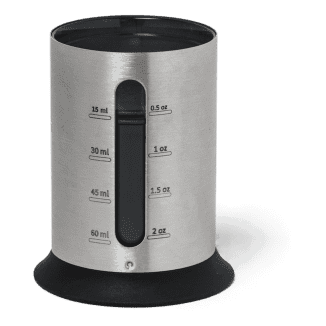


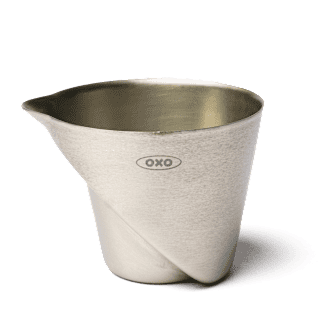
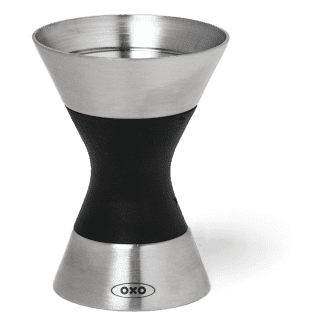
The best jiggers allow you to measure liquids accurately, easily, and neatly. We have two top choices: the OXO Good Grips Mini Angled Measuring Cup and the OXO SteeL Angled Jigger. The two models are nearly identical and handle and measure liquids equally well. The plastic version is lighter-weight and has a few more useful volume measurement markings. (In addition to fluid ounces, it also measures tablespoons, cup fractions, and milliliters, making it handy not only for cocktails but also for measuring liquids for baking and cooking projects.) The metal version is heavier, which gives it a solidity that some actually preferred, and its measurement lines are restricted to ounces and tablespoons.

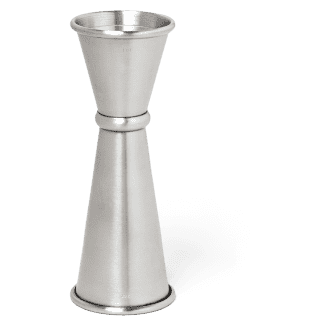
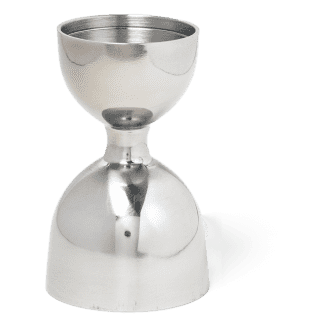
A jigger is a handy bar tool used to measure small volumes of liquids for cocktails. There are several different types. Conventional jiggers are roughly hourglass- or bow tie–shaped, with one end designed to measure a larger volume (often 1.5 or 2 ounces) and the other to measure a slightly smaller one (often 1 ounce). They sometimes come with long handles that are affixed to the middle of the jigger. Japanese-style jiggers are also double-ended, but the shape of each end is slightly different: long and thin as opposed to squat, as with conventional jiggers. In addition to these two basic styles, there are also a host of more innovative designs, many of which we’ve tested over the years.

What’s the Best Style of Jigger?
There’s no one right answer—we recommend jiggers in a variety of styles, and pretty much any of the models we tested can be successfully used to make a drink. That said, our favorite jiggers for home use are somewhat unconventional, with a unique design that essentially makes them mini measuring cups.
Why? While conventional and Japanese-style double-ended jiggers are the norm in professional bars, they’re harder for home bartenders (especially novices) to use due to their smaller openings and often minimal (or nonexistent) measurement markings. For professional bartenders, speed is a priority, as multiple drink orders must be prepared at a time. Most professional bartenders don’t have the time to carefully measure specific volumes. Instead, they’ll either eyeball the measurement of different volumes using a single conventional or Japanese-style jigger, or they’ll “double-jigger,” using two or more sizes of the same jigger to get the full range of specific volumes needed to make cocktails.

Double-ended jiggers are also messier. If you have to use both ends of a jigger to measure different volumes for a drink, the end you use and empty first will drip liquid as soon as you flip the jigger. This may seem like a minor point, but most testers preferred measuring tools that had just one opening; these kept their hands and counters drier and less sticky.
If you find yourself slinging dozens of drinks a night and like the visual flair of using a conventional or Japanese-style jigger, more power to you! But we think most home bartenders are better off using one of our top choices, which allow for more accurate measurements and are neater and easier to use.
What to Look for
- Accuracy: We preferred models with markings or ends that correctly indicated the volumes of liquid measured. In our testing, almost all the jiggers we tested were accurate at each of the volumes marked.
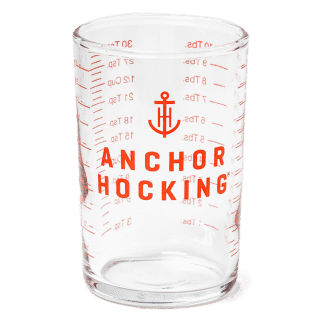
- Bold, Easy-to-Read Interior Measurement Markings: Models with bold, clearly marked volume measurement lines were easiest to read. We also preferred those that provided plenty of specific volumes (¼ ounce, ½ ounce, ¾ ounce) so that we didn’t have to estimate volumes in between those indicated or use two jiggers, in the case of the conventional and Japanese-style models. And we preferred models where these bold measurement lines were in the interior of the jigger. This allowed us to see from above whether we’d filled the jigger to the right level; a few transparent models had measurement lines and numbers on their exteriors, which forced us to squat down to measurement-line level to make sure we’d gotten the correct volume. While we don’t mind doing this occasionally for accurate measuring when cooking or baking, it was awkward to do repeatedly while making cocktails.

- Durability: In our experience, most measurement markings will fade over time and repeated washing, especially if you run your jiggers through a dishwasher regularly. Still, we preferred those with markings that didn’t disappear after the 15 washes we performed over the course of testing.
- Wide Mouths: The larger the opening on the end or mouth of a jigger, the easier the jigger was to fill. We preferred models with mouths measuring at least 2 inches across.

What to Avoid
- Faint, Crowded, or Nonexistent Measurement Markings: These made it hard to measure different volumes easily or accurately. Two of the jiggers we tested had no measurement lines at all, so we just had to remember the total volume held by each end and estimate any smaller measurements. Another had lines but no numbers inscribed next to them. Still others had numbers that were hard to read because they’d been etched into or molded out of the material used to make the jigger. And another had so many measurement lines in such short order that it was difficult to tell at a glance which was which.

- Small Mouths: Jiggers with openings measuring 1.6 inches across or less made for small targets, requiring us to aim our bottles and pour from them very carefully.
The Tests
- Evaluate accuracy at each measurement line with a lab-grade digital scale
- Pour large and small volumes of gin directly from a bottle into each jigger
- Pour large and small volumes of simple syrup from a bottle with a pourer into each jigger
- Have testers with different levels of bartending experience use each jigger to make a sidecar
- Wash 15 times in the dishwasher
How We Rated
- Markings: We rated the jiggers on how useful, accurate, and easy to read their markings were.
- Neatness: We rated the jiggers on how much of a mess they produced during use.
- Ease of Filling: We rated the jiggers on how easy they were to fill.

 Buy at Cocktail Kingdom