


 Buy at Amazon
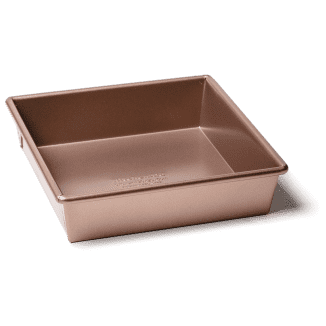
 Buy at Williams Sonoma
Square baking pans are handy for making cakes and brownies, but that’s not all. We also use them for recipes such as Chocolate Fudge, Honey Cornbread, and Nanaimo Bars. Because we call for them in so many of our recipes, we decided to find out which of the many pans on the market was the best. We chose several models, made of various materials. To test them, we made yellow cake and brownies in each, sliced the cooled baked goods in the pans with a knife, and then washed the pans repeatedly to evaluate durability.
What did we discover? Most pans baked food well. The pans produced slightly different-looking cakes, one model couldn’t hide a glaring durability issue, and cleaning these pans was not always an easy task. Happily, though, we found several models that excelled.

Nonstick Pans Release Easily
The materials of the pans in our lineup varied. We tested models made from metal, glass, silicone, and stoneware. Six of the metal pans had nonstick coatings; none of the other models did.
The first thing we noted was the slight differences in baking times. Because metal is generally a better conductor of heat than glass or stoneware is, the nonmetal models required more time in the oven to finish baking—5 to 8 minutes longer for yellow cake and about 5 minutes longer for brownies. Even with these differences, the baking times in all the pans fell within acceptable ranges.
Our recipes called for either greasing or greasing plus flouring the pans, which was sufficient to prevent sticking in almost every pan. We preferred models with a nonstick coating, which ensured that cakes and brownies released effortlessly. Models that lacked this coating sometimes had cakes or brownies stick to their interiors, making for less pretty results and more scrubbing during cleanup.
Regardless of material, all the pans produced appetizing brownies and cakes with golden-brown tops. Two of the cakes had slightly darker exteriors than the others, likely because they baked in darker-colored pans, but they were still perfectly acceptable.
Straight Sides versus Tapered Sides
We also evaluated how the cakes looked. Some of the cakes had rounded corners and edges that tapered outward. Some of the cakes were noticeably squarer, with straight sides. While these straight-sided cakes are important if you're making a layer cake—they make uniform, easy-to-frost tiers—for single-layer applications, home bakers will be just as happy with the cakes that have tapered sides.

Functional Handles Were Very Helpful
We also noted whether a pan had defined handles. Four models in our lineup featured rolled edges with narrow lips that were sometimes tricky to hold securely, especially when removing the pans from a hot oven or greasing and flouring them. When greasing and flouring the pans, we’d find ourselves gripping the edges of the pans with our thumbs and using our fingers to support the pan bottoms, with our thumbs often smearing the grease-and-flour coatings.
The rest of the models featured defined handles. One had a roughly ½-inch flattened edge that functioned as a handle; another had wider, flat handles; and two more had looped handles. The pans with handles were easier to flour and grease and maneuver into and out of the oven.

The silicone model wasn’t durable enough to withstand a paring knife.
Silicone Was Not Durable
To test the durability of the pans, we used a sharp paring knife to repeatedly slice cake and brownies in each pan, checking to see if any scratched easily. All five metal pans showed faint nicks, but nothing that would affect their performance.
One pan, however, was a total letdown. While slicing brownies in the silicone pan, we inadvertently sliced right through the side, leaving a ¾-inch gash and rendering the pan unusable.


Molded metal pans (left) are seamless and much easier to clean. Folded pans (right) trapped crumbs, requiring extra attention during cleaning.
Pans with Seams Were Harder to Clean
To see how easy the pans were to clean, we washed each pan five times according to the manufacturer’s instructions. Most of the pans we tested were dishwasher-safe, but a few weren’t, so we washed those by hand. We didn’t have a strong preference for one method, but some of the pans were harder to clean than others.
The interiors of the glass, stoneware, and silicone pans were all smooth and seamless and therefore easy to clean. Most of the metal models, though, had seams as a result of the way they were constructed. Three of the metal pans were molded, meaning that a hot sheet of metal was pressed into a mold. The other metal pans were folded—made by folding a metal sheet into the shape of a pan, creating seams. The folded pans’ seams sometimes trapped food and required extra attention to clean. It wasn’t a deal breaker, but it wasn’t ideal either.
The Winners: All-Clad Pro-Release Nonstick Square Baking Pan and Williams Sonoma Goldtouch Nonstick Square Cake Pan
Three pans surpassed the others. The All-Clad Pro-Release Nonstick Square Baking Pan had a molded interior with a slick nonstick coating that made for easy release and quick cleanup. It had wide handles that were comfortable to hold while maneuvering the hot pan around the oven. Best of all, it baked brownies and cake evenly. At nearly half the price, our Best Buy shared many of the same traits as our winner. Both these pans had slightly rounded corners and tapered edges. The Best Buy was just a touch darker, so it browned foods a bit more quickly and deeply.
If you’re looking for a pan that will produce baked goods with straight edges, check out the Williams Sonoma Goldtouch Nonstick Square Cake Pan. It made beautiful brownies and cake and released both easily, and is perfect for making layer cakes. It doesn’t have handles, so it’s a bit challenging to maneuver in and out of the oven. And its folded construction means small crumbs might get stuck in the corners.
- Make brownies using Ghirardelli Chocolate Supreme Brownie Mix, our winning boxed brownie mix, and then cut the cooled brownies in the pans into 16 squares and repeat the cutting motion four additional times
- Make yellow cake using our Make-Ahead Yellow Cake Mix, and then cut the cooled cakes in the pans into 16 squares and repeat the cutting motion four additional times
- Line the winning pan with an aluminum foil sling and make Basic Brownies
- Wash the pans five times according to manufacturers’ instructions
- Produced evenly browned baked goods
- Had dedicated handles that made the pan easy to hold and maneuver
- Had a smooth, seamless interior that was easy to clean
- Resistant to damage