


 Buy at Amazon

The best vacuum sealers for home cooks perform well and have simple, intuitive controls. Our overall favorite is the Nesco Deluxe Vacuum Sealer. This compact but sturdy external vacuum sealer excelled at vacuum-sealing food and has an easy-to-read display screen that indicated when the machine was vacuuming, sealing, or done with its cycle. A handful of settings offered all of the customization we needed. We also love the sleek and even more compact Anova Precision Vacuum Sealer Pro, which performed just as well and is just as easy to use. An added bonus: Both machines have a roll storage compartment with built-in slicer so that you can easily cut bags to size, though Anova’s jammed occasionally during use.
Finally, our favorite chamber vacuum sealer is the Anova Precision Chamber Vacuum Sealer. It’s large, expensive, and heavy, but did a great job of vacuum-sealing different types of foods, and can even vacuum-seal liquids. It also has some fun extra functions, allowing you to infuse, compress, and quick-pickle foods. It can’t vacuum-seal large items (roasts, a gallon of tomato sauce), though, so it’s best for cooks who will make use of those extra functions and only save or seal small or flat foods.

During long-term freezer storage, zipper-lock bags (left) can allow air to enter and ice crystals to form, which negatively impacts the texture and flavor of the food. Vacuum-sealing steak (right) prevents it from developing ice crystals and will keep it fresher for longer.
Have you ever frozen ground meat or berries inside a zipper-lock bag and found them covered in ice crystals only a week later? We have. Vacuum sealers can prevent that disappointment. These machines remove air from customized storage bags before sealing them tightly, effectively protecting the foods inside the bags from moisture loss or gain, whether they’re stored for long periods in the freezer or at room temperature in the pantry.
Countertop vacuum sealers are ideal for those who do a lot of vacuum-sealing—vegetable gardeners, frequent visitors to farmers’ markets, CSA members, people who like to hunt and fish, bulk shoppers, and meal preppers—they’re sturdier, easier to use, and more powerful than the handheld vacuum sealers that you’ll occasionally see on the market. And because their customized bags are watertight and sturdy, vacuum sealers are also a good tool to have if you do a lot of sous vide cooking.
What are the Different Types of Vacuum Sealers?
There are two main types of countertop vacuum sealers, each with different advantages.

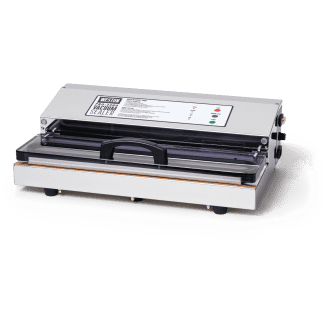
External vacuum sealers, such as the one pictured, gradually suck the air out of the bag. Once this is done, the machine melts a narrow strip across the top of the package, sealing it shut.
External vacuum sealers, sometimes called edge sealers, are the most common type; they’re usually affordable and compact. With these, you put food in a plastic vacuum-seal bag and insert the open end of the bag into the sealer. The vacuum sealer gradually sucks the air out of the bag; once this is done, it melts a narrow strip across the top, sealing it shut.
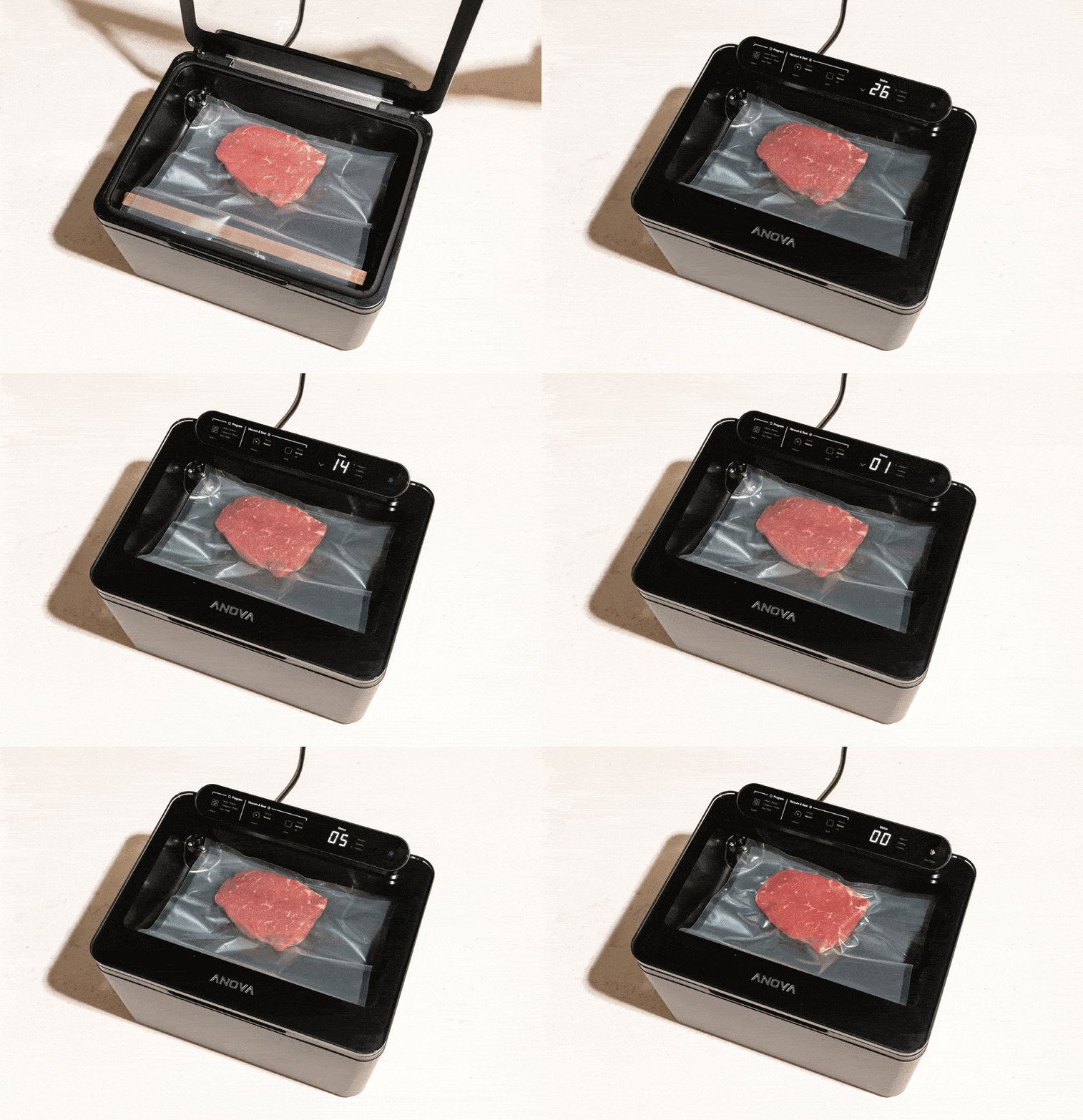
Chamber vacuum sealers have been found in restaurant kitchens for years and are now making their way into home kitchens. They operate slightly differently from external vacuum sealers. With these, the bag of food doesn’t sit outside the sealer; you put the whole thing inside a chamber on top of the machine. Instead of sucking air out of just the bag, the machine removes air from the entire chamber in a sudden whoosh before sealing the bag and releasing the vacuum.
Chamber sealers offer a few advantages over external sealers. For one thing, they’re more powerful, though most external sealers are more than powerful enough for home use. And they can actually seal liquids or very wet foods such as a batch of tomato sauce or leftover chicken soup. This is because when air is removed from the chamber, the pressure on the outside of the bag is equal to the pressure on the inside of the bag, so liquid stays put and isn’t forced out. With external vacuum sealers, you’ll need to freeze any liquids or wet foods before vacuum sealing. If you don’t, anything more than a little liquid will simply run out of the bag as air is removed, creating a mess and preventing the bag from sealing properly. You can also use chamber vacuum sealers for several other tasks, including infusing and quick-pickling foods with either bags or jars.
On the downside, chamber vacuum sealers’ extra power and functionality come at a price. They’re heavier and larger—models designed for home use are about the size of a printer, though commercial models can be much bigger. And they simply cost more. Retail-grade chamber vacuum sealers start around $300, and most are much more expensive than that. And while the chamber vacuum sealer we’ve tested has a relatively large footprint, its actual capacity is small. You can’t use it to vacuum-seal large cuts of meat, for example; you’re limited to littler pieces of food or foods that can sit flat enough to fit inside its relatively small chamber.
No matter which type of vacuum sealer you choose, there are a few features that distinguish the better models.
What to Look For
- Good Vacuum Strength: A vacuum sealer should be able to remove as much air as possible from the bag so that food will not oxidize or develop freezer burn. Happily, all the machines we’ve tested performed well; even after 4 months, all the vacuum-sealed foods we’d left in the pantry and freezer were still tightly sealed and the condition of the food remained unchanged, with no oxygen or moisture entering.
- Two Essential Settings: Vacuum sealers only really need two settings: one that lets you run the machine automatically and one that lets the machine be controlled manually, allowing you to start and stop the vacuum process yourself, a helpful feature when trying to avoid crushing delicate foods such as raspberries or crunchy, fragile snacks. Several machines came with additional settings, which we found useful but not essential. The pulse buttons on several models allowed us to remove air incrementally, which we liked. Some machines also had gentle settings or the option to decrease the vacuum power, which can be handy if you are trying not to crush delicate foods in your vacuum bag.

The automatic settings on vacuum sealers can suck out air so powerfully that delicate items such as crunchy snacks or fruit are crushed. This happened with the Gourmia model we tested (left). Gentle settings are designed to avoid this but some, like the gentle setting on the Gourmia (right), hardly removed any air at all. In general, we preferred to use the machines' manual options (middle) so that we could control the air removal ourselves when sealing delicate foods.
- Simple Controls and Display: Our favorite machines had clearly labeled buttons plus a row of indicator lights or a small digital screen that communicated each step of the vacuum-sealing process: vacuum, seal, done.
- For External Vacuum Sealers, Gentle Closure Mechanisms: Before any of the machines could pull air from bags, their lids had to be firmly closed and locked, a process that proved surprisingly difficult with many models. The lids of higher-ranked models had to be held down gently for only the first few seconds of use, just until the vacuum suction began, which was quick and easy enough. One had a dial that, once turned, caused an internal mechanism to latch softly but reassuringly. The lid of our favorite model offered a big, sturdy handle that we could swing forward a few degrees with minimal effort to tightly lock it into place.
- Moderate Weight: We preferred external vacuum sealers that were heavy enough to sit securely on the counter during use but that weren’t so heavy that they became difficult to lift or move. Our favorite models struck a good balance: Weighing 5 to 6 pounds, they were easy to lift, relatively easy to store, and reassuringly sturdy. Chamber sealers run heavier; if you get one, you’ll want to keep it in one place and not move it often, as they can weigh upwards of 17 pounds.

What to Avoid
- Complicated Controls: Some of the machines had puzzling control panels that were hard to decipher. One had little lights that illuminated as we toggled between settings, but they dimmed too quickly and left us unsure about which setting we had selected. Another had up and down arrows that could be used to customize both the vacuum pressure and seal time. We surmised that tinkering with settings and figuring out the best possible combination of settings when sealing different types of foods would be appealing to some users, but it felt like overkill for most of us.
- For External Vacuum Sealers, Hard-to-Close Lids: Some machines had lids that had to be firmly pressed in two places until we heard a clicking sound. When sealing gallon-size bags, the lids of some lower-ranked machines were awkwardly positioned at about an arm’s length away, making it hard to get enough leverage to close them firmly. We hated the sharp cracking noise that some models made when we pressed down on their lids. Even though we were following the machines’ directions, it sounded like we were breaking something.
The Tests
- Vacuum-seal cereal and pretzels and store at room temperature for 9 weeks
- Vacuum-seal strawberries, chicken leg quarters, finely ground coffee, blade steak, ground beef, and leftover lasagna—and freeze for 9 weeks
- Vacuum-seal oxygen-detecting tablets inside 5 bags in various sizes
- Vacuum-seal squash with ¼ cup of water
- Sous-vide each bag at a high temperature (200 F) for 60 minutes
- Measure vacuum strength
- Recruit four additional people to use and evaluate each machine
How We Rated
- Handling: We liked vacuum sealers that were relatively lightweight and small enough to move around the kitchen easily. The best models had lids that locked into place gently and easily.
- Ease of Use: Our favorite models had clearly labeled buttons and indicator lights. We also liked digital screens that tracked the progress of the vacuum-seal process.
- Performance: The preferred vacuum sealers successfully removed air from their bags, and the bags did not lose their seal during extended testing.