Roti
By Andrea GearyPublished on February 5, 2024
Time
1 hour, plus 30 minutes resting
Yield
Makes 12
Ingredients
Flour Paste
½ cup plus 2 tablespoons water 5 tablespoons (1½ ounces/43 grams) chakki attaDough
1⅔ cups (8⅓ ounces/236 grams) chakki atta ½ cup cold water 2 teaspoons vegetable oil, plus oil for kneading and handling½ teaspoon table saltBefore You Begin
Chakki atta, a finely milled whole-wheat flour, is available at South Asian markets and online. If it's unavailable, you can substitute whole-wheat pastry flour; do not use regular whole-wheat flour, which has a stronger flavor and a darker appearance. We strongly recommend weighing the flour for this recipe. To ensure soft rotis, use as little flour as possible when handling the dough. Parchment used to separate rotis may be reused; as you become more proficient, you may prefer to roll the rotis as you cook. Serve these rotis with any curry in your repertoire. Make your accompanying dish while the dough rests in step 2.
Instructions
- Whisk water and chakki atta in medium bowl until no lumps remain. Microwave, whisking every 30 seconds, until mixture thickens to very stiff, gelatinous consistency that does not flow, about 2 minutes.
- Add chakki atta, water, and oil to flour paste and mix with rubber spatula until all flour is moistened (if dough is too stiff for spatula, let cool slightly and knead by hand). Cover and let rest for at least 30 minutes or up to 1 hour.
- Sprinkle salt over dough and knead in with your lightly oiled hand. Transfer dough to lightly oiled work surface and knead until mostly smooth, about 1 minute. Divide into 12 equal portions. Flatten 1 portion to ½-inch thickness with palm of your hand. Fold edges toward center to form ball. Turn ball seam side down and round to form smooth sphere. Repeat with remaining portions.
- Coat balls very lightly with oil. Press each to form 2-inch disk. Heat 10-inch carbon-steel or cast-iron skillet over medium-low heat. Place all-purpose flour in shallow bowl. Line rimmed baking sheet with parchment paper. Line plate or shallow bowl with clean towel. Roll second clean towel in tight wad.
- Dip 1 disk in flour and turn to coat. Roll gently to 6-inch round of even thickness (it needn't be perfectly round). Transfer to prepared baking sheet and cover with second piece of parchment. Roll out 2 more dough balls, placing rolled rotis under parchment, 3 rotis per layer, and overlapping as little as possible. Increase heat under skillet to medium-high, and continue rolling and covering remaining dough balls, separating each layer of 3 rotis with parchment.
- Gently place 1 roti in skillet. Cook until small bubbles begin to form on surface and underside of roti is light blond with a few darker spots, 15 to 20 seconds. Using metal spatula, flip roti. Cook until underside is speckled evenly with brown spots, 40 to 60 seconds (if roti colors too quickly or slowly, adjust heat accordingly).
- Flip roti. Press edges gently with wadded towel, rotating roti as you press, until roti puffs. Cook puffed roti for 10 seconds longer, then transfer to prepared plate (roti will deflate). Brush lightly with ghee or butter, if using. Cover with towel. Repeat cooking remaining roti. (Roti are best eaten fresh but can be stored at room temperature for up to 2 days. Warm briefly in skillet before serving.)
for the flour paste
for the dough

Time
1 hour, plus 30 minutes restingYield
Makes 12Ingredients
Flour Paste
Dough
Test Kitchen Techniques
Ingredients
Flour Paste
Dough
Test Kitchen Techniques
Ingredients
Flour Paste
Dough
Test Kitchen Techniques
Why This Recipe Works
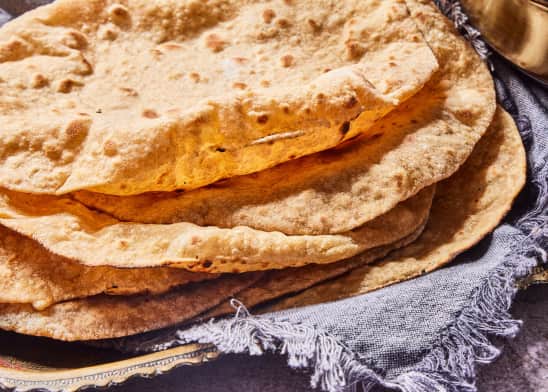
The Indian subcontinent's rotis (aka chapatis) are simple, wholesome whole-wheat flatbreads, perfect for scooping up curries and stews. For rotis with just the right tender chew, we sought out chakki atta, a South Asian whole-wheat flour that is the traditional choice for the job. The friction produced by the chakki atta–milling process heats up the starches, imparting a slightly sweet flavor, and it damages some of the gluten-forming proteins, so the rotis have some elasticity but aren't tough. If atta is unavailable, we found that whole-wheat pastry flour makes a good substitute. Instead of kneading by hand, we opted for building gluten by incorporating a 30-minute autolyse into our recipe. This passive gluten-building step reduced the active kneading to only about 2 minutes. A roti balloons during cooking and the trapped steam cooks it quickly from the inside, leaving the flatbread soft and flexible. To ensure success for new roti makers, we boosted the hydration of our dough by adding a tangzhong, a gelatinized flour paste. The extra moisture meant extra steam which in turn meant a greater chance of puffing. Traditionally made rotis are ephemeral delights that stiffen and dry out within a few hours of being made. The extra moisture in our formula means these rotis can be stored at room temperature for up to two days or frozen for several weeks.
Want more? Read the whole story




28 Comments