
 Buy at Amazon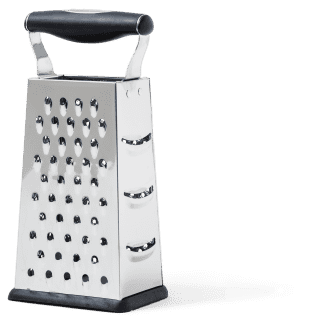
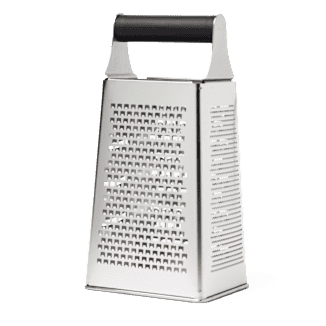
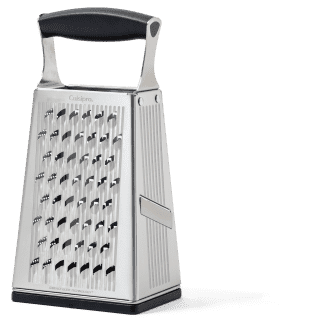
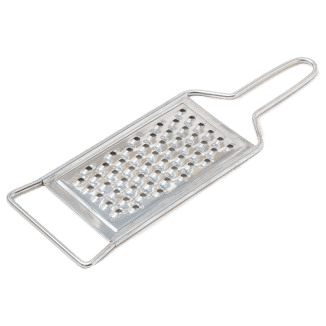
The best graters have sharp stamped teeth and are easy to use. Our favorite paddle-style grater is the Rösle Coarse Grater. It grated foods of all types quickly; its compact design makes it easy both to store and to use in various positions. Our favorite box grater is the Cuisinart Box Grater. It performed just as well and is ideal for folks who prefer to grate foods in an upright position.

A good grater is an essential tool that we use to shred piles of vegetables and blocks of cheese by hand. While the shredding disk of a food processor can be useful, especially when tackling larger volumes of food, not everyone has one of these appliances—and those who have one aren’t always willing to drag it out and clean it after use. By contrast, a grater is much simpler to use and clean, making it much more practical for most cooks.

What Are the Different Types of Graters?
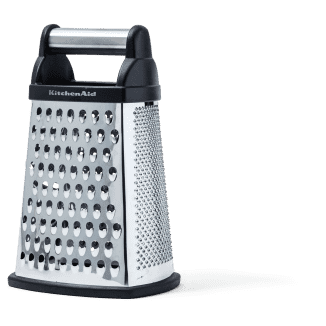
There are two main types of graters. Box graters are the type most folks are familiar with. Most of these have four sides: Three sides are set with teeth of different sizes—fine, medium, coarse—and the last side usually comes with a few horizontal blades for slicing. Box graters are meant to sit stably on the countertop and are used in a vertical position, food gliding up and down the side of the grater you’re working with. They’re theoretically more versatile, since they can produce shreds and slices of different sizes, though in practice, many of us only use the side with the largest teeth. That versatility also necessitates a larger footprint: Those four sides mean that box graters take up more room in your storage and on the counter. Their box-like shape also can make them a little more finicky to clean.

By contrast, paddle graters have a much thinner, more compact profile. They have only one grating surface and are easier to store and clean as a result, though they can only produce shreds of one size. But many of our test cooks prefer them because they can be used in a variety of positions: anchored on the cutting board and used at different angles or hooked horizontally over a bowl.

In the end, the choice of which type to get is up to you. If you have the storage space and think you might use more than one side of your grater, choose a box grater. If you have limited space and don’t plan on using your grater for anything besides garden-variety shredding, go with a paddle grater.
For this review, we focused on the ability of both paddle and box graters to produce coarse shreds, as this is the size we’ve found home cooks use most often.
Stamped versus Etched Teeth: What’s the Difference?
While all the graters that we tested worked, a few factors made certain models shred food more quickly, more safely, and with less waste than others. The type of teeth each grater had was critical. Teeth are formed when holes are made in the grater surface in one of two ways. The holes can be stamped—punched out of a thick, rigid sheet of metal, forming teeth that rise relatively high above the grating surface and are sharpened in a separate step by the manufacturer. Or the holes can be etched, the pattern of the holes printed photographically onto a thinner, more flexible sheet of metal, and then selectively eroded by chemicals. After the holes have been etched, the teeth are pushed up by a machine. These etched teeth sit at a lower angle to the grating surface than those on stamped models; there’s no need to sharpen them, since the etching process makes them very keen.
The type of teeth doesn’t necessarily dictate a grater’s sharpness; we’ve tested stamped and etched graters that were razor-sharp and also reviewed models in both categories that were dull as rocks. Rather, the main difference between stamped and etched graters came down to how thickly they shredded food—and how easy they were to use as a result.


The teeth on etched graters (left) sit at a low angle to the grating plane, creating relatively narrow holes in which food can get stuck. By contrast, the teeth on stamped graters (right) are pushed higher above the grating plane, creating bigger holes that don’t clog as easily.
In general, we preferred graters with stamped teeth. Because stamped teeth usually jut out higher above the grating surface, they provide more clearance for food to pass through, creating thicker shreds. The greater clearance makes it easier to grate different foods effectively—especially soft ones such as mozzarella—and since the shreds themselves are thicker, it takes less time and often fewer passes overall to get through a piece of food.
Etched teeth, by contrast, sit lower on the grating plane, creating narrower openings and much thinner shreds. Food is more likely to get stuck in those narrow openings, skidding dangerously as you’re shredding and taking extra time to clear. Since etched teeth are pitched at a lower angle, it’s harder to get foods to catch on them; we had to grip blocks of mozzarella perilously close to the teeth in order to direct them. In addition, the metal used to make etched graters is thinner and more flexible than those found on stamped graters, flexing when we pushed the mozzarella against the grating surface and requiring us to work harder to get the cheese to maintain contact with the teeth. More often than not, we ended up extruding the mozzarella through the etched holes, creating odd, pellet-like shreds plus a lot of chunks that we couldn’t grate, since the mozzarella frequently twisted off into large, squishy pieces as we pressed it against the grater.

Box graters with etched holes do have one advantage: Their small-holed sides are much better for zesting citrus and grating hard cheeses such as Parmesan than the pinholes found on stamped graters, which clog easily. But this isn’t a big issue for us, since we rely on our favorite rasp graters to perform these jobs anyway.
To be clear, while we prefer models with stamped teeth, your meal won’t be ruined if you have an etched grater that makes thin shreds. Curious whether the shred size made a difference in cooking, we made latkes and carrot cakes with the thickest and thinnest shreds. While the textures of the finished products varied slightly, all were acceptable. Similarly, we saw that even mutilated-looking shredded mozzarella will melt on chicken parm or lasagna.
What to Look for
- Large, Long Grating Surface: The larger and longer the grating surface, the more food we could shred in a single pass, making for quicker grating overall. We liked models with grating surfaces that were at least 6 inches in length and had a total area of at least 15 square inches. Shorter and smaller grating surfaces sometimes made it hard to complete each pass, leaving shreds still hanging onto potatoes and blocks of cheddar and requiring more time to shred all the food.
Graters with large, long grating surfaces make it easy to shred foods quickly and efficiently, using long strokes.
- Sharp Teeth: Regardless of type, the teeth on the best graters were very sharp, capable of easily shredding dense carrots and soft mozzarella.
- Stability Features: It won’t do to have your razor-sharp grater slipping around during use. We liked graters with features that helped them sit or stand securely on the counter, such as rubbery bumpers on the bottoms of box graters or textured plastic feet on paddle graters.
- Large, Grippy Handles: We also preferred graters with big, thick handles made from rubbery materials, which were more comfortable to hold—especially when wet—and accommodated a variety of grips.

What to Avoid
- Dull Teeth: Models with dull teeth struggled to shred food and were more dangerous to use, too: We had to work harder to force food through and the food itself often caught or skidded during each pass, which made it more likely that our knuckles would scrape on the teeth.
Other Considerations
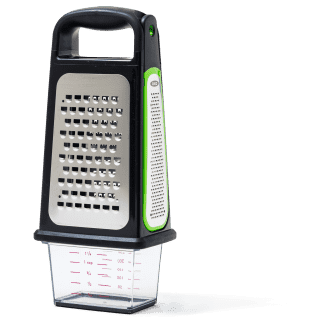
- Collection Bins: Several box graters came with collection bins that snapped onto the graters’ bases. In theory, we appreciated this feature, as it neatly collected any shreds we created. In practice, the bins were more trouble than they were worth. They raised the graters’ center of gravity too high off the counter, which made them more prone to tipping as we shredded food. And they were too small to be very helpful, filling up quickly. Unless you shred only a half-cup of food at a time—and are very careful when you do it—we think you can toss these bins.
The Tests
- Shred blocks of whole-milk mozzarella
- Shred blocks of cheddar cheese
- Shred potatoes
- Shred carrots
- Wash according to manufacturer’s instructions 10 times
- Have testers of different hand sizes and dominant hands evaluate
How We Rated
- Ease of Use: We rated the graters on how stable and comfortable they were to hold, how safe they were to use, and how easy they were to clean and store.
- Performance: We evaluated how quickly, easily, and effectively the graters were able to shred different foods.