


 Buy at Amazon
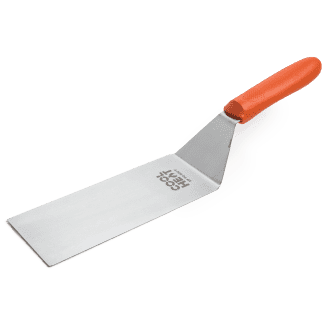
The best offset turners are ideal for heavy-duty or high-volume cooking tasks. Our winner is the Dexter-Russell Sani-Safe 8 x 3" Cake Turner. Its solid head is long and spacious, so it can scoop up plenty of food at a time. While the back end of the head is thick and sturdy, which helps it support large tarts easily, its front edge is thin, flexible, and rounded, allowing it to slip easily under food. And with a 5-inch-long handle made from textured plastic and set at a steep angle, it’s easy to grip and allows for good control.

Nine times out of 10, we grab a metal or nonstick-safe fish spatula when we want to flip or transfer food: Their heads are thin and flexible enough to get under the food without damaging it and long enough to do a good job of supporting most foods once they’re off the cooking surface. But occasionally we find ourselves wishing we had a tool that was a bit bigger or beefier—something that could help pick up larger or heavier foods, such as a roast or a cake, or that could corral and flip more pieces of food, like roasted vegetables, at a time.


Offset turners excel at flipping large quantities of food, such as roasted Brussels sprouts, and flattening other foods, such as hash browns.
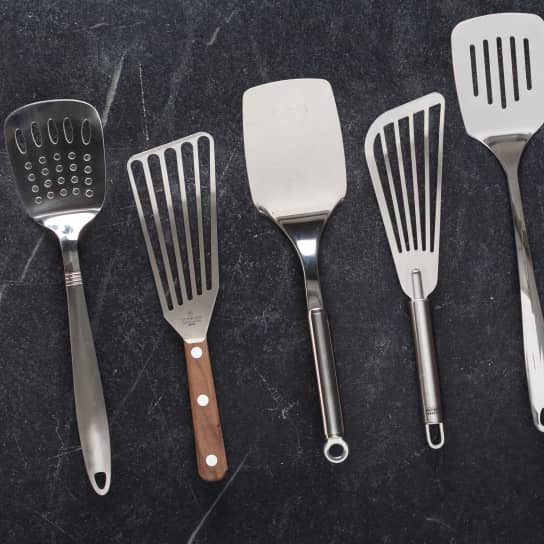
The solution can be found on the short-order line at your local diner. Offset metal turners look like supersized offset spatulas: Their heads are broad and long. And, as their name implies, the handles are bent, or “offset,” in such a way that they sit nearly parallel to the turner heads, which can make it easier to scoop up lots of food at a time.
What to Look for
- Moderately Large Head: We liked heads with plenty of surface area, as these could pick up a significant amount of food in a single pass without being unwieldy. We found that heads with an area of 23 square inches were ideal. Smaller heads were better at maneuvering in tighter spaces and a touch easier to control when flipping food, but they took about the same number of passes to turn food as our favorite metal spatula (which has a surface area of about 12 square inches), and they could smash only one burger at a time. On the flip side, models with bigger heads offered the greatest security when transferring freeform tarts from a baking sheet, owing to their large surface area. But because they were so broad and heavy (weighing nearly a pound), they were awkward to maneuver and tired our arms quickly.

- Long, Narrow Head: The dimensions of the heads mattered too. We preferred models with long but relatively narrow heads measuring about 7.5 by 3 inches. These longer heads allowed us to easily flip large swathes of hash browns, smash two burgers at a time into thin, crispy patties, and securely pick up large tarts. These models also provided a little more distance between our hands and the surface of the screaming-hot stovetop griddle when we were flipping the burgers. Most couldn’t support a whole ham, but we found this to be a minor issue.

- Head with Tapered Thickness: Our favorite turners had heads that tapered from 1.3 to 1.5 millimeters thick at the back ends to a thinner 0.6 to 0.9 millimeters at the front ends. As a result, they were sturdy enough to support heavy or fragile foods but thin and flexible enough to easily wiggle under food.

- Long, Textured Handle: Handles that were about 5 inches long were big enough to accommodate hands of all sizes and allowed for more control when flipping or lifting. We liked handles made from soft or textured plastics, as they were easier to grip than models with handles made of slicker, harder plastics, especially when they were wet or greasy. Wood handles could be easy to grip, too, but they had to be hand-washed.
- Head with Rounded Edges: Testers slightly preferred heads with rounded edges, as they slipped under food more fluidly. Heads with square corners did a good job of dislodging food from cooking surfaces, but those with sharper edges often nicked burgers and flaky tarts or gouged the aluminum foil under the cauliflower.

- Solid Head: Most of the turners we tested had heads that were made from solid pieces of metal. But one model had perforations in its head. While these helped drain excess grease, they occasionally caught on the exteriors of soft burgers and cauliflower, tearing them; most testers preferred solid, unperforated heads.
What to Avoid
- Extra-Long and Thin Heads: Some turner heads were too long, which made them more difficult to maneuver when flipping foods. Ultrathin heads were too flexible and couldn’t hold heavier foods such as tarts.
How We Tested
The Tests
- Lift and transfer Easy Peach and Blackberry Tart
- Lift and transfer an 8-pound spiral ham
- Flip and transfer Sheet-Pan Hash Browns
- Flip and transfer Roasted Cauliflower
- Smash, flip, and transfer Griddled Smash Burgers
- Have users of different hand sizes and dominant hands test
- Wash 5 times by hand or in the dishwasher, according to manufacturers’ directions
How We Rated
- Performance: We rated the turners on how much food they could hold and flip and how securely they lifted hams and tarts.
- Ease of Use: We evaluated the turners on how comfortable and secure they were to hold and how nimbly they maneuvered around cookware of different sizes.
- Durability/Ease of Cleanup: We rated the turners on how durable they were and how easy they were to clean.