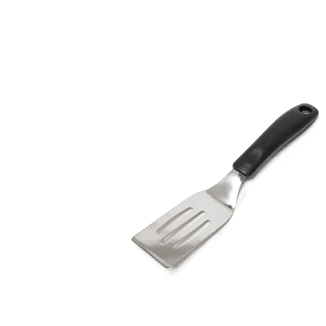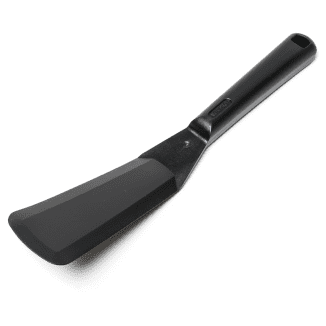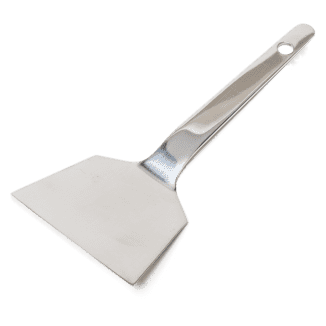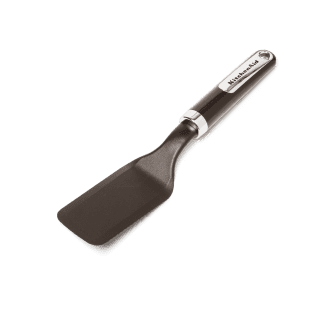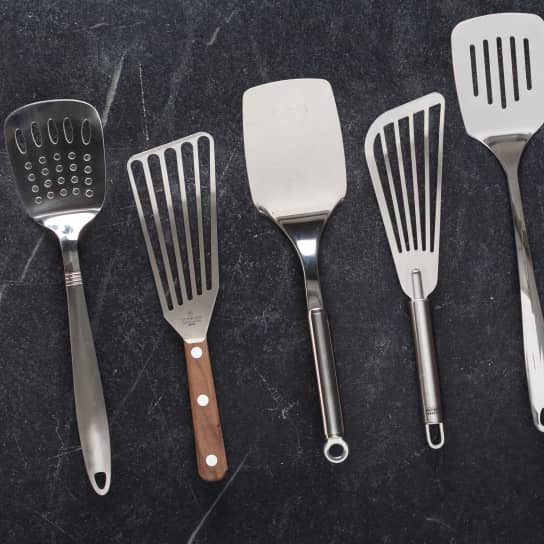


The best compact spatulas excel at maneuvering small portions of food and work nimbly in confined spaces. They have thin, well-proportioned heads and moderately long, rounded handles. Our winner, the OXO Good Grips Silicone Cookie Spatula, exemplifies these traits, slipping easily under cookies and deftly flipping fried eggs.

Compact spatulas, also called cookie spatulas, maneuver more precisely where conventional spatulas might prove cumbersome. Their heads are about half the size of the metal and nonstick-safe spatulas we use for most cooking tasks, which allows them to lift individual cookies or brownies without knocking into and damaging the surrounding sweets. Their uses extend beyond baking, though: They’re great for flipping silver-dollar pancakes, griddling sliders or sausage patties, and scrambling or frying eggs in 8- or 10-inch skillets.


Compact spatulas are designed to navigate tight spaces with ease, easily flipping fried eggs in 8-inch skillets or lifting single cookies without disturbing their neighbors.
We tested spatulas with heads made of steel, silicone, and nylon (a type of plastic); they had wood, steel, or plastic handles. One model was crafted from a single piece of stainless steel. The head shapes fell into two general categories: narrow and slightly elongated, or relatively wide and boxy with square or trapezoidal profiles. A few heads had thin, beveled edges meant for sliding easily under food, or—in the case of metal heads with especially sharp edges—for cutting brownies.
What to Look for
- Moderately Sized Heads: We liked models with heads narrow enough to squeeze between cookies on a baking sheet and to remove whole, intact brownies from a tightly packed pan without agitating neighboring ones. We also preferred medium-length heads, which accommodated most foods while still being easy to maneuver in tight spaces. Our favorite heads were roughly 3 inches long and about 2.5 inches wide, providing around 7.5 square inches of usable surface area.
- Relatively Long Handles: While all the spatulas we tested had short handles when compared to full-size spatulas, we preferred handles on the longer side within this lineup. Handles measuring at least 6 inches long provided sufficient distance to protect our hands from heat and enough space to comfortably grip.
- Thicker, Rounded Handles: Comparatively thick handles—measuring ⅔ inch or thicker—felt substantial and fit nicely in hands of all sizes. We also found rounded handles to be the most comfortable to hold.

- Durable Materials: Top-performing spatulas were made of durable silicone, metal, and plastic that withstood high heat, frequent use, and rigorous cleaning without getting damaged.
What to Avoid
- Undersized or Oversized Heads: The two spatulas with the shortest heads, each around 2 inches long, couldn’t fully support eggs and pancakes during flipping. Heads that were too long weren’t good, either; our longest spatula head, at 5 inches, felt unwieldy during brownie removal. Most of the spatulas we tested were too wide to be truly compact; their bulk made them feel oversized for removing individual cookies and brownies. And one model’s head was too narrow: it tapered back toward its handle, eliminating functional surface area and leaving us only about an inch of width; cookies teetered precariously on this narrow strip.

- Short Handles: We had to be careful while making eggs and pancakes using spatulas with handles shorter than 6 inches, since they positioned our hands much closer to skillets. In one case this resulted in accidental (and painful) hot contact with a pan’s edge.
- Flat, Thin Handles: One metal handle was downright awful; it was short, flat, and thin, with uncomfortable, hard-to-grip edges that dug into our palms.
- Flimsy Materials: We docked points from some models that melted or warped from high heat or showed visible wear at the end of testing.
Other Considerations
- Head Materials: The models we tested had heads made of metal, plastic, or silicone. Plastic and silicone models clung to the butter and oils in cookies and other baked goods, while metal heads repelled those fats. This created a tradeoff: Some plastic and silicone models had slightly more trouble sliding under cookies and brownies, but once they did, they gripped those foods securely, holding them fast as we maneuvered them. Metal heads usually glided easily under foods of all kinds, but cookies and other oily foods slipped and slid around on the metal while in transit. The head material you choose comes down to your preference, with one caveat: Metal spatulas aren’t safe to use on nonstick cookware, which they can easily scratch.
- Head Flexibility: The spatulas’ heads were either somewhat pliable, with edges that could flex, or fairly rigid and unable to bend much. Flexible models such as our winner glided smoothly around the sides of skillets, making them ideal for scrambling eggs. These models’ soft edges also kept them from damaging yolks when we fried eggs over-easy; rigid spatulas were more likely to puncture and ruin them. We still found rigid spatula heads useful: They allowed us to scrape (and eat) every bit of brownie crust from the sides of pans—which flexible spatulas couldn’t do. But other issues marred the more rigid models in our lineup, so we can’t fully recommend any.
The Tests
- Remove Thin and Crispy Chocolate Chip Cookies from a baking sheet
- Remove Thick and Chewy Chocolate Chip Cookies from a baking sheet
- Remove brownies from an 8-inch square baking pan
- Cook two over-easy eggs, one at a time, in a 10-inch nonstick skillet
- Cook two pancakes, one at a time, in a 10-inch nonstick skillet
- Leave each spatula in a 10-inch nonstick skillet over low heat for 1 minute
- Rest each spatula on a hot baking sheet for 1 minute immediately after removing the sheet from a 350-degree oven
How We Rated
- Performance: We tested how effectively the spatulas flipped and stirred foods in—and removed foods from—multiple cooking and baking vessels.
- Ease of Use: We assessed how nimbly the spatulas maneuvered around cookware of different sizes and shapes, how comfortable they were to hold, and how much control they gave us.
- Durability: We evaluated how well the spatulas withstood damage from heat and general use.