
 Buy at Amazon

Hot water dispensers offer convenience for those who don’t want to wait for water to boil every time they make a hot beverage. The Zojirushi VE Hybrid Water Boiler & Warmer is our favorite. It speedily brought water to a boil and held it at the set temperature for 8 hours. The Tiger Electric Water Boiler and Warmer is our Best Buy. It performed almost as well as our winner, but it was a little more difficult to fill.

Hot water dispensers differ from regular electric kettles and gooseneck kettles in several important ways. After heating water to a boil, they keep it hot for hours at a time. They are convenient for people who go through lots of hot water daily, whether making tea, instant coffee, baby formula, instant noodles, or instant soup. While most electric kettles hold between 1 to 2 liters of water, the capacities of hot water dispensers range from 3 to 5 liters. Due to their larger size and design, they’re slower to boil water—averaging 35 minutes when full instead of the roughly 5 minutes it takes other kettles. They’re also heavier; hot water dispensers weigh between 5 and 7 pounds but are typically compact enough to fit under kitchen cabinets that have a standard height of 18 inches. All models heat water to a full boil. Keeping water hotter than about 208 degrees would cause it to evaporate instead of being usable all day, so these dispensers instead hold the water within a temperature range of 185 to 210 degrees, depending on the model. You can use the water at the holding temperature or use the “reboil” feature to return it quickly to a full boil.

More advanced models include a variety of temperature settings, ostensibly selected for specific types of tea (more on that later). After bringing water to a boil, the models with multiple set temperatures default to either 185 or 195 degrees depending on the model, but some can be set as high as 208 degrees. Instead of lifting and pouring water from them, water flows from a spout at the top of the dispenser into a mug or bowl. As a safety feature, all have a child lock and will automatically shut off when they become empty. We focused on models that held roughly 4 liters, enough to make at least a dozen 8-ounce drinks. We tested several promising models, some with more features than others. Read on to find out what separates the best models from the rest.
What to Look For
- Speed: We liked dispensers that boiled water quickly (less than 30 minutes for 3 liters of water or less than 35 minutes when full). The fastest took 32 minutes to boil water at full capacity; one large dispenser took almost 50 minutes to bring 5 liters of water to a boil, a very long wait time to get a morning started.
- Temperature Accuracy: A little fluctuation is expected when holding hot water at a set temperature for hours at a time—but we preferred models that stayed closer to our chosen temperature settings. The water temperatures of three models fluctuated just 2 degrees over an 8-hour period, while temperatures of others fluctuated as much as 7 degrees.
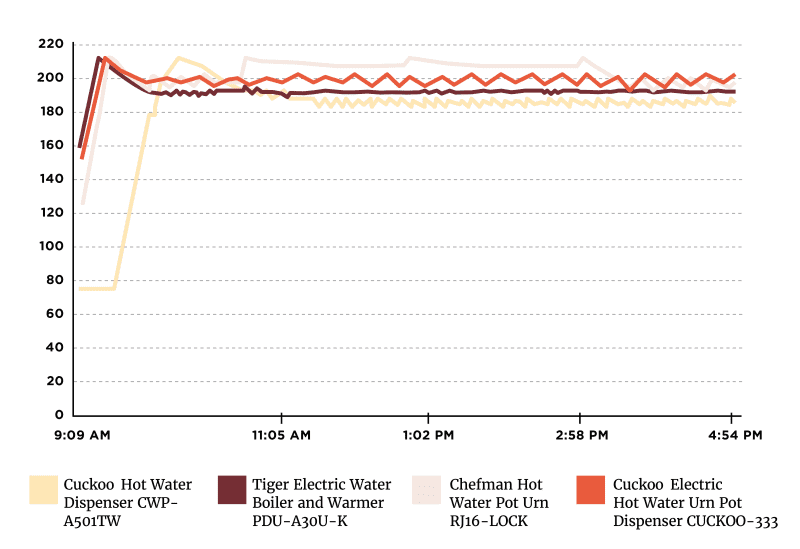
- High Hold Temperature: We liked models that kept water close to boiling temperature because hotter water is more beneficial for a variety of uses. The highest hold temperature for some models was 185 degrees, which is too low for tasks such as making instant ramen, meaning we had to use the “reboil” feature and that slowed us down. The best models had a hold temperature of at least 208 degrees.
- Temperature Display: We preferred models with displays that showed the heating progress, allowing us to monitor and estimate when the water would be ready.


We preferred models with curved bodies because round vessels, such as mugs, bowls, and water bottles, fit more snugly when dispensing water.
- Curved Body for Easy Dispensing: Models with curved bodies were better at dispensing water into bowls, cups, mugs, and water bottles. One model had straight sides, and it was impossible to position rounded vessels directly underneath the opening on the dispenser. As a result, water splashed down near the side of the bowl or mug.
- Audible Notifications: We liked models that audibly alerted us, either with a beep or a rendition of a melody, when the boiling cycle was done and/or the hold temperature could be adjusted. Some models were quiet while running and had no alert system when the water finished boiling. We had to wait longer than necessary because we weren't aware the water was at temperature.
Nice to Have
- Smooth Wheels: Hot water dispensers are hefty and remain mostly stationary, but some have wheels so that they can be spun to face different directions, a thoughtful feature that makes it easy to access them in a busy or crowded kitchen.

- Easy-to-Read Water-Level Markings: When filling the hot water dispensers, we appreciated clearly marked volume lines that made it easy to see the amount of water we were adding. Models with water lines on the exterior allowed us to tell at a glance how much hot water remained inside. These marks prevented us from accidentally running out of hot water.
What to Avoid
- Poorly-Designed Control Panels: The buttons of some models were flush with their control panels, which required us to press hard to access the menu. One model had us memorizing a sequence of short and long presses to unlock the machine. When making our morning coffee or a quick lunch, we don’t want to have to remember complicated instructions or consult a user manual.


We didn’t like buttons that were flush with their control panels, making it hard to press (on the left). We liked models with a clearly labeled control panel and a temperature display (on the right).
- High Spouts: All models splashed a little when dispensing water, but we found that the greater the distance between the spout and the counter, the bigger the splash. To avoid accidental burns, we recommend avoiding models with spouts that are positioned more than 10 inches above the counter. Even models with the lower spouts can still accommodate a travel mug or a French press coffee maker.
Other Considerations
- Multiple Temperature Settings: We were intrigued by the promise of multiple temperature settings on several models. According to the owner’s manuals, each setting was designed for brewing specific types of tea, such as 160 degrees for green tea, 195 for oolong and white tea, and 208 for black tea. But these suggestions are disputed by the International Tea Masters Association (ITMA), which lays out more exact ranges, including 140 to 149 degrees for Gyukuro (a Japanese green tea), 165 to 175 degrees for Chinese green tea, 175 to 185 degrees for oolong, and 195 to 203 degrees for black tea. This makes brewing fine teas in a hot water dispenser not necessarily practical. Further, as the water passes through a dispenser’s pumping mechanism, its temperature drops by as much as 20 degrees. (For comparison, water traveling the much shorter distance from our favorite electric kettle to a mug cools by about 1 degree.) That drop in temperature can be mitigated by tossing out the first cup of water and immediately dispensing a second cup, the temperature of which is only a few degrees lower than the set temperature of all but the worst-performing model.
The Tests
- Measure average boiling speed with standard volume of 3 liters
- Measure average boiling speed at maximum capacity
- Test accuracy when holding a set temperature for 8 hours
- Dispense one cup of water, record the temperature, and discard the water; dispense a second cup immediately after, record the temperature, and note the temperature differences between the actual internal temperature and the dispensed water
- Sample boiled water for off-flavors
- Clean each dispenser between uses
How We Rated
- Performance: We recorded how quickly each dispenser heated water, noting its maximum temperature setting, how effectively each dispenser kept water hot, and whether dispensing water from the spout caused a drastic drop in temperature. We also noted whether water boiled by each model had any off-flavors.
- Ease of Use: We evaluated how easy each model was to use; we also considered how easy it was to fill them to specific water levels and whether their alerts and displays were helpful.
- Cleanup: We assessed how easy it was to clean each model.