
 Buy at Amazon
Good glass food storage containers are stain-resistant and can safely be heated in the microwave or cleaned in the dishwasher, making them a desirable alternative to plastic options. The best ones also seal tightly and come in sets with a useful assortment of sizes. The Rubbermaid Brilliance Glass Food Storage Container 9-Piece Set hit all the marks. The containers were leakproof, heat-resistant, and pleasant to use. The Rubbermaid Brilliance line also won our Plastic Food Storage Container testing. The plastic lids can be used interchangeably between the glass and plastic containers, making them a convenient pair. For people who want a plastic-free option that uses glass lids, we recommend the Bentgo Signature Leak-Proof Glass Food Storage.

Glass food storage containers are useful when meal-prepping, packing up leftovers, or storing pantry items. Amid rising concerns about plastic food storage containers and restrictions on how to use them safely, glass options are growing in popularity. Unlike plastic containers, they can be heated and washed in the dishwasher at high heat with no concerns about micro- or nanoplastics shedding and entering your food or the water used to wash them. They can also be safely used in the microwave and, in most cases, the oven too. We also appreciate that glass containers look more elegant than plastic when used as serving containers.
There are cons, though. Glass containers can shatter. Glass is also heavy, making it less ideal for transport, and it can weigh down a refrigerator shelf. And while some glass containers have glass lids, most come with plastic lids. For those who want to avoid plastic or minimize their use of it, though, these trade-offs may well be worth it.
What Size Glass Food Storage Containers Should You Choose?
We evaluated the market and bought a wide range of sets. Although you can buy glass storage containers à la carte, it’s more cost-effective to purchase them in a set, and it’s nice to have a variety of sizes in order to store things as efficiently as possible.

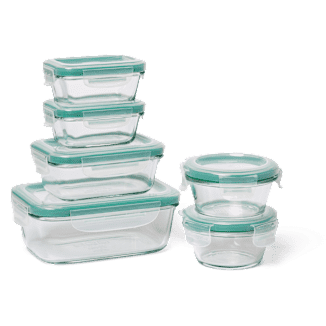
We focused on sets with at least four containers. The glass containers trended smaller than plastic, likely due to weight—glass gets heavy quickly. Only one glass set had a container that held more than 9 cups, while that size (or larger) was a staple in many of the plastic sets. Instead, the large glass containers typically topped out at 5 to 8 cups. We think specific capacities matter less than getting a set with a good range of sizes. Smaller containers are useful for sauces, dips, and those extra 2 tablespoons of tomato paste; the medium sizes are good for a salad or sandwich; and the biggest containers are suitable for, say, a batch of soup or lasagna for four.
Not All Glass Containers Are the Same
Two types of glass were used in the glass food storage containers we tested: soda lime and borosilicate. Soda lime is relatively tough and cheap to produce, but it is not as resilient against thermal shock, the stress imposed on an object when its temperature rapidly changes and causes uneven contraction and expansion across the material; as a result, it's more prone to shattering. To alleviate this, some manufacturers use heat to strengthen soda-lime glass, a process called tempering, so you may also see containers made from “tempered glass.”
Borosilicate, the second type of glass present in our lineup, is less susceptible to heat-related cracking. However, it’s less tough than soda lime when it comes to physical impact, so it’s less likely to survive a drop.
All of the containers we tested were advertised as microwave-safe (without their lids), regardless of the type of glass used to make them. We appreciated the ability to quickly heat up food without transferring it first to another dish. We also liked being able to reheat leftovers or prepared foods in the oven. Most containers were also ovensafe to 450 or 500 degrees. One set wasn’t ovensafe at all, limiting its versatility. Despite these variations in their maximum heat-safe temperatures, we didn’t find performance differences between the two types of glass. No one type of glass was inherently better or worse than another. Other factors proved more important. Here’s what we learned.
What to Look for
- Gaskets: To make the containers leakproof, a gasket on the lid was a must. One set had press-down lids with no gasket. Because the containers didn’t seal tightly, liquid spilled everywhere when we shook them. Of the sets with gaskets, we preferred those that were permanently attached to the lids; we liked that we didn’t have to take the gasket out, clean it separately, and then nudge it back into place once it was dry.
- Secure Latches: We liked latches that swung smoothly and locked firmly into place with a gentle push.


We liked containers with secure latches that opened and closed smoothly with minimal effort. Some containers had stiff latches that were a pain to use.
- Flat Lids: Flat lids meant we could stack the containers, allowing us to use our fridge and freezer space more efficiently. Some containers had slightly domed lids, which made stacking precarious.

- Wide Rims: People often use glass containers for heating foods in microwaves and ovens, and it’s important to be able to hold the containers comfortably and safely while they’re hot. Some had wider rims, and we liked having the extra space to grab on to. It was especially noticeable when we had bulky oven mitts on.

What to Avoid
- Thick Gaskets: One set had gaskets that were so large and thick that we had to press down on the lids with a lot of force.

- Hard-to-Access Channels: Gaskets are housed in channels on the underside of the lids. These gaskets often come into contact with food, and both the gasket and the channel surrounding it can get moldy and harbor bacteria if they’re not cleaned properly. We preferred a wide channel around the gasket, which trapped less debris and moisture and made it easier to get into to clean.
- Stiff Latches: A number of models had stiff latches that were a pain to open and close. One set was so bad that it required both hands to operate.
- Sets with Insufficient Packaging Materials: One set arrived damaged not once but three times. The packaging was flawed: There was no padding between the glass containers to absorb impact during transportation and handling. Other manufacturers added cardboard or foam padding between containers. We attempted to contact the manufacturer of the containers that repeatedly arrived broken, but it never responded to our inquiries.

Other Considerations
- Plastic versus Glass Lids: Glass containers with plastic lids were lighter overall than those with glass lids; our winner had plastic lids, and we preferred them for this reason. But glass lids have advantages too. They can be washed in the dishwasher and be used in the microwave. We liked one set, from Bentgo, that had glass lids with vents that pop open, so you can reheat leftovers without the food drying out or splattering everywhere. Some of the plastic lids had vents, but since we don’t microwave plastic we didn’t test them this way.
- Container Shape: Some sets included containers in two or more shapes, such as round, square, or rectangular. We found that when you have an assortment of shapes, you need more space for storing the containers when they’re not in use; we had to stack or nest the containers in multiple piles according to their shapes. A set in one shape will be simplest to store, but some people like options, and we found great sets in each style. Shape ultimately comes down to a personal choice: Think about what shape you want to eat from, serve from, and store in your cupboards to guide your decision.

The Tests
For the largest container in each set:
- Fill with water dyed blue; shake for 15 seconds to check for leakage
- Store oil-packed tuna in the fridge overnight, then wash and evaluate for lingering odor
- Bake macaroni and cheese (ovensafe containers only)
- Microwave leftover macaroni and cheese
- Store macaroni and cheese in the freezer for 1 week, then evaluate food’s appearance and quality
- Open and close 100 times
- Repeat the leakage test with blue water, checking to see if the seals deteriorated over the course of testing
- Additionally, recruit testers to use a set at home for a week
How We Rated
- Performance: We assessed whether the containers sealed tightly and securely; we also tested how leakproof they remained over time.
- Ease of Use: We evaluated how easy it was to open, close, and maneuver each container.
- Durability: We considered whether the containers stood up to repeated use and whether they were ovensafe and/or microwave-safe.
- Cleanup: We evaluated how easy it was to clean each container, either in the dishwasher or by hand, depending on their instructions. We also noted if they retained stains or odors.
 Buy at OXO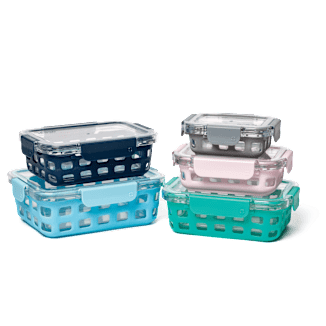

 Buy at Pyrex