
America's Test Kitchen LogoCook's Country LogoCook's Illustrated Logo

Reviews You Can Trust.
See Why.

The Best Slow Cookers

What are the different types of slow cookers, and which ones make the best stews and braises?

Headshot of Sarah SandlerHeadshot of Lisa McManus
By Sarah Sandler & Lisa McManus

Last Updated November 5, 2025

Editor&aposs Note:Update, November 2025

We tested two slow cookers with Dutch oven inserts. We recommend the All-Clad 6-in-1 Digital Slow Cooker with Enameled Cast Iron Pot and have named it our Best Dutch Oven Slow Cooker.

What You Need To Know

The best slow cookers are easy to use, offering you reliable, set-and-forget home cooking at the touch of a few buttons. We chose three slow cooker winners. Each produced delicious meals, with different features that made them stand out. The Hamilton Beach Temp Tracker 6 Quart Slow Cooker is our favorite traditional slow cooker. It has simple controls and cooked exceptionally well; it also has some useful extra features, including a temperature probe and lockable lid for transport. If you’d like a lighter-weight hot plate–style slow cooker that lets you sear directly in the crock, we like the Cuisinart 6-Quart 3-in-1 Cook Central. It cooks faster and hotter than traditional slow cookers with ceramic inserts, so you must check your food’s doneness early. If you’d like a more versatile option, our favorite Dutch oven slow cooker is the All-Clad 6-in-1 Digital Slow Cooker with Enameled Cast Iron Pot. It works well as a slow cooker, and its crock can be used as a stand-alone Dutch oven on the stovetop, though it’s a little heavy. And at 5 quarts, the Dutch oven is on the small side compared to what we generally recommend for Dutch ovens.

If you cook only for one or two people at a time, see our reviews of small slow cookers and mini slow cookers

A slow cooker promises to be a little fantasy grandmother who sits in the kitchen all day cooking for you, but use the wrong cooker and that dream could fizzle. A cooker might run hotter than expected, drying out the food or turning it mushy, or slower than you want, so dinner isn’t ready when you are. Then there can be issues with hot spots, which make food cook unevenly. And what if operating your machine is so confusing that you have to pore over the manual each time you use it?

A well-designed slow cooker excels in covered, moist-heat cooking, also known as braising. This technique is beneficial for meat—usually tough, cheap cuts that tenderize through long, gentle cooking. When connective tissue, which is made mostly of collagen, is cooked beyond 140 degrees, it begins to break down into gelatin, the protein that makes for tender meat. Collagen breaks down most efficiently in a moist environment at temperatures around 200 degrees. This lower-than-boiling temperature range is also good for developing deep, complex flavors in soups, stews, and sauces. 

Poached salmon in a black and silver slow cooker.
Set-it-and-forget-it slow cookers are more versatile than you think, cooking everything from pot roast to poached salmon.

Most slow cookers come with two settings: low and high. The two settings give cooks flexibility: You can either cook for a shorter span on high or about twice as long on low. Generally the choice is about convenience, not flavor or texture, though delicate foods often require the low setting. Frequently we have found that slow cookers reach the same final temperature on either setting but take longer to do so on the low setting than they do on the high setting. 

 We wanted a slow cooker that would deliver a properly cooked meal and be simple and intuitive to use. Previous testing taught us that glass lids were a must so that you can see progress without opening the lid, which lets heat escape and slows down cooking. We also prefer oval- and rectangular-shaped crocks, which can accommodate large roasts; provide abundant surface area to successfully slow-cook rice, grains, and beans; and generally offer more versatility than round crocks. A generous 6- to 7-quart stated capacity was a must—the same capacity as the Dutch oven we’d otherwise use for similar tasks. Few slow cookers actually hold as much as their stated capacity, but we’ve found them to be adequate for all tasks regardless. 

What Are the Different Types of Slow Cookers?

There are three main styles of slow cookers: traditional slow cookers, hot plate–style slow cookers, and Dutch oven slow cookers. Each style is distinguished by the way it heats food and the material of its crock.

We learned more about the differences between how the types are heated when we dismantled a set of cookers with the help of Gregory Thiel, a postdoctoral associate in mechanical engineering at the Massachusetts Institute of Technology. Traditional slow cookers have thick, heat-retaining ceramic vessels that absorb and transmit heat gradually. They’re warmed by a thin heating element strip made of nickel and chromium (or “nichrome”) that wraps around the vessel like a belt. When the cooker is on, this wire heats up more or less powerfully depending on the wattage and the setting.

Oval black crock being placed in a silver slow cooker.
Traditional slow cookers feature a ceramic crock that’s heated by a thin heating element that wraps around the vessel like a belt.

Hot plate–style slow cookers feature a crock that sits on an electric heating element in the base that acts like an enclosed burner. Their crocks are typically made from thin metal (usually aluminum) that often has a nonstick coating.

More recently, a new type of slow cooker has emerged. It uses a cast-iron Dutch oven as a crock and is heated the same way as hot plate–style slow cookers with an electric base. These Dutch oven slow cookers are often labeled as “multicookers,” but this is a bit of a misnomer since you can’t pressure-cook in them as you can in a true multicooker

Round black Dutch oven being placed in a silver slow cooker.
Dutch oven slow cookers work by heating a cast-iron Dutch oven set inside an electric base.

There are pros and cons to each style. Traditional slow cookers tend to be a bit more affordable, often costing less than $100. Because their crocks are made of ceramic, they can crack if dropped or sharply struck, but they are otherwise durable. You can’t brown or sauté in ceramic crocks; you must brown food in a skillet on the stove and transfer food to the slow cooker. We’ve found that some heat unevenly too; as you’ll see below, top-performing traditional slow cookers have extra insulation to limit hot spots.

Hot plate–style slow cookers are typically a bit pricier, starting at around $200. Their thin aluminum crocks can be easier to use because they are lightweight and won’t crack, and their nonstick coating makes them easier to clean. They let you sauté and brown food right in the crock, no separate skillet needed. While it’s convenient to sauté food right in the cooker, it’s important to note that models with metal crocks often slow-cook much faster than models with ceramic crocks: first, because they are often starting hot after sautéing, and second, because models with thin metal crocks heat up faster than ones with thick ceramic, especially when the entire metal crock bottom rests on a large heating element. As a consequence, with a metal crock, if you don’t pay close attention, you can easily overcook food. It’s important to check for doneness earlier than indicated in most recipes, which are usually developed in ceramic slow cookers.

Dutch oven slow cookers can be a versatile investment—they combine a slow cooker and a Dutch oven into a single unit—but they are heavier and harder to lift.

Should You Get a Dutch Oven Slow Cooker?

Maybe. On the plus side, Dutch oven slow cookers are versatile. The Dutch ovens that come with the units can be used separately, either on the stove or in the oven. The Dutch ovens themselves performed well on their own, though they’re smaller than we generally prefer—about 5 quarts instead of 7.

Some of the Dutch ovens worked well as slow cookers too. A Dutch oven slow cooker can be a good option if you want to be able to sear and sauté directly in your slow cooker but would prefer not to use the nonstick-coated crocks that come with other hot plate–style slow cookers.

Chopped onions sautéed in a Dutch oven slow cooker.
Because hot plate–style slow cookers and Dutch oven slow cookers are heated by an electric heating element in the base, you can sauté directly in the pot instead of in a separate skillet on the stove.

One downside is that unlike traditional oval-shaped slow-cooker crocks, cast-iron Dutch oven inserts are round, making it hard to fit long pieces of food, such as brisket. And cast-iron Dutch ovens are much heavier than even traditional ceramic slow cooker crocks, so they can be a bit more difficult to lift, especially when filled with food.

In addition, Dutch oven slow cookers may save a little storage space, but they’re unlikely to save you much money, as they cost at least $300 to $650, or roughly the same to twice as much as it would cost to get both our Best Buy Dutch oven and our winning hot plate-style slow cooker. Ultimately, we think our top choice in this category, the All-Clad 6-in-1 Digital Slow Cooker with Enameled Cast Iron Pot, is best for people who want to get both a midsize Dutch oven and a slow cooker but have limited storage space. Most people would be better off buying a Dutch oven and slow cooker separately because our favorites in both categories perform better and are easier to use than an all-in-one product.

What to Look for

  • Digital, Programmable Controls: We much preferred digital programmable cookers, which let us choose our desired cooking time and high or low setting to cook our meal, showed us a countdown to doneness, and also automatically switched to “warm” when the preset cooking time was up. 
  • Simple, Intuitive Controls: A few models were a pleasure to use, with controls that were unambiguous and buttons that clicked satisfyingly and lit up when pressed and indicated that cooking had started.
Hand setting temperature to low on Hamilton Beach slow cooker.
Simple controls make it very easy to set the temperature and time and to monitor progress throughout cooking.
  • Internal Temperature Sensor and Control: Our temperature tests revealed that better slow cookers had internal temperature sensors and controls. That meant that they cooked more gently and successfully than slow cookers without temperature controls (which simply keep heat fully on until food boils at 212 F, with predictably rubbery, overcooked results). Cookers with sensors kept food at a braising temperature, just below boiling, so the foods cooked gently and became tender while retaining their juiciness. Note: You can’t see this feature when you’re shopping, but our testing results (using a temperature probe suspended in water in the slow cooker over hours of cooking on low and high settings) clearly indicated which models had internal controls and heated gradually to cook more gently and successfully. 
  • Large, Stay-Cool Handles: Crocks with handles that were easy to grasp securely and stayed cool were easier to use.

Person wearing red oven mitts lifting crock out of Hamilton Beach slow cooker.
Comfortable handles make it easier (and safer) to lift a hot crock full of food.
  • For Traditional Models—Good Insulation: Traditional slow cookers can sometimes heat unevenly, with hot spots around the belt-shaped heating element that surrounds the ceramic crock. When we dismantled all the crock pots, we found that the traditional slow cookers that performed best had thick, heat-resistant padding and foil heat shields packed inside. The other traditional models were empty except for the heating element. The insulation buffered the crocks from contact with the heating elements, preventing hot spots and promoting even cooking. It also explained why some of those models, including one of our favorites, tended to run a bit slower.

Nice to Have

  • Attached Temperature Probe: One model had an attached probe that accurately measured the temperature of food cooking inside the slow cooker. While it’s possible to slow-cook successfully without this feature, we appreciated that the probe let us monitor food safety and cooking progress without opening the lid. This is important because slow cookers typically cook very gently, and every time you open the lid to stir or check food, you lose considerable heat, which lengthens the cooking time. The model that came with this temperature probe had three ports in the lid with tight silicone gaskets that kept heat in but allowed us to insert the probe in different locations as needed. The probe stored neatly in the handle when not in use, so we didn’t risk losing it.
Temperature probe plugged into Hamilton Beach slow cooker.
We appreciated that one model’s temperature probe let us monitor food safety and cooking progress without opening the lid.
  • Latching Lids and Silicone Gaskets: Since we often take a slow cooker to a potluck or other occasion, we liked models that had latching lids and silicone gaskets around those lids, which helped prevent leaks in transit.

Hand adjusted latched lid on a slow cooker.
Especially when taking a slow cooker on the go, models with latching lids and silicone gaskets help prevent leaks.
  • “Hold Temperature” Feature: One model can hold food at your desired temperature for up to 24 hours. This feature lets you use the slow cooker to reheat leftovers, as a fondue pot, or as a yogurt maker. While the manufacturer claims this also allows you to use it as a sous vide cooker, it lacks a propeller to circulate water around the food, which you’d find with dedicated sous vide immersion circulators.

What to Avoid

  • Analog Controls: Unless you really want a very simple, inexpensive slow cooker and you plan to be around while it’s cooking, avoid models with analog controls (that is, simple knobs that switch the cooker to on, off, high, low, or warm). These may seem less confusing than digital controls, but they don’t indicate progress (showing remaining cooking time), and they won’t switch over to keep warm when cooking is done, so you run the risk of overcooking your food.
  • Overcomplicated Displays: You really shouldn’t need the manual after the first time you use a slow cooker. We wanted intuitive controls, but several models had so many buttons with such confusing layouts that our testers couldn’t tell if they’d set them correctly or even whether they were on.

The Tests

  • Cook Slow-Cooker Classic Pot Roast with Carrots and Potatoes, 6 to 7 hours on high 
  • Cook Slow-Cooker Chicken Tikka Masala, 3 to 4 hours on low
  • Test browning function, if included in cooker, by sautéing diced onions
  • Check that 6-inch springform pan atop coil of aluminum foil fits inside crock (a setup used in some dessert recipes)
  • Heat 4 quarts water for 12 hours on low and 6 hours on high, tracking water temperature to map heating patterns and maximum cooking temperatures

How We Rated

  • Cooking: We evaluated the taste and texture of food cooked in each slow cooker.
  • Ease of Use: We assessed how easy it was to use, set, and handle the slow cookers. 
  • Cleanup: We noted whether cookers were easy to keep clean and in good condition.
FAQs

The Instant Precision Dutch Oven performed well as a slow cooker and its enameled cast-iron vessel also can be removed to work as a standalone Dutch oven. If you are in the market for both a slow cooker and a Dutch oven, it’s a good choice. For more information, see our review.

An Instant Pot is a multicooker, an appliance known for having lots of features, typically including slow cooking, pressure cooking, rice cooking, steaming, searing, fermenting, and more. In our testing, we’ve rarely found multicookers that can actually slow-cook food well; they’re better at pressure cooking. So if you want an appliance that will slowly cook your food over the course of a day, you’re better off with a slow cooker. To learn more, see this comparison. 

Check out our list of the top tips for cooking in a slow cooker.

We address this common problem in this article on maximizing flavor in your slow cooker.

We’ve developed many recipes for the slow cooker over the years. Here’s our catalog of slow cooker recipes, covering everything from stews to beans to crème brûlée (yes, that’s right).

Everything We Tested

Good 3 Stars out of 3.
Fair 2 Stars out of 3.
Poor 1 Star out of 3.

Highly Recommended

  • Cleanup
  • Cooking
  • Ease of Use

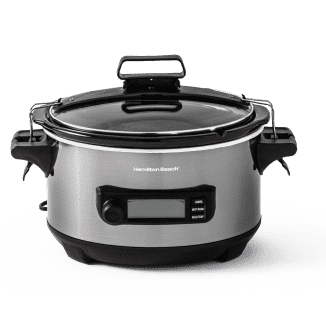
Best Traditional Slow CookerHamilton Beach Temp Tracker 6 Quart Slow Cooker

Every dish we made in this slow cooker emerged deeply flavorful and perfectly cooked. Its simple controls made it very easy to set temperature and time and to monitor progress; an attached temperature probe let us know exactly when our food was done. Its temperature climbed very slowly and gradually, cooking foods more gently than other models in our testing. Aside from executing basic slow cooking recipes perfectly, it had some nice extras: The lid offers three silicone-gasketed ports that let us insert the temperature probe at different locations without worrying about losing heat. The probe stores neatly on the handle between uses. Latches and a silicone gasket around the lid create an especially tight seal on the cooker for safe transport. While its actual capacity seems comparatively small, in practice, it easily fit a large pot roast with potatoes and carrots without crowding. Lastly, this cooker offers a bonus: Its “hold temp” feature lets you set a desired temperature and cooking time to use the cooker as a fondue pot, to reheat leftovers, or to make yogurt. Despite its advertising, we don’t recommend this feature for sous vide cooking, since it can’t circulate water to cook food evenly; it also takes three times as long to heat water to your desired temperature as our favorite immersion circulator. One quibble: This cooker was very easy to clean, but we discovered that painted labels partly wore off two control buttons; this did not affect performance. 

Model Number: 33866

Style: Digital programmable

Features: Low, medium, high, warm, hold-temp settings; temperature probe; will keep warm for 24 hours after cooking

Crock Weight: 7 lb

Crock Material: Ceramic

Actual Capacity: 3.5 qt

Advertised Size: 6 qt

Crock and Lid Dishwasher-Safe?: Yes

Highest Temp Reached on Low Setting: 201.7°F

Highest Temp Reached on High Setting: 212°F

Price at Time of Testing: $89.99

  • Cleanup
  • Cooking
  • Ease of Use

Every dish we made in this slow cooker emerged deeply flavorful and perfectly cooked. Its simple controls made it very easy to set temperature and time and to monitor progress; an attached temperature probe let us know exactly when our food was done. Its temperature climbed very slowly and gradually, cooking foods more gently than other models in our testing. Aside from executing basic slow cooking recipes perfectly, it had some nice extras: The lid offers three silicone-gasketed ports that let us insert the temperature probe at different locations without worrying about losing heat. The probe stores neatly on the handle between uses. Latches and a silicone gasket around the lid create an especially tight seal on the cooker for safe transport. While its actual capacity seems comparatively small, in practice, it easily fit a large pot roast with potatoes and carrots without crowding. Lastly, this cooker offers a bonus: Its “hold temp” feature lets you set a desired temperature and cooking time to use the cooker as a fondue pot, to reheat leftovers, or to make yogurt. Despite its advertising, we don’t recommend this feature for sous vide cooking, since it can’t circulate water to cook food evenly; it also takes three times as long to heat water to your desired temperature as our favorite immersion circulator. One quibble: This cooker was very easy to clean, but we discovered that painted labels partly wore off two control buttons; this did not affect performance. 

Model Number: 33866

Style: Digital programmable

Features: Low, medium, high, warm, hold-temp settings; temperature probe; will keep warm for 24 hours after cooking

Crock Weight: 7 lb

Crock Material: Ceramic

Actual Capacity: 3.5 qt

Advertised Size: 6 qt

Crock and Lid Dishwasher-Safe?: Yes

Highest Temp Reached on Low Setting: 201.7°F

Highest Temp Reached on High Setting: 212°F

Price at Time of Testing: $89.99

  • Cleanup
  • Cooking
  • Ease of Use

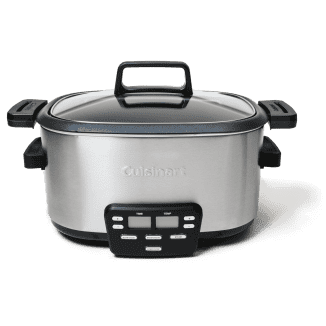
Best Hot Plate–Style Slow CookerCuisinart 6-Quart 3-in-1 Cook Central

We loved the lightweight, nonstick metal crock and stay-cool plastic handles that made this model so easy to maneuver and clean. The long, rectangular crock sits directly over a built-in hotplate, so this model tends to run a little hotter and cooks foods faster than traditional ceramic slow cookers. We suggest checking recipes early for doneness. It cooked evenly in every test and has built-in temperature sensors that prevent the contents from boiling. Its brown/sauté function eliminates the need for a separate skillet, and you can even steam in it using a metal rack accessory. A few testers found setting this cooker a little confusing due to its slightly busy control panel. That said, it’s a solid performer that yielded excellent cooking results and is a great choice if you hate to lift heavy crocks or worry about breakage.

Model Number: MSC-600

Style: Digital programmable

Features: Low, high, simmer, and warm settings; brown/sauté and steam functions; metal rack for steaming; will keep warm for 24 hours after cooking

Crock Weight: 3.45 lb

Crock Material: Aluminum with nonstick coating

Actual Capacity: 4.5 qt

Advertised Size: 6 qt

Crock and Lid Dishwasher-Safe?: Yes

Highest Temp Reached on Low Setting: 199.8°F

Highest Temp Reached on High Setting: 206.7°F

Price at Time of Testing: $156.95

  • Cleanup
  • Cooking
  • Ease of Use

We loved the lightweight, nonstick metal crock and stay-cool plastic handles that made this model so easy to maneuver and clean. The long, rectangular crock sits directly over a built-in hotplate, so this model tends to run a little hotter and cooks foods faster than traditional ceramic slow cookers. We suggest checking recipes early for doneness. It cooked evenly in every test and has built-in temperature sensors that prevent the contents from boiling. Its brown/sauté function eliminates the need for a separate skillet, and you can even steam in it using a metal rack accessory. A few testers found setting this cooker a little confusing due to its slightly busy control panel. That said, it’s a solid performer that yielded excellent cooking results and is a great choice if you hate to lift heavy crocks or worry about breakage.

Model Number: MSC-600

Style: Digital programmable

Features: Low, high, simmer, and warm settings; brown/sauté and steam functions; metal rack for steaming; will keep warm for 24 hours after cooking

Crock Weight: 3.45 lb

Crock Material: Aluminum with nonstick coating

Actual Capacity: 4.5 qt

Advertised Size: 6 qt

Crock and Lid Dishwasher-Safe?: Yes

Highest Temp Reached on Low Setting: 199.8°F

Highest Temp Reached on High Setting: 206.7°F

Price at Time of Testing: $156.95

Recommended

  • Cleanup
  • Cooking
  • Ease Of Use

Best Dutch Oven Slow CookerAll-Clad 6-in-1 Digital Slow Cooker with Enameled Cast Iron Pot

This Dutch oven slow cooker had straightforward controls for choosing the setting and cook time, with buttons that were clearly marked and intuitive to use. It made great chicken tikka masala cooked on high, with juicy meat and a rich sauce. It also made tender, flavorful pot roast cooked on low. We loved that we could sauté aromatics right in the pot before transitioning to slow cooking. The insert also performed well when we used it on its own as a Dutch oven, and its looped handles were comfortable to grasp. A few minor quibbles Because the crock is on the small side and round instead of oval, it was a tight fit for a long cut of meat, like chuck roast, so you may need to downsize certain recipes. The cooking surface of the Dutch oven has a raised spiral, and its lid has bumps on the interior, both of which make it trickier to scrub off browned food residue. Also, while the exterior and interior of the crock are enameled, the rim is not, which means you have to dry it well and occasionally season with oil to prevent rusting. The crock is on the heavy side for Dutch ovens of this size, so it’s a bit more difficult to lift. Still, if you’re shopping for both a Dutch oven and a slow cooker (and don’t mind a smaller pot), this model may be a good choice for you.

Model Number: SD922D51

Style: Digital programmable

Features: High, low, braise, simmer, sauté, manual, keep warm

Crock Weight: 15.3 lb

Crock Material: Enameled cast iron

Actual Capacity: 5 qt

Advertised Size: 5 qt

Crock and Lid Dishwasher-Safe?: Crock, yes; lid, no

Highest Temp Reached on Low Setting: 190°F

Highest Temp Reached on High Setting: 211°F

Price at Time of Testing: $299.95

  • Cleanup
  • Cooking
  • Ease Of Use

This Dutch oven slow cooker had straightforward controls for choosing the setting and cook time, with buttons that were clearly marked and intuitive to use. It made great chicken tikka masala cooked on high, with juicy meat and a rich sauce. It also made tender, flavorful pot roast cooked on low. We loved that we could sauté aromatics right in the pot before transitioning to slow cooking. The insert also performed well when we used it on its own as a Dutch oven, and its looped handles were comfortable to grasp. A few minor quibbles Because the crock is on the small side and round instead of oval, it was a tight fit for a long cut of meat, like chuck roast, so you may need to downsize certain recipes. The cooking surface of the Dutch oven has a raised spiral, and its lid has bumps on the interior, both of which make it trickier to scrub off browned food residue. Also, while the exterior and interior of the crock are enameled, the rim is not, which means you have to dry it well and occasionally season with oil to prevent rusting. The crock is on the heavy side for Dutch ovens of this size, so it’s a bit more difficult to lift. Still, if you’re shopping for both a Dutch oven and a slow cooker (and don’t mind a smaller pot), this model may be a good choice for you.

Model Number: SD922D51

Style: Digital programmable

Features: High, low, braise, simmer, sauté, manual, keep warm

Crock Weight: 15.3 lb

Crock Material: Enameled cast iron

Actual Capacity: 5 qt

Advertised Size: 5 qt

Crock and Lid Dishwasher-Safe?: Crock, yes; lid, no

Highest Temp Reached on Low Setting: 190°F

Highest Temp Reached on High Setting: 211°F

Price at Time of Testing: $299.95

Recommended with Reservations

  • Cleanup
  • Cooking
  • Ease of Use

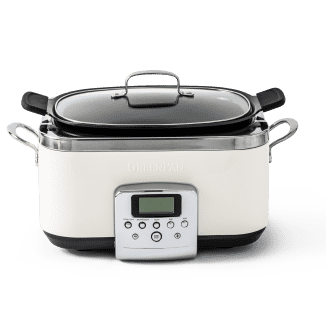
GreenPan Elite 8-in-1 Programmable 6 Quart Slow Cooker

We loved the clean look of this slow cooker, its stay-cool exterior, and its lightweight, ceramic–nonstick coated metal crock. We liked being able to sauté in the cooker without using a separate skillet, but its slow-cooking results were uneven. Our first pot roast emerged shriveled, with a rubbery rather than fork-tender texture; the sauce was greasy and broken and the meat was dry. Additional cooking didn’t help the meat tenderize. Chicken Tikka Masala was acceptable, though compared to the same dish made in a higher-rated cooker, its flavors seemed less fresh and bright, and the chicken was a bit overcooked. Our temperature testing showed that this model heated rapidly and climbed steeply on both low and high settings and then leveled off below boiling. Since sautéing in the cooker meant that it started out warm, this could have accelerated its cooking times. So we made another complete pot roast with vegetables, which cooks on high for 6 to 7 hours, checking the meat for tenderness one hour early (after 5 hours and again at 6 hours) and got more acceptable results, though the meat remained a bit chewier than ideal. 

Model Number: CC005108-001

Style: Digital programmable

Features: Low, high, simmer, and warm settings; brown/sauté and steam functions; metal rack for steaming; will keep warm for 8 hours after cooking

Crock Weight: 3.63 lb

Crock Material: Metal with ceramic nonstick coating

Actual Capacity: 4.5 qt

Advertised Size: 6 qt

Crock and Lid Dishwasher-Safe?: Yes

Highest Temp Reached on Low Setting: 199.9°F

Highest Temp Reached on High Setting: 206.8°F

Price at Time of Testing: $249.00

  • Cleanup
  • Cooking
  • Ease of Use

We loved the clean look of this slow cooker, its stay-cool exterior, and its lightweight, ceramic–nonstick coated metal crock. We liked being able to sauté in the cooker without using a separate skillet, but its slow-cooking results were uneven. Our first pot roast emerged shriveled, with a rubbery rather than fork-tender texture; the sauce was greasy and broken and the meat was dry. Additional cooking didn’t help the meat tenderize. Chicken Tikka Masala was acceptable, though compared to the same dish made in a higher-rated cooker, its flavors seemed less fresh and bright, and the chicken was a bit overcooked. Our temperature testing showed that this model heated rapidly and climbed steeply on both low and high settings and then leveled off below boiling. Since sautéing in the cooker meant that it started out warm, this could have accelerated its cooking times. So we made another complete pot roast with vegetables, which cooks on high for 6 to 7 hours, checking the meat for tenderness one hour early (after 5 hours and again at 6 hours) and got more acceptable results, though the meat remained a bit chewier than ideal. 

Model Number: CC005108-001

Style: Digital programmable

Features: Low, high, simmer, and warm settings; brown/sauté and steam functions; metal rack for steaming; will keep warm for 8 hours after cooking

Crock Weight: 3.63 lb

Crock Material: Metal with ceramic nonstick coating

Actual Capacity: 4.5 qt

Advertised Size: 6 qt

Crock and Lid Dishwasher-Safe?: Yes

Highest Temp Reached on Low Setting: 199.9°F

Highest Temp Reached on High Setting: 206.8°F

Price at Time of Testing: $249.00

Not Recommended

  • Cleanup
  • Cooking
  • Ease Of Use

Staub Precision Induction Multi Cooker

This model combines an electric hot-plate base with Staub’s classic enameled Dutch oven, which is sold separately, to transform it into a cast-iron slow cooker. The Dutch oven performs well on its own and its handles are comfortable to hold, but its lid is a bit tricky to clean due to spikes and a groove that can collect food. Its touch-screen interface has a bit of a learning curve, as you need to use the manual to check which symbol corresponds with your desired setting. But once you memorize these symbols, it’s fairly intuitive to use. Occasionally, when the touch screen got greasy, it became a little less responsive to our fingertip. Performance was mixed. Chicken tikka masala, cooked on high, turned out well. Since the temperature only reached 195 degrees on high (whereas other models reach 212), it took about four hours to cook, closer to the longer end of the prescribed cooking time. Pot roast, made on low, didn’t cook properly in the recipe’s prescribed time range. After seven hours, the meat was still pink and potatoes were firm. When we monitored the temperature of water on the low setting, it reached only 162 degrees (whereas other slow cookers reach close to 200 degrees on low), so ingredients just didn’t get hot enough. We appreciated that we could sauté right in the pot before slow-cooking, but the “brown” setting ran a little hot, cooking onions a little more quickly than desired; if you buy this model, just be sure to keep a close eye on whatever you’re sautéing. If you’re in the market for a slow cooker, already own a 5½-quart Staub Dutch oven, and want to save a little on storage space, purchasing the slow cooker base may be an acceptable option for you; just know that certain recipes cooked on high may take longer than the stated time range, and it doesn’t get hot enough on the low setting to cook foods properly. If you don’t already own a Staub Dutch oven, we don’t think this set is worth your money, given its mixed performance as a slow cooker and steep price tag.

Model Number: 1028021

Style: Digital programmable

Features: High, low, braise, brown, steam, manual, keep warm

Crock Weight: 12.9 lb

Crock Material: Enameled cast iron

Actual Capacity: 5.25 qt

Advertised Size: 5.5 qt

Crock and Lid Dishwasher-Safe?: Crock, yes but hand washing is recommended; lid, no

Highest Temp Reached on Low Setting: 162°F

Highest Temp Reached on High Setting: 195°F

Price at Time of Testing: $649.95 ($400.00 for the Dutch oven, $249.95 for the base)

  • Cleanup
  • Cooking
  • Ease Of Use

This model combines an electric hot-plate base with Staub’s classic enameled Dutch oven, which is sold separately, to transform it into a cast-iron slow cooker. The Dutch oven performs well on its own and its handles are comfortable to hold, but its lid is a bit tricky to clean due to spikes and a groove that can collect food. Its touch-screen interface has a bit of a learning curve, as you need to use the manual to check which symbol corresponds with your desired setting. But once you memorize these symbols, it’s fairly intuitive to use. Occasionally, when the touch screen got greasy, it became a little less responsive to our fingertip. Performance was mixed. Chicken tikka masala, cooked on high, turned out well. Since the temperature only reached 195 degrees on high (whereas other models reach 212), it took about four hours to cook, closer to the longer end of the prescribed cooking time. Pot roast, made on low, didn’t cook properly in the recipe’s prescribed time range. After seven hours, the meat was still pink and potatoes were firm. When we monitored the temperature of water on the low setting, it reached only 162 degrees (whereas other slow cookers reach close to 200 degrees on low), so ingredients just didn’t get hot enough. We appreciated that we could sauté right in the pot before slow-cooking, but the “brown” setting ran a little hot, cooking onions a little more quickly than desired; if you buy this model, just be sure to keep a close eye on whatever you’re sautéing. If you’re in the market for a slow cooker, already own a 5½-quart Staub Dutch oven, and want to save a little on storage space, purchasing the slow cooker base may be an acceptable option for you; just know that certain recipes cooked on high may take longer than the stated time range, and it doesn’t get hot enough on the low setting to cook foods properly. If you don’t already own a Staub Dutch oven, we don’t think this set is worth your money, given its mixed performance as a slow cooker and steep price tag.

Model Number: 1028021

Style: Digital programmable

Features: High, low, braise, brown, steam, manual, keep warm

Crock Weight: 12.9 lb

Crock Material: Enameled cast iron

Actual Capacity: 5.25 qt

Advertised Size: 5.5 qt

Crock and Lid Dishwasher-Safe?: Crock, yes but hand washing is recommended; lid, no

Highest Temp Reached on Low Setting: 162°F

Highest Temp Reached on High Setting: 195°F

Price at Time of Testing: $649.95 ($400.00 for the Dutch oven, $249.95 for the base)

  • Cleanup
  • Cooking
  • Ease of Use

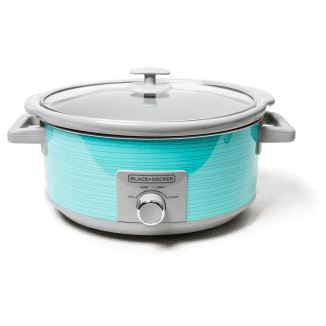
Black + Decker 7-Quart Slow Cooker—Teal

Large and inexpensive with a big, heavy pot, this uninsulated manual cooker cooked unevenly, which was especially noticeable with chicken breasts but also with pot roast and turkey. While it’s easy to set, it’s not that convenient to use: It has no countdown display, so you can’t monitor progress unless you set a separate timer, and it can’t automatically switch to warming mode after cooking is done—you have to return to turn it down or switch it off.

Model Number: SC2007D

Style: Manual

Features: Hanger inside lid to hook lid to side of crock; warm, low, high settings

Crock Weight: 8.0 lb

Crock Material: Ceramic stoneware

Actual Capacity: 5 qt

Advertised Size: 7 qt

Crock and Lid Dishwasher-Safe?: Yes

Highest Temp Reached on Low Setting: 196.2°F

Highest Temp Reached on High Setting: 205.4°F

Price at Time of Testing: $39.99

  • Cleanup
  • Cooking
  • Ease of Use

Large and inexpensive with a big, heavy pot, this uninsulated manual cooker cooked unevenly, which was especially noticeable with chicken breasts but also with pot roast and turkey. While it’s easy to set, it’s not that convenient to use: It has no countdown display, so you can’t monitor progress unless you set a separate timer, and it can’t automatically switch to warming mode after cooking is done—you have to return to turn it down or switch it off.

Model Number: SC2007D

Style: Manual

Features: Hanger inside lid to hook lid to side of crock; warm, low, high settings

Crock Weight: 8.0 lb

Crock Material: Ceramic stoneware

Actual Capacity: 5 qt

Advertised Size: 7 qt

Crock and Lid Dishwasher-Safe?: Yes

Highest Temp Reached on Low Setting: 196.2°F

Highest Temp Reached on High Setting: 205.4°F

Price at Time of Testing: $39.99

America's Test Kitchen Accolades Badge

Reviews You Can Trust

The mission of America’s Test Kitchen Reviews is to find the best equipment and ingredients for the home cook through rigorous, hands-on testing. We stand behind our winners so much that we even put our seal of approval on them. Have a question or suggestion? Send us an email at atkreviews@americastestkitchen.com. We appreciate your feedback!

Appears In

This item is featured in the following. Click the links to dig in!

*All products reviewed by America’s Test Kitchen are independently chosen, researched, and reviewed by our editors. We buy products for testing at retail locations and do not accept unsolicited samples for testing. We list suggested sources for recommended products as a convenience to our readers but do not endorse specific retailers. When you choose to purchase our editorial recommendations from the links we provide, we may earn an affiliate commission. Prices are subject to change.

Reviews You Can Trust.
See Why.

This is a members' feature.
America's Test Kitchen LogoCook's Country LogoCook's Illustrated Logo