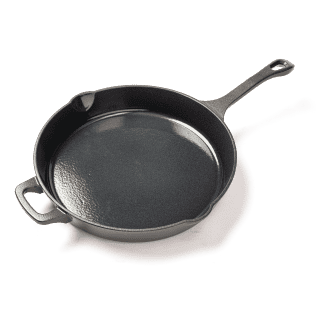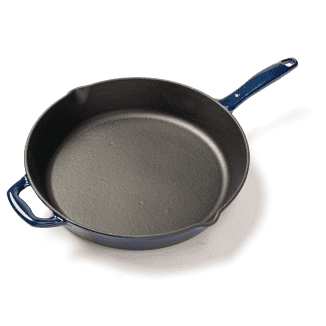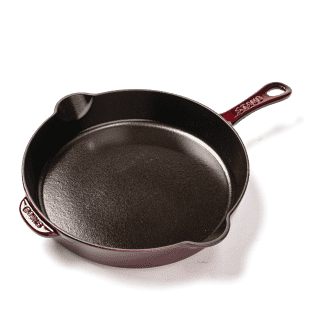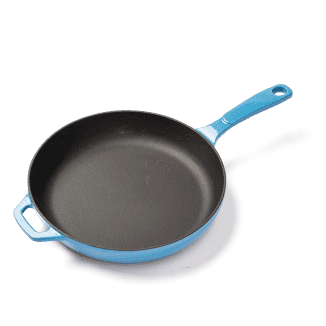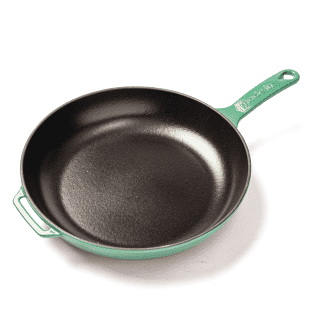
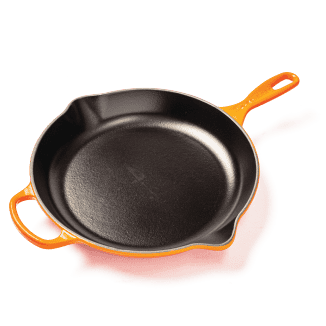
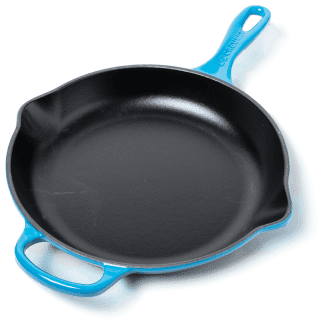
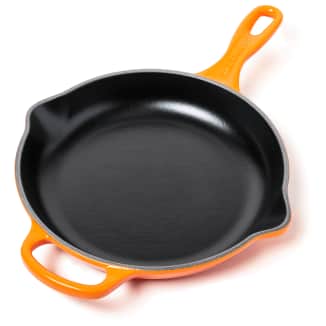
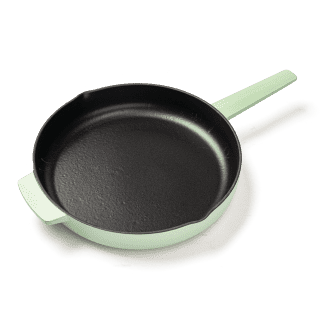
Our ATK Recommended favorite enameled cast-iron skillet is Le Creuset 11-3/4” Signature Skillet. With low, flaring sides; an oversize helper handle; wide pour spouts; a broad, satiny interior; and balanced, moderate weight, this expensive but beautifully made skillet (available in a variety of colors) is a pleasure to cook in. Our Best Buy, the KitchenAid Enameled Cast Iron 12" Skillet, has an extra-broad cooking surface offering plenty of space to cook anything we wanted, and handled well, though it was slightly heavier than our top choice, with straighter sides than we prefer.
If you’d like a smaller version of our favorite, we also recommend Le Creuset’s 10.25- and 9-inch models.
Looking for traditional cast-iron skillets? This review’s got you covered.

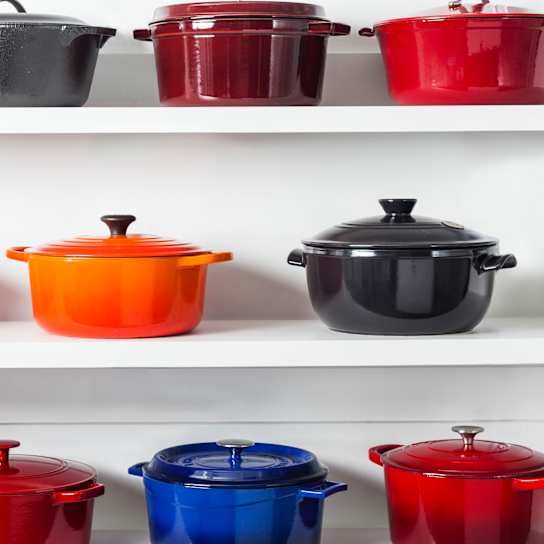
Enameled cast-iron skillets often get lumped in with regular cast iron. We’ve been guilty of that ourselves. Sure, both are cast iron, but enameled versions offer a different range of features and cooking options. Like regular cast iron, these pans have excellent heat retention, so they sear, fry, and braise well, maintaining the heat you want without undesirable temperature dips as food is added or flipped. But unlike regular cast iron, their enamel coating makes enameled cast-iron pans virtually maintenance-free. You never have to season them, and you can soak, use soap, and scrub as much as you like. Best of all, you can cook almost anything—even acidic foods that need to simmer for a long time—because the enamel seals the cast iron, making the pan rust-proof and nonreactive. While both regular and enameled cast-iron pans are induction-compatible, the smoother enameled bottoms can be a little gentler on glass cooktops (though you should still lift and place heavy pans carefully, rather than dropping or dragging). Finally, their colorful appearance is pretty enough to bring to the table for serving. (Our recipes for warm dips and fondue take advantage of these features.)


We love to cook and then serve right in enameled cast-iron skillets, which keep foods warm due to their thick, heat-retaining material. Cast Iron Warm Marinated Artichoke Hearts with Olives and Feta (left) and Cast Iron Beer and Cheddar Fondue (right) take advantage of the pans’ special abilities and good looks.
The downside? Don’t expect enameled cast-iron skillets to be—or become—nonstick. Enamel is a glasslike coating heated to very high temperatures and bonded to the pan’s surface. It will not become seasoned as you use it, the way plain cast iron does. While some manufacturers claim their pans will become nonstick with use, in our hands-on testing experience, we have found it not to be the case. Seasoning is oil that has been heated until it polymerizes, meaning that its molecules link, bonding together and to the metal cooking surface of a pan to create a natural, renewable nonstick coating. Enamel prevents the oil from bonding to the surface as successfully as it does to plain metal. As a result, food sticks, and this won’t change over time as it does with traditional cast iron.
Furthermore, enamel can be damaged if the pan is exposed to very high, direct heat, so unlike regular cast iron, it’s not for the campfire or grill. Avoid thermal shock (rapid changes from cold to hot or vice versa), scrubbing with rough abrasives such as steel wool, or whacking with metal utensils.
Caveats aside, these pans can be an excellent addition to your kitchen, and we ultimately recommended all of them. As we tested, we learned which features were most desirable.
What Size Skillet Should You Get?
We think that a 12-inch skillet is the best size for most cooks, providing plenty of room to cook for as many as six people.
A smaller 10-inch skillet can also be a good choice if you have limited storage space or regularly cook for two to four people.
An 8- to 9-inch skillet lets you cook for one to two people. It’s also useful for small tasks, such as toasting nuts or browning butter.
What to Look For
- Broad Cooking Surface: We preferred having plenty of room to brown food without crowding (which leads to steaming rather than searing) and ample space to maneuver tongs or a spatula. Our 12-inch favorites had at least 10 inches of flat cooking surface—enough room to fit two steaks, a batch of ziti, or five to six chunky apple fritters with ease.


We preferred pans with ample cooking surface (left) that didn’t leave us worrying about overflows when cooking high-volume recipes such as Cast Iron Baked Ziti as we did with smaller pans (right).
- Big, Secure Handles: These pans are heavy—12-inch models weigh anywhere from around 6 to 8 pounds empty—and longer handles gave better leverage as we maneuvered them, though shorter ones worked if the pan had a good helper handle. The best helper handles were large and gave us a great grip; the worst were tiny.
- Moderately High Sides: We preferred sides measuring about 2 inches high for 12-inch models, tall enough to contain food, oil, and splatters when shallow-frying apple fritters or simmering ziti with tomato sauce, but low enough to slide in a spatula at a comfortable angle. We saw enameled cast-iron skillets on the market with sides much higher than 2 inches; these very deep pans work better for deep-frying and braising than as a skillet. Some manufacturers even call them “chicken fryers.”

Nice to Have
- Maximum Ovensafe Temperature of 500 Degrees Fahrenheit: Most of our pans were rated ovensafe to 500 degrees, and one was even higher. This is helpful because you can use them under the broiler, as we did when browning cheese on ziti. With pans that listed top temperatures in the 400-degree range, we confirmed with manufacturers that it was OK to put them under the broiler for brief periods of 5 to 10 minutes. When we did, they were fine—but we’d prefer not to worry about it.

- Color Choices: Function is far more important than looks, but it’s a pleasure to choose an attractive enamel color. Some pans came in a wider range of colors.
- Glossy versus Matte Interior: Enameled cast-iron pans are enameled inside and out, typically with matte black enamel interiors and glossy, colorful exteriors. One or two pans flip the script. Their glossy interiors were slightly easier to clean; food stuck a bit less, and wiping them dry with towels never snagged lint the way rough matte interiors did. The matte exterior of our Best Buy also made the handles grippier, a nice feature.

What to Avoid
- Cramped Cooking Surfaces: Cooking surfaces on the pans we tested ranged from 9 to over 10 inches across the interior. While we cooked successfully in every pan, those with smaller cooking surfaces made us nervous with recipes such as baked ziti that filled pans nearly to the brim.
- Poor Weight Balance: Awkwardly balanced weight made heavy pans harder to handle. One pan felt harder to maneuver than others, and we were surprised to find that it wasn’t actually the heaviest pan. When we lifted it, it felt like someone was pulling down on the other side of the pan.

- Inadequate Helper Handles: We’re not always a fan of helper handles, but with enameled cast-iron pans, they’re a necessity. Small, slippery ones were uncomfortable and dangerous. It’s no joke; we dropped the front of a hot skillet onto the glass of an open oven door because the stubby helper handle slipped out of our pot holder–covered hand.
The Tests
- Cook pan-seared steak
- Make Cognac and Mustard Pan Sauce
- Cook Cast Iron Baked Ziti with Charred Tomatoes
- Fry Cast Iron Apple Fritters
- Hand-wash pans after each use
How We Rated
- Performance: We assessed pans’ ability to retain and transmit heat during cooking on the stove and in the oven.
- Ease of Use: We evaluated the pans’ design, weight, and shape, including main and helper handles, to see how easy, comfortable, and secure they felt to maneuver, including when stirring, flipping, pouring, and lifting in and out of the oven.
- Cleanup: We considered how much work it took to keep pans clean and in good condition.