

 Buy at Amazon
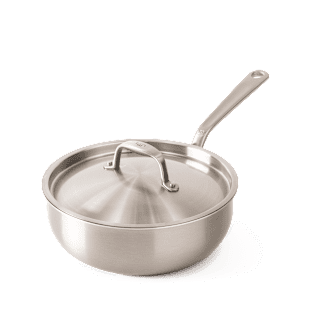
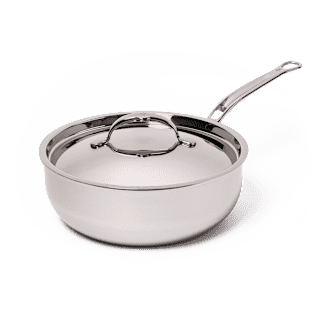
A saucier is a type of saucepan with a distinctly round shape and a wide, flared opening. Our winner is the Le Creuset Signature Stainless Steel Saucier Pan, a fully clad pan that heats evenly, with smoothly sloped walls whose lack of corners makes whisking and stirring easy. Our Best Buy is the Cooks Standard Multi-Ply Clad Stainless Steel Wok Stir Fry Pan, 10.5 inch. While it’s called a stir-fry pan, it has all of the characteristics that define a saucier, at a fraction of the price.

Sauciers are extraordinary pans. The open shape allows great visibility in the pan and the curved walls enable you to sweep a spatula or whisk around with ease, keeping all of the food in motion. Nothing gets stuck, scorched, or left behind.
Originally created for French chefs making sauces, sauciers have a bowl-like shape designed for the continuous stirring and reduction necessary for success. But sauciers have mostly remained a restaurant secret, never fully translated into home kitchens in the United States and sidelined by standard saucepans. Today, these useful pans are making their way back to the spotlight. They’re excellent for more than just sauces: A good saucier’s open construction lends itself to making everything from smaller batches of soup and pasta—and for tossing that pasta in sauce—to risotto, gravy, pudding, pastry cream, caramel, and more—particularly recipes that call for frequent stirring or whisking.

Once you’ve used a good saucier, it’s tempting to leave your regular saucepan on the shelf. A saucier can do anything a saucepan can. The reverse isn’t necessarily true: You could make recipes like pastry cream or beurre blanc in a straight-sided saucepan, but it takes more effort, with more opportunity for subpar results.

What’s the Best Material for Sauciers?
When we shopped for sauciers, we focused our search, skipping the priciest sauciers made of copper. We also passed up enameled cast-iron models because they are extremely heavy; a full pan of risotto is weighty enough. We further eliminated “disk-bottom” models where the base of the pan is thickened by an attached disk of extra metal, while its sides are a single, thinner layer of stainless steel; in our experience, disk-bottom pans heat erratically and scorch around the thinner steel sides. We think the best material for sauciers is stainless steel. More specifically, fully clad stainless-steel pans, which are made entirely of bonded layers of metal, with stainless steel sandwiched around aluminum. This combination helps pans transfer heat evenly and efficiently, giving you excellent temperature control and uniform browning.
Other Names for Saucier Pans
The industry uses many names for the pans we think of as “sauciers.” In traditional French kitchens, the saucier is the chef who makes the sauce, not the pan, so the name is not firmly affixed to this rounded, open pan. We found this distinctive shape called a “chef pan,” “essential pan,” “splayed saute pan,” “rounded sauteuse,” “sauteuse évasée” or, from some French brands, simply a “saucepan.” We examined them all and even extended our search to “stir-fry” or “wok pans” and included a fully clad stainless-steel version that fit our saucier specs.
A saucier’s wide, round shape helps you keep food that requires frequent stirring, such as risotto, in motion. We loved pans whose curving walls fit the shape of our favorite whisk and wooden spoon.
What Size Saucier Should I Get?
We prefer sauciers in the 3- to 3.5-quart size, which we find to be the most versatile. Smaller 1.5- to 2-quart sauciers only excel for very small quantities; they’re specifically for sauce-making. Five-quart (or larger) sauciers verge into the territory where we’d rather use a Dutch oven. In testing, we slightly preferred 3.5-quart models over 3 quarts; the extra half-quart felt noticeably more spacious, giving us a bit more room to stir vigorously without splashing.
Do Sauciers Really Reduce Faster?
The wide, open shape and broad cooking surface of a saucier are designed to speed up evaporation compared to the straight L-shaped sides of a saucepan. This helps you reduce, thicken, and concentrate liquids such as sauces and gravies more efficiently. We compared evaporation in our top-rated saucier from Le Creuset to that of our favorite All-Clad saucepan. The saucier evaporated about 13 percent more water than the saucepan did after 20 minutes. That’s proof that these flared pans are more efficient for sauce-making, though the disparity isn’t so great that a recipe designed for a saucepan will fail in a saucier. When using a saucier, expect that the food might be done on the earlier end of the cooking time range.

What to Look for
- Classic Saucier Shape: The unique rounded shape of a saucier is what makes it great, so make sure you’re buying a pan that actually has that shape. A cornerless, round pan with smoothly curved sides that open to a wide, flaring shape at the rim gives you that easy access and visibility. Pans that were merely lightly modified saucepans, with more angled corners and straighter walls, just didn’t measure up.

- Long, Angular, Grippy Handle: It’s safer to have a grippable handle that you can hold securely and that won’t rotate or slip, especially when the pan is full of heavy, hot food. Our top picks had handles with angles that locked securely into our hands and were long enough to support a variety of holds as we worked. Handles that were too smooth, too rounded, or too short didn’t function as well.

- Moderate, Balanced Weight: Even several ounces made a big difference in whether a pan felt too heavy or just right when we were maneuvering it. We preferred well-balanced pans, where it didn’t feel like the pan’s weight was tugging it out of our hands. Our top picks were under 3 pounds (without lids).
Nice to Have
- Helper Handle: One pan’s “helper handle”—a small, C-shaped handle opposite the pot’s main handle—was welcome when we were transferring a full, hot pan from stove to trivet.
- Flat Rivets: It wasn’t a dealbreaker, but we enjoyed completely flat, smooth interior rivets because they didn’t trap food or snag our whisk like pans with more protruding rivets did.
What to Avoid
- L-Shaped Corners: Shop for sauciers by shape, not name. We saw so-called “sauciers” with straight, L-shaped sides that curved only a bit as they met the pan bottom. These were more like modified saucepans than true sauciers. Expanding our search, we found pans such as a “stir-fry” pan with the desired shape and construction.

The Tests
- Prepare Beurre Blanc
- Cook Pastry Cream
- Cook Parmesan risotto
- Have additional testers make roux, then pour and scrape from hot pan
- Wash by hand after each test
How We Rated
- Performance: We evaluated the flavor and appearance of the food we prepared in each saucier.
- Ease of Use: We considered the user-friendliness, comfort, and design of each pan.
- Cleanup: We assessed how easily each pan could be cleaned after use and whether its appearance became permanently marred during routine use.



 Buy at Hestan


 Buy at Heritage Steel