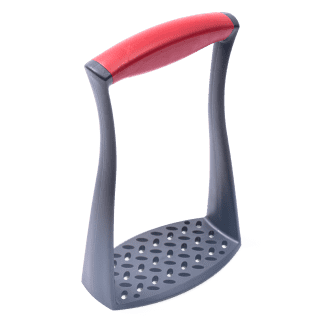



The best potato mashers are sturdy, easy to wield for long periods, and capable of mashing foods to a fairly fine texture without overworking them. Our favorite is the Misen Masher, which did a great job of processing potatoes and other foods quickly and kept hands safe and comfortable during use.
The humble potato masher is best known for processing potatoes into a relatively fine mash. (For the smoothest purées, we prefer a potato ricer or a food mill.) But a good potato masher is useful for more than just potatoes. It’s also our go-to option for turning many other solid foods such as beans into a rough mash and breaking up big chunks of cooked meat into finer, more even bits.
Our top-rated model mashes lots of potatoes quickly and evenly.
What Are the Different Types of Potato Mashers?
There are two main styles of potato mashers, each characterized by the design of its head. One type has a head that’s essentially a thick, wavy wire, and the other has a head that’s a perforated disk. We’ve also tested a few innovative models that feature coils, spring-loaded handles, and other gimmicks to supposedly improve your mashing experience. We’ve never been particularly impressed with any of these, and most were eliminated from our consideration in preliminary rounds of testing due to issues involving comfort, durability, and performance.

What to Look for
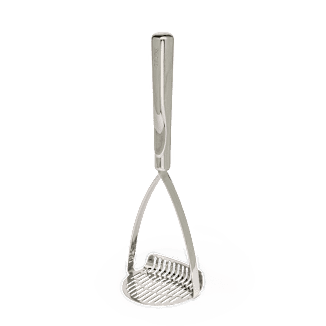
- Perforated Disks: We vastly preferred potato mashers with heads made from perforated disks to those made from wavy wires. Perforated disks mashed our potatoes, beans, and ground beef to a smoother, finer consistency than wavy wires and did so more quickly too.


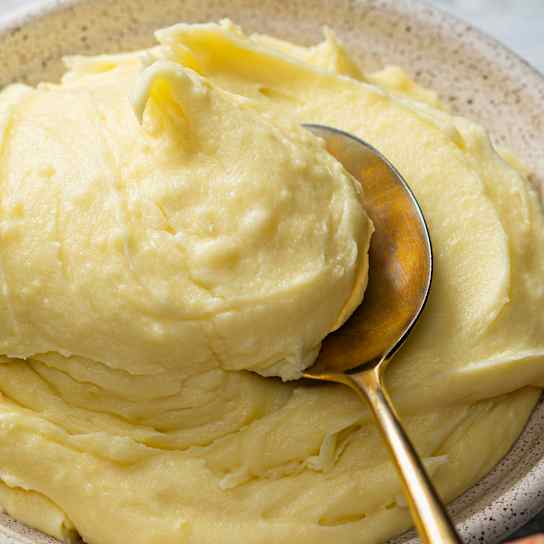
Mashers with wavy heads made uneven, lumpy potatoes (right). Mashers with perforated heads made smooth, creamy ones (left).
- Durable Metal Construction: The best models were made from thick, rigid metal that didn’t flex or warp during even the most vigorous use.
- Moderately Large Heads: We also liked models that had moderately large heads with an area of at least 9 square inches; these were large enough to cover plenty of territory quickly but not so large that they felt cumbersome in a 4-quart saucepan. The shape of the head itself didn’t matter; both round and oval heads worked well.
- Lots of Medium-Size Holes: The number and size of the holes mattered too. The best mashers had at least 50 holes measuring about 0.25 inches in diameter; these ensured a smoother, more even mash without requiring us to exert a lot of effort.
- Moderate Height: We liked models that stood at least 10 inches tall from the bottom of their heads to the ends of their handles. These kept our hands at a safe distance from the hot food as we mashed.
- Moderately Long, Grippy Handles: Handles that were at least 5 inches long allowed even the largest-handed testers to hold the mashers securely. We also liked handles that were covered in textured silicone or plastic, which allowed us to keep a secure grip amid the steam from all the food.

What to Avoid
- Wavy Heads: This style of masher never got our potatoes even close to a smooth texture. The gaps between the waves of most mashers left large chunks of untouched potato, and these mashers’ blocky footprints made it difficult to navigate the circular edges of pans, especially in smaller saucepans. If you don’t mind having really rustic, chunky potatoes, this style might be fine, but most of us want at least the option to get a finer mash.
- Plastic Heads: Some mashers had heads made from nylon or other plastics, which can melt if exposed to high heat (say, the bottom of a pot left over a burner.) We’d rather stick with something a little hardier.
- Overly Small or Large Heads: Mashers with small heads took more passes to cover a pot full of potatoes, while those with large heads were awkward and cumbersome to maneuver in small spaces.
- Too Few, Too Small, or Too Large Holes: We found we had to work harder to mash potatoes with models that had fewer than 50 holes or especially small ones. Models with holes that were too large sometimes missed a few lumps and required a few extra passes to render the potato smooth; while this wasn’t a huge dealbreaker, we’d prefer to be a bit more efficient.
- Short Height: The shorter the masher was overall, the closer our hands came to the hot potatoes, making for uncomfortable and potentially dangerous mashing.
- Short or Slippery Handles: Handles measuring 4 inches or less were hard for large-handed testers to grasp. We also weren’t wild about models with smooth metal handles, which were a touch slippery and harder to grasp.
The Tests
- Mash 2 pounds of Yukon Gold potatoes as a pretest to eliminate inefficient products
- Mash 4 pounds of russet potatoes
- Mash 14 oz cooked pinto beans in 10-inch cast-iron skillet
- Mash 1 pound beef for sloppy joes
- Test compatibility in 2- and 4-quart saucepans and a 7-quart Dutch oven
- Test with lefties and righties of different hand sizes
- Wash by hand after each test and in dishwasher 10 times
How We Rated
- Ease of Use: We evaluated the models on how comfortable they were to grip and maneuver.
- Performance: We rated the models on how quickly and smoothly they mashed different foods.
- Durability: We evaluated the models on how well they withstood extended washing and use, noting any damage.

 Buy at Amazon


 Buy at Williams Sonoma