America's Test Kitchen LogoCook's Country LogoCook's Illustrated Logo

Reviews You Can Trust.
See Why.

The Best Tart Pans

Which pans are easy to use and make the most attractive tarts?

Headshot of Sarah Sandler
By Sarah Sandler

Last Updated November 11, 2025

What You Need To Know

The best tart pans are easy to use and yield professional-looking tarts. After baking different styles of crusts and tarts, we can recommend most of the pans in our lineup. We chose two co-winners due to their wide availability and lower price point. The Fox Run 9" Loose Bottom Tart/Quiche Pan produced evenly browned crusts, and it was easy to remove the bottom and outer ring. The USA Pan 10-Inch Tart Pan produced similarly crisp, professional-looking tarts that were a touch wider but equally appealing.

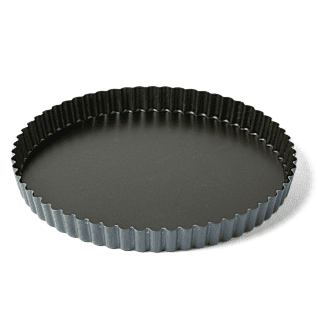
If you make a lot of tarts, a great tart pan should be part of your bakeware arsenal. Tart pans give these baked goods an attractive, fluted crust with no freehand crimping required. Unlike a classic pie plate, which is a continuous piece of glass, ceramic, or metal, tart pans typically consist of two parts: a thin, flat metal bottom and a fluted ring that you remove after baking and cooling the tart. They’re typically made of aluminum, stainless steel, or carbon steel, and almost always have a nonstick coating. There are some single-piece ceramic “tart pans” on the market, but we chose to include only metal tart pans with removable bottoms in this review because this format makes it easier to create neat, tidy slices.

Someone using their hands to pat a crust into a tart pan.Someone using their hands to place a rolled-out tart dough in a tart pan.

Metal tart pans with removable bottoms can be used to bake both pat-in-the-pan crusts and rolled-out tart doughs.

We put our tart pans to the test with two types of classic tart crusts: pat-in-the-pan (a simple dough that is pressed directly into the pan) and a more traditional pâte sucrée that is rolled out and then placed in the pan. We then used the blind-baked pâte sucrée crusts to make Classic Lemon Tarts with each pan.

What to Look for

  • Stainless Steel or Carbon Steel: Most of the pans we tested were made of stainless steel or carbon steel, which we preferred. These materials conduct heat more slowly than aluminum. Because the sides and bottom don’t heat up significantly faster than the center of the tarts, the filling of our lemon tarts was silky and evenly baked.
  • Shallow Flutes: All of the tart pans in our lineup had removable fluted rings, but the number of flutes and their depth varied from model to model. We preferred models with fairly shallow flutes, which were easier to place crusts into. These pans produced tarts with crisp-edged crusts, and they were also quicker to clean.
Someone using their hands to push tart dough into the flutes of a tart pan.
We preferred tart pans that had flutes that weren’t too deep because it was easier to shape crusts, to remove them after baking, and to clean the pans.  
  • Nonstick Coating: No one wants to go through the effort of baking a picture-perfect tart only to have it stick to the pan. Almost all the tart pans in our lineup had a nonstick coating, which helped both baked tart crusts and filled tarts to release effortlessly.

What to Avoid

  • Aluminum: Aluminum has a higher thermal conductivity than steel, which means it heats up more quickly. While this is a positive for baking sheets when we’re looking for deeply browned chicken skin or crispy potatoes, it’s problematic for tart pans. Lemon tart filling quickly bubbled on the outside before the inside could set up, due to the heat from the bottom and sides of the pan.
Four lemon tarts baked in tart pans placed on silver baking sheets.
Aluminum heats up quickly. Lemon tarts baked in aluminum tart pans (left) baked more unevenly than those prepared in stainless-steel or carbon-steel tart pans (right).
  • Deep Flutes: One of the pans in our lineup had deep flutes to produce crusts that more closely resembled a classic pie than a tart. While we didn’t mind the appearance of the crust this pan yielded, it was trickier to gently push a delicate pâte sucrée dough into the deep flutes without tearing it. It was also more difficult to reach into its crevices with a sponge in order to clean it.

Other Considerations

  • Dimensions: Standard tart pans can be anywhere from 8 to 10 inches in diameter. Although most of our tart recipes were developed using a 9-inch pan, 8-inch and 10-inch models will work just fine. Just know that tarts may be slightly thicker and taller or thinner and shorter, respectively. It’s also a good idea to pay attention to visual cues and check for doneness sooner than indicated in the recipe instructions.

The Tests

How We Rated

  • Performance: We evaluated the evenness of browning on the crust, the crispness of the fluted edges, and the quality of curd filling. 
  • Ease of Use: We assessed how easy it was to place different types of crusts in the pan and to release them after baking, as well as how easy the pans were to clean.

FAQs

First, be sure to let your tart fully cool so that the crust is firm and the filling is set. To remove the outer ring, we like to set the pan on a cylindrical object such as a can of tomatoes or a canister of oats and allow the ring to fall away. Then, to remove the tart from the metal round, run a thin, nonstick-safe spatula along the edges and lift the tart.

There are some concerns in the cookware industry about the safety of nonstick materials such as PTFE, but tart pans are typically used at lower temperatures (350 to 400 degrees Fahrenheit), which minimizes any possible risks. You should avoid using metal serving utensils or knives on your tart pans to prevent scratching the nonstick coating. We also recommend hand-washing nonstick cookware and bakeware.

Everything We Tested

Good 3 Stars out of 3.
Fair 2 Stars out of 3.
Poor 1 Star out of 3.

Highly Recommended

  • Performance
  • Ease Of Use

Co-WinnerFox Run 9" Loose Bottom Tart/Quiche Pan

This inexpensive carbon-steel tart pan produced pat-in-the-pan and pâte sucrée crusts that were evenly browned with attractive, crisp fluted edges. The lemon tart had a smooth and evenly baked filling, due in part to its steel construction that heated a little more slowly. The nonstick coating ensured that the tart crusts didn’t stick to the pan.

Model Number: 44513

Materials: Carbon steel with nonstick coating

Diameter: 9 in

Height: 1 in

Price at Time of Testing: $13.06

  • Performance
  • Ease Of Use

This inexpensive carbon-steel tart pan produced pat-in-the-pan and pâte sucrée crusts that were evenly browned with attractive, crisp fluted edges. The lemon tart had a smooth and evenly baked filling, due in part to its steel construction that heated a little more slowly. The nonstick coating ensured that the tart crusts didn’t stick to the pan.

Model Number: 44513

Materials: Carbon steel with nonstick coating

Diameter: 9 in

Height: 1 in

Price at Time of Testing: $13.06

  • Performance
  • Ease Of Use

Co-WinnerUSA Pan 10-Inch Tart Pan

Pat-in-the-pan and pâte sucrée tart crusts baked evenly in this sturdy tart pan. Its base is slightly wider than those of some other models, so we had to roll our pâte sucrée a hair thinner to fit well. Similarly, fillings were a tiny bit thinner than those made in narrower tart pans; especially if using a recipe that calls for an 8- or 9-inch tart pan, you should check for doneness a few minutes early. The pan produced a perfect lemon tart with a smooth, glossy finish. It was also a breeze to remove the ring and the bottom after baking.

Model Number: 1089TT-1

Materials: Aluminized steel with nonstick silicone coating

Diameter: 9.25 in

Height: 1 in

Price at Time of Testing: $20.64

  • Performance
  • Ease Of Use

Pat-in-the-pan and pâte sucrée tart crusts baked evenly in this sturdy tart pan. Its base is slightly wider than those of some other models, so we had to roll our pâte sucrée a hair thinner to fit well. Similarly, fillings were a tiny bit thinner than those made in narrower tart pans; especially if using a recipe that calls for an 8- or 9-inch tart pan, you should check for doneness a few minutes early. The pan produced a perfect lemon tart with a smooth, glossy finish. It was also a breeze to remove the ring and the bottom after baking.

Model Number: 1089TT-1

Materials: Aluminized steel with nonstick silicone coating

Diameter: 9.25 in

Height: 1 in

Price at Time of Testing: $20.64

  • Performance
  • Ease Of Use

Matfer Bourgeat Exopan Steel Tart Mold with Removable Bottom, Nonstick, Fluted, 9½"

This steel tart pan made pat-in-the-pan and pâte sucrée tart crusts that were golden brown and had nice, neat edges. In it, we made a beautiful lemon tart with a silky filling and crisp, professional-looking fluted edges.

Model Number: 332225

Materials: Stainless steel with nonstick coating, enameled exterior

Diameter: 9 in

Height: 1 in

Price at Time of Testing: $34.25

  • Performance
  • Ease Of Use

This steel tart pan made pat-in-the-pan and pâte sucrée tart crusts that were golden brown and had nice, neat edges. In it, we made a beautiful lemon tart with a silky filling and crisp, professional-looking fluted edges.

Model Number: 332225

Materials: Stainless steel with nonstick coating, enameled exterior

Diameter: 9 in

Height: 1 in

Price at Time of Testing: $34.25

  • Performance
  • Ease Of Use

Williams-Sonoma Goldtouch Pro Tart Pan with Removable Bottom

This tart pan made attractive pat-in-the-pan and pâte sucrée crusts. Carbon steel heats up a little more slowly than aluminum, and as a result, the lemon tart we made in it had a beautiful, smooth filling. The nonstick coating made the finished tart easy to remove.

Model Number: N/A

Materials: Carbon steel with nonstick coating

Diameter: 9.25 in

Height: 1 in

Price at Time of Testing: $24.95

  • Performance
  • Ease Of Use

This tart pan made attractive pat-in-the-pan and pâte sucrée crusts. Carbon steel heats up a little more slowly than aluminum, and as a result, the lemon tart we made in it had a beautiful, smooth filling. The nonstick coating made the finished tart easy to remove.

Model Number: N/A

Materials: Carbon steel with nonstick coating

Diameter: 9.25 in

Height: 1 in

Price at Time of Testing: $24.95

Not Recommended

  • Performance
  • Ease Of Use

Nordic Ware Quiche and Tart Pan

This pan, which is marketed for both tarts and quiches, was double the height of the other pans in our lineup. The tall walls had no noticeable effect on the quality of tarts we baked. Its fluted edges were deeper than a traditional tart pan, presumably in an effort to make a crust that more closely resembles a classic crimped pie. This made it more difficult to gently lay a delicate pâte sucrée crust into the pan without tearing it. The deep flutes also made it trickier to get into the grooves with a sponge and clean off any lingering crumbs or buttery residue when hand-washing the pan. Because this pan is made of aluminum, which conducts heat more quickly than steel, the lemon tart filling baked unevenly and looked a little bubbly and messy.

Model Number: N/A

Materials: Aluminum with silicone nonstick coating

Diameter: 8.5 in

Height: 2 in

Price at Time of Testing: $18.00

  • Performance
  • Ease Of Use

This pan, which is marketed for both tarts and quiches, was double the height of the other pans in our lineup. The tall walls had no noticeable effect on the quality of tarts we baked. Its fluted edges were deeper than a traditional tart pan, presumably in an effort to make a crust that more closely resembles a classic crimped pie. This made it more difficult to gently lay a delicate pâte sucrée crust into the pan without tearing it. The deep flutes also made it trickier to get into the grooves with a sponge and clean off any lingering crumbs or buttery residue when hand-washing the pan. Because this pan is made of aluminum, which conducts heat more quickly than steel, the lemon tart filling baked unevenly and looked a little bubbly and messy.

Model Number: N/A

Materials: Aluminum with silicone nonstick coating

Diameter: 8.5 in

Height: 2 in

Price at Time of Testing: $18.00

  • Performance
  • Ease Of Use

Fat Daddio’s Anodized Aluminum Tart & Quiche Pan, 9½"

This tart pan was the only model in our lineup that didn’t have a nonstick coating. Unfortunately, crusts and tarts stuck to its surface and were difficult to remove. Its aluminum construction, which heats up quickly, resulted in lemon tart filling that baked unevenly and was a tad grainy.

Model Number: PFT-95

Materials: Anodized aluminum

Diameter: 8.25 in

Height: 1 in

Price at Time of Testing: $12.31

  • Performance
  • Ease Of Use

This tart pan was the only model in our lineup that didn’t have a nonstick coating. Unfortunately, crusts and tarts stuck to its surface and were difficult to remove. Its aluminum construction, which heats up quickly, resulted in lemon tart filling that baked unevenly and was a tad grainy.

Model Number: PFT-95

Materials: Anodized aluminum

Diameter: 8.25 in

Height: 1 in

Price at Time of Testing: $12.31

America's Test Kitchen Accolades Badge

Reviews You Can Trust

The mission of America’s Test Kitchen Reviews is to find the best equipment and ingredients for the home cook through rigorous, hands-on testing. We stand behind our winners so much that we even put our seal of approval on them. Have a question or suggestion? Send us an email at atkreviews@americastestkitchen.com. We appreciate your feedback!

The Expert

Author: Sarah Sandler

Sarah Sandler

Associate Editor, ATK Reviews

Sarah is an associate editor for ATK Reviews who is deeply passionate about anchovies and sourdough bread.

Sarah Sandler is an associate editor for ATK Reviews. Before joining ATK, she was an intern for Saveur and Chef Daniel Boulud, and spent a summer baking at Levain Bakery. She is deeply passionate about anchovies (both eaten plain and in/on other foods), she bakes sourdough bread weekly, and she always carries a travel-size tin of Maldon salt.

*All products reviewed by America’s Test Kitchen are independently chosen, researched, and reviewed by our editors. We buy products for testing at retail locations and do not accept unsolicited samples for testing. We list suggested sources for recommended products as a convenience to our readers but do not endorse specific retailers. When you choose to purchase our editorial recommendations from the links we provide, we may earn an affiliate commission. Prices are subject to change.

Reviews You Can Trust.
See Why.

This is a members' feature.
America's Test Kitchen LogoCook's Country LogoCook's Illustrated Logo