
 Buy at Amazon
Brewing cold-brew coffee is traditionally a slow, mostly hands-off process. We tested both manual models and automatic machines. The Toddy Cold Brew System, a no-frills manual coffee maker, is our favorite. It is easy to use and brews well-balanced, fruity cold-brew coffee concentrate that can be diluted to taste.
Cold-brew coffee has attracted much fanfare and even converted non-coffee drinkers thanks to its smooth body and rounded taste. The traditional process of making cold-brew coffee is straightforward: Steep coarsely ground coffee in room-temperature or cold water for 12 to 24 hours, and then drain the liquid from the grounds. The result is a concentrated coffee that can be diluted in a ratio of 1 part concentrate to 1 to 2 parts water, milk or dairy alternatives, or poured over ice. Compared to coffee brewed with hot water, cold brew tastes more floral and fruity and less sour, according to a study by the Coffee Science Foundation.

Cold-Brew vs. Iced Coffee: What's the Difference?
Both styles of coffee are delicious but they differ majorly in taste.
Learn MoreYou can hack an at-home cold-brew maker with a French press, but using a dedicated machine will be easier and tidier. Cold-brew coffee makers come in a few main styles: drawdown, strainer, and electric. Each style varies considerably in size, shape, and design, so it’s important to follow the manufacturers’ recommended coffee-to-water ratios, as well as their instructions for how to add the water to the grounds.
How Different Styles of Cold-Brew Makers Work
Drawdown-style brewers feature a bucket-like container and a carafe. For most models, you seal the bucket with a rubber plug (or flip a switch), insert a reusable disk-shaped wool or felt filter into the bucket, and then add a paper coffee filter and the coffee grounds. To wet the grounds, you gradually pour water over them (alternatively, you can pour all the water at once and then stir the grounds); they ideally become fully immersed in water and have room to expand as they absorb it. Eventually, you dispense the coffee from the bucket into the carafe by pulling the plug or flipping the switch.


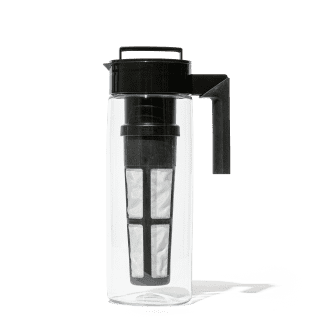
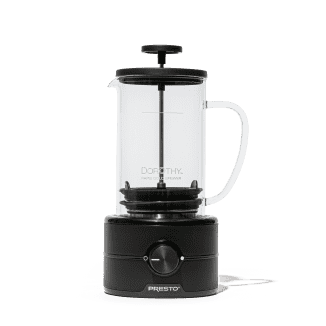
We tried three styles of cold-brew coffee makers: drawdown (left), strainer (middle), and electric (right).
Strainer-style models resemble a teapot with a narrow, infuser-like basket for the coffee grounds. Instead of draining the coffee from the grounds—a hands-off but somewhat tedious step—you simply remove the brew basket, a feature that has made this style increasingly popular.
Lastly, electric models shorten the steeping process (which for all other machines ranges from 12 to 24 hours) by spinning coffee grounds at high speed. This method promises to produce cold-brew coffee in as few as 5 minutes for one model, which, alas, proved too good to be true (more on that later).
Testing Cold-Brew Coffee Makers
To find the best cold-brew coffee maker, we rounded up a mix of all three styles at various price points. We brewed batches of coffee of various strengths and recorded the Total Dissolved Solids (TDS) of every sample we brewed. A higher TDS means there are more flavor compounds and other dissolved solids in the coffee, which is an indication of strength—though that’s not the only determining factor in a successful cold brew. Coffee with TDS levels that are too high can taste awful. The sensory experience matters the most, so we also held randomized tastings with colleagues and coffee professionals from Counter Culture Coffee and Broadsheet Coffee Roasters. We calculated the cost of 8-ounce servings of coffee, based on dilution suggestions provided by manufacturers. Read on to find out more about cold-brew coffee makers and which one to buy.

What to Look For
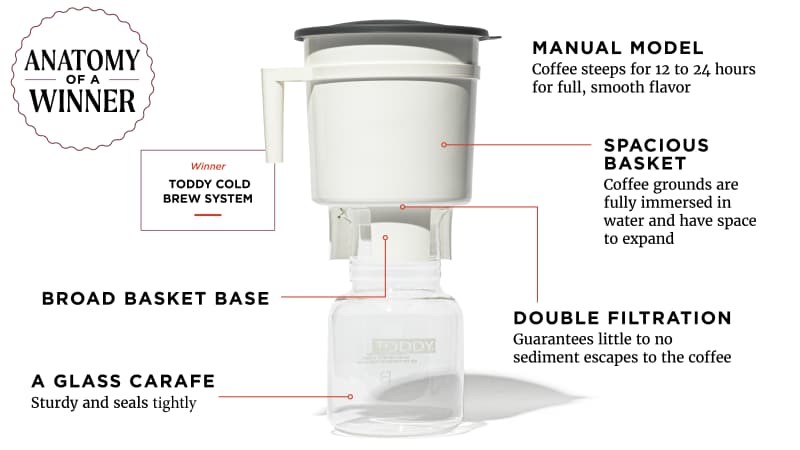
- Manual Models: Both types of manual models, drawdown and strainer, allow you to let coffee grounds steep in water for an extended period of time, which results in optimal flavor extraction.
- Spacious Brewing Baskets: We preferred drawdown-style models with wide brewing baskets that allowed us to totally immerse the grounds in water by gradually pouring water over the grounds, stirring the grounds in water, or both. A big brewing basket also gave the grounds enough space to expand and release their flavor compounds, resulting in a flavorful cup. The next-best options were strainer-style baskets whose designs allowed us to fully wet the grounds before adding them to their carafes.

- Brewing Basket with a Broad Base: Weighing the coffee grounds and water when making cold brew ensures that you get the perfect ratio. You typically have to add coffee grounds to the filter basket before inserting the basket into the carafe, so we preferred sturdy filters with broad bases that could stand upright on their own. If the filter baskets were tall and skinny, they were easy to knock over when we placed them on our scale.
- Double Filtration: All the cold-brew coffee makers we tested had at least one filter. Our favorites had two. These filters are made of various materials, such as stainless steel, plastic, paper, and wool. We found that models with two layers of filtration produced sediment-free and clean-tasting coffee.

- A Sturdy Glass Carafe: With some drawdown-style models, you steep the coffee in a bucket-shaped container and then place it on top of a carafe to drain, so it’s important that this carafe is sturdy. One drawdown-style model had a light plastic carafe that felt tippy when coffee was draining into it.
- A Compact Carafe: All models produced large batches of cold-brew coffee that can be consumed over the course of several days. With some models, you place the brewing carafe in the refrigerator after you remove the coffee grounds. With others, you drain the coffee into a separate carafe. In both cases, we preferred compact carafes that were easy to fit in the refrigerator.
What to Avoid
- Electric Models: We found mechanically made cold brew to be watery in taste, muddy in appearance, and gritty in mouthfeel. This is because the quick spin doesn’t fully extract the complex flavors in the grounds. However, oils and sediment came out in the spinning process quite easily, making the coffee cloudy. One model made passable coffee but only after we followed optional instructions in the manual to finish steeping the coffee in the refrigerator overnight—negating the time savings promised by the automatic process. Unfortunately, the grittiness remained in the coffee even after overnight steeping.

- Narrow Filter Baskets: Narrow filter baskets constrain coffee grounds in a tiny space, preventing them from being fully immersed in the water and resulting in unextracted, weak coffee with too low a TDS level. The narrow design also posed a cleaning headache, as the long, narrow tubes were hard to reach into.
- Messy Drawdown Release Mechanisms: With two of the drawdown-style models, you release a plug from the underside of the brewing buckets before quickly placing them atop their carafes to drain. With one model, coffee gushed out as soon as we pulled the plug, making a mess. The easiest-to-use drawdown model had a simple switch that minimized spillage.
- Many Small Parts: Some models had too many small parts for us to keep track of. We preferred models with fewer parts.
The Tests:
- Make four batches of cold-brew coffee brewed for various lengths of time (from 12 to 24 hours), according to manufacturers’ instructions
- In a randomized tasting, have a panel of tasters, including coffee professionals from Counter Culture Coffee and Broadsheet Coffee Roasters, sample and rate the flavor and body of the coffee brewed in each model
- Wash each cold-brew coffee maker between uses for a total of 10 times
- Record Total Dissolved Solids (TDS), a measure of coffee particles suspended in the water that contain flavor compounds, of each batch
- Calculate the approximate cost per 8-ounce serving of coffee, using manufacturers’ strongest recommended dilution ratio or a 1:1 ratio of concentrate to water when no recommended ratio was provided
How We Rated
- Coffee Quality: We evaluated the quality of the coffee we brewed and rated the coffees in a randomized taste test.
- Ease of Use: We rated how easy each coffee maker was to use. We also took into account how well written each user manual was.
- Construction: We evaluated the build quality of each model, including whether there were too many little parts to keep track of.
- Cleanup: We assessed how easy it was to clean each model.