

 Buy at ThermoWorks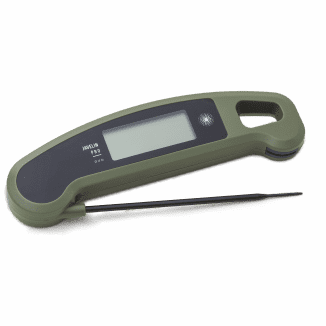
 Buy at Amazon
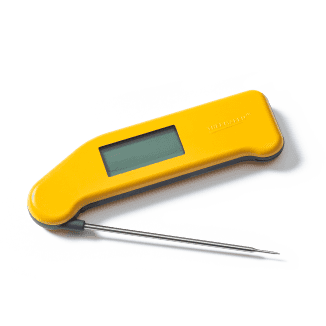
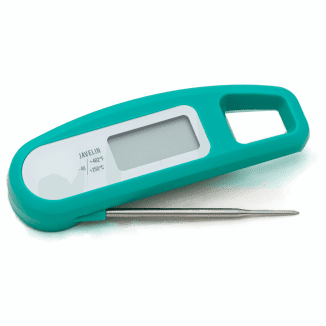
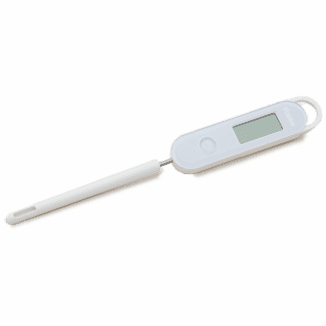
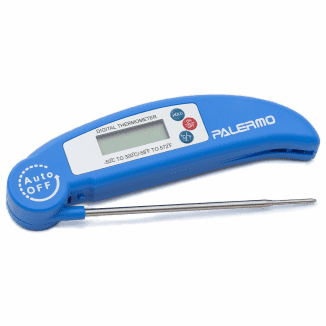
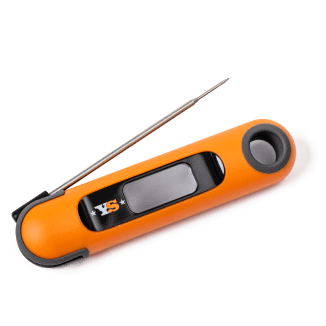
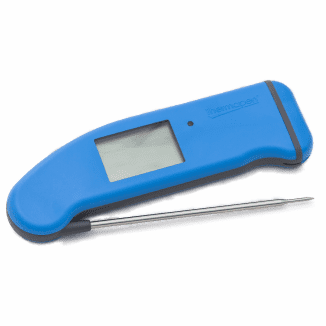
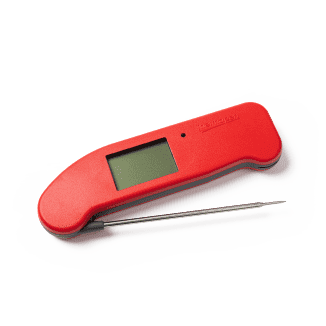
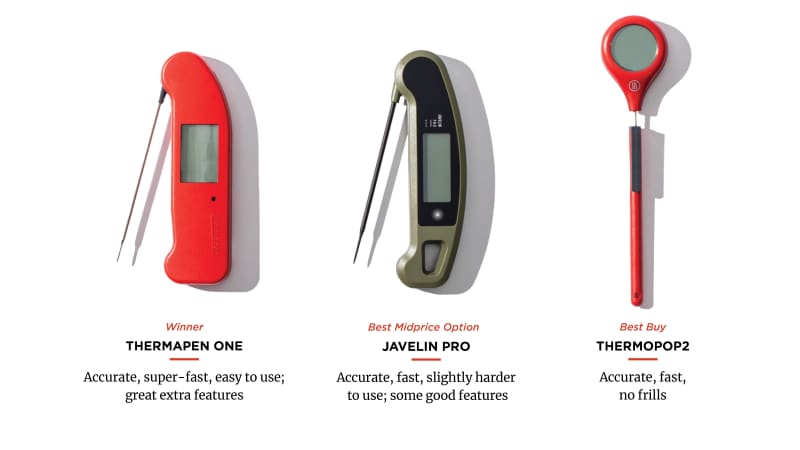
The ThermoWorks Thermapen ONE is our favorite instant-read thermometer and has been for years. It’s fast, accurate, and easy to use. It has all the handy extra features we like (a long folding probe, a simple backlit display that rotates depending on your orientation, and an automatic sleep mode) and none that we don’t. It’s expensive, but it’s incredibly durable and should last a long time. Our favorite midprice option is the Lavatools Javelin PRO Duo. It’s a tad slower and a tiny bit less accurate than our top choice, but it still has many of the features we like in a thermometer. Finally, the best inexpensive option is the ThermoWorks ThermoPop 2. This no-frills model is quick, accurate, and dead simple to use—a bargain for the price.
Prone to dropping your Thermapen? You might benefit from an extra layer of protection from the Thermapen ONE Silicone Boot, a special cover for it. Check out our full review here.
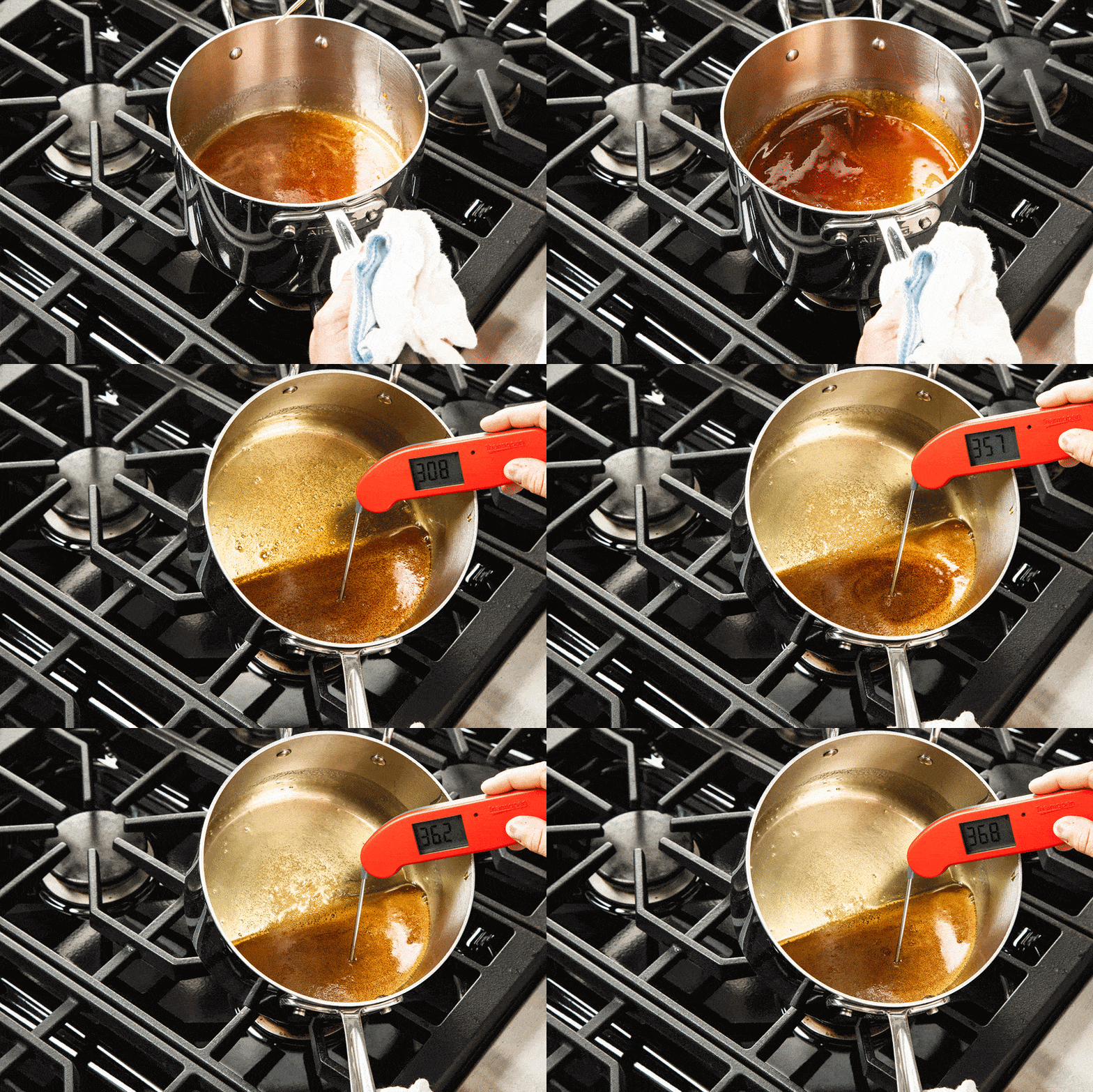
Every cook should have an instant-read thermometer. A good thermometer is a kitchen essential that takes the guesswork out of cooking and baking. It reads the internal temperature of your food quickly, letting you know exactly what’s going on in your food as it heats up and making it less likely that it’ll over- or undercook. Many of us put out our thermometers to work on a daily basis, using them to take the temperature of everything from expensive prime rib roast to simple caramel sauce.
There are different types of instant-read thermometers, but we stopped evaluating old-school dial thermometers long ago—they’re slow, imprecise, and often hard to read. For quick, accurate measurements, digital models are the only way to go.
We’ve tested dozens of digital instant-read thermometers over the years. All the models we tested have two basic parts: a metal probe that sticks into the food and a handle that houses any controls. And there can be a big difference between the best models and the worst. Here’s what we’ve learned.

What to Look For
- Accuracy: If your thermometer is inaccurate, what's the point? We prefer models that are accurate within 1 degree of the correct temperature, no matter whether we’re temping a custard, frying oil, or a steak.

If a thermometer's inaccurate, what's the point?
- Speed: The best instant-read thermometers read in just 1 to 3 seconds, allowing us to get in and check the temperature quickly, so our hands didn’t have to hover too long over a hot roast or pot of bubbling sauce or oil.
- Large, Simple, Rotating Displays: We like thermometers with large, easy-to-read displays that show the temperature alone in large numerals, with no unnecessary additional buttons or data to clutter the interface. We also preferred those that displayed the temperature in whole numbers rather than decimal points, which we found distracting; after all, it doesn't matter if your steak is cooked to 125 or 125.2 degrees. And we liked displays that were positioned toward the probe side of the handle, since we didn’t need to adjust our grip in order to read them, as we did with displays toward the back of the handle. Finally, we appreciated displays with digits that rotate as you move the thermometer; these are great for lefties and anyone who needs to adjust their grip during use so that they don't have to read the temperature backward or upside down. Some models rotated the digits two ways, flipping them 180 degrees; others rotated four ways, so the digits could face all sides of the screen. But our favorite model went a step further: You can actually choose whether the display rotates two or four ways or opt to lock it in a single direction.

- Large, Grippy Handles: The best models had long, broad handles that were easy for hands of all sizes to hold and could be held in different ways. We also liked models that had handles with rubbery features, as these were slightly less slippery to hold, especially when our hands were wet.
- Moderately Long, Narrow Probes: We preferred probes that were at least 4 inches long; they could reach into the center of a roast or a large pot of sauce or oil while keeping our hands farther away from the heat. Narrow probes put smaller holes in food, so less juice leaked out of roasts and everything we temped looked more presentation-worthy than foods we’d poked with thicker probes.
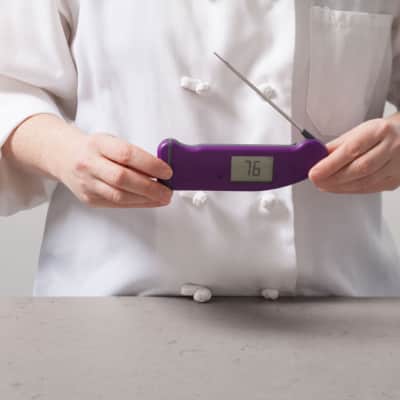
How to Test Digital Thermometer Accuracy with Ice Water
You don't need lab-calibrated tools to find out if your kitchen thermometer is accurate. This simple test with ice water does the trick.
Learn MoreNice to Have
- Simple Folding Probes with Moderate Tension: We had a slight preference for thermometers with probes that unfolded like a switchblade. For one thing, folding probes were more compact and easy to store than models with straight, fixed probes, which were often a bit more ungainly and had separate probe sheaths to keep track of. Among folding thermometers, we preferred those that used a single step for powering on: Simply swing open the probe and go. The other thermometers all required two or three steps to turn them on: Open the probe and press the power button or, in the worst case, press a button to release the probe, open the probe, and then press the power button. Tension also mattered: We preferred models that were stiff enough for us to securely set them at offset angles but not so stiff that they were a bear to open and close. And while most of these switchblade-style probes opened to 180 degrees, some went further, to 225 degrees, meaning that we could use it at an offset angle in both our right and left hands—a nice perk that kept our hands out of the pot and even farther away from the heat.

- A Backlight: We liked models that had displays with a backlight; we found these useful for grilling at night or seeing temperature as we reached into dark ovens. Several models had backlights, but not all of them turned on automatically in low-light conditions. Another model, from OXO, didn't have a backlight but instead had a black screen with white digits, making it easy to read even in low light.
- Sleep Mode: This feature allows thermometers to turn off when not in use, prolonging battery life. While several models we tested have this ability, only a few had both sleep mode and an auto wake-up feature so that they turn on again as soon as they're moved (if the probe remains open). This prevents you from having to stop what you're doing, close the probe, and open it back up to power on the thermometer.

What to Avoid
- Inaccuracy: The most imprecise models were off by about 2 degrees—not enough to ruin a dish but not exactly confidence-inspiring.
- Slow Readouts: Our least favorite thermometers took from 4 seconds to more than 20 seconds to provide a temperature reading. Even 8 seconds may not seem like much, but when our hands were hovering over a steaming pot of boiling water or bubbling caramel sauce, it felt like an eternity.
- Tiny, Slippery, or Sloped Handles: These were hard to grip comfortably, giving us nowhere to rest our fingers; we could only pinch-grip them with our thumb and pointer finger, which felt a bit dainty.
- Short Probes: Thermometers with probes measuring 3 inches or less weren’t able to reach into the center of a large roast or a broad steak. They also put our hands closer to uncomfortably hot food.

How to Use a Digital Thermometer and Never Overcook Meat Again
The only things standing between you and a perfectly cooked steak are a must-have kitchen tool and some invaluable kitchen knowledge.
Learn MoreOther Considerations
- Type of Temperature Sensor: Digital thermometers for home cooks generally use one of two types of sensors to measure temperatures: a thermocouple or a thermistor. A thermocouple is essentially two wires from different metal alloys that are welded together (“coupled”). The wires produce a voltage that changes in response to temperature; the thermometer takes that information and converts it into the temperature you see on the display. A thermistor is a metal oxide semiconductor embedded in a small metal chip or disk; it registers changes in resistance (opposition to the flow of current through it) as the temperature changes and converts that data into the temperature you see on the display. In general, thermocouples are capable of registering a larger range of temperatures (up to 1000 degrees F) and are usually faster than thermistors, though they’re not quite as accurate. Thermistors are typically more accurate, but over a smaller range of temperatures (most can only handle those between 392 and 572 degrees F), and can be slower, in part because the sensor itself is stuck inside that thicker housing; it takes a bit more time for temperature changes to be conducted all the way to the sensor. In practice, however, we’ve found that these differences with the type of sensor don’t matter too much for home cooks. Thermometers made with both types can be fast and accurate enough for use in the kitchen.
The Tests:
- Test accuracy in a ice bath
- Test accuracy over time using a sous vide machine
- Prepare Easy Caramel Sauce
- Prepare Slow Roasted Beef
- Prepare Pan Seared Inexpensive Steak
- Prepare Easy Grill-roasted Butterflied Chicken
- Ask additional users to test each model
How We Rated
- Accuracy: We evaluated the accuracy of each thermometer in an ice bath at 32 degrees, in a sous vide water bath set to 125 degrees (the temperature of a medium-rare steak), and in boiling water at 212 degrees; models that were within 1 degree of accuracy at each temperature rated highest; any thermometer within 2 degrees received a fair rating, and those that were more than 2 degrees off the target temperature received a poor rating.
- Speed: We timed how long it took for each thermometer to read the temperature in ice water, boiling water, and a sous vide water bath at 125 degrees (medium-rare for a steak); those that read in 6 seconds or less rated highest.
- Ease of Use: We rated how easy and comfortable each model was to use. We preferred those with spacious, grippy handles; long probes; and minimal buttons. Models with automatic wake-up, easy-to-read displays, and a single step for turning on and off also rated highest.
- Durability: We monitored the thermometers throughout testing for both functional and cosmetic damage; those that emerged looking and operating like new rated highest.


 Buy at Fireboard