
 Buy at Amazon
- Pour peppercorns from 18-ounce bulk container into pepper mill
- Pour dried rosemary from 6-ounce bulk container into 1-ounce spice jar with 1½-inch opening
- Pour chili powder from 20-ounce bulk container into 1.9-ounce spice jar with 1½-inch opening
- Pour barbecue sauce from 1.5-quart saucepan into 16-ounce squeeze bottle
- Pour olive oil from 1-gallon container into 16.9-ounce bottle
- Wash in dishwasher 10 times
- Place in 4-inch-high kitchen drawer to assess ease of storage
- User testing
When you need to transfer a lot of food or liquid from one container to another, you reach for a funnel—or else you’re likely to slosh oil or spill peppercorns all over your counter. You pour food or liquid into the funnel’s wider opening, which then narrows into a spout, directing the goods into the intended receptacle. This small tool has a major payoff: It eliminates spills and minimizes waste—but only if you have a good funnel.
Since we last tested, our winner, the Progressive Collapsible Funnel, has been discontinued, and new models are now on the market. We selected seven funnels priced from $4.41 to $14.19, using each one to transfer foods and liquids with different textures into containers of varying sizes, including peppercorns into a pepper mill, herbs and spices from bulk containers to spice jars, thick barbecue sauce from a saucepan to a squeeze bottle, and olive oil from a gallon-size jug to a smaller bottle. We also tested how easy the funnels were to store, how durable they were, and how well they suited a range of testers. Three models came in sets, so we tested any funnel in each set that was 1 cup or larger; we’ve found in previous testings that funnels with a smaller capacity are less versatile, as thicker liquids and peppercorns easily overwhelm them.
Our testing proved that two characteristics are essential to a great funnel: stability (the degree to which a funnel wobbles during use) and flow (how easily liquids and foods move through the funnel).

Collapsible funnels and models with shorter spouts require stabilization to prevent spills.
Longer Spout, Less Wobbling
Funnels with longer spouts, at least 1½ inches long, were more stable. These spouts served as an anchor in vessels to prevent wobbling, making them feel secure enough to use hands-free. Funnels with shorter spouts felt unsteady, like they might tip over at any second, and they were harder to use because we always had to stabilize them with one hand.
For Good Flow, Focus On Nozzle Diameter
A funnel’s chief purpose, however, is to promote flow and keep everything moving with no backups or spills. The key to this was the size of the spout’s opening. The narrowest acceptable opening was ⅜ inch in diameter; any smaller and we had to whack, vigorously shake, or for one silicone model, milk it like a cow to get things moving. Still, oversize openings were also a problem. Two models had nozzles that measured more than 1 inch wide; this was too large to fit neatly inside all the containers we tested, and we often had to perch these models atop containers or place them outside the containers’ rims. This led to more messes.

The size of a funnel’s spout impacts its performance; a narrow spout can impede flow while a spout that’s too wide can prevent the funnel from sitting securely in the container.
The shape of the spout’s opening mattered, too. One funnel’s nozzle wasn’t just oversize—it was also slanted. When we perched it atop a spice jar, it didn’t sit flush and we ended up with chili powder all over the counter. Flat nozzles were preferable. Even if they sat on the rim of the container instead of inside, we were able to create a solid seal by holding the nozzle firmly against the container rim and sometimes wrapping our hand around the two.
- Spout at least 1½ inches long for hands-free use
- Medium spout diameter (⁹⁄₁₆ inch) for good flow and tidy transfers
- Minimum 1-cup capacity to prevent overflow
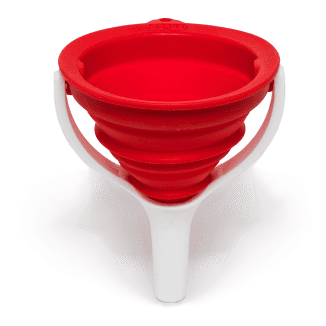
- Collapsible for easy storage
Our favorite funnel had an ideal-size opening, at ⁹⁄₁₆ inch. It was wide enough for foods to flow through with relative ease (with a few taps to get herbs and spices moving) but still narrow enough to fit inside an array of containers for tidy transfers.
Durability also mattered. Most funnels withstood frequent washings, but we noticed that one funnel with vertical silicone strips showed signs of flaking near the spout. We downgraded it because we didn’t want to risk getting bits of silicone in our food.
The Best Funnel For Your Kitchen
In the end, one funnel was noticeably better than the rest. The Prepworks Thinstore Collapsible Funnel ($9.11) had a long spout that made it stable enough to use hands-free and a nozzle that was wide enough to allow foods and liquids to flow through fairly easily. It also held up well to numerous washings. And because funnels are notoriously difficult to store, we especially liked that this one collapsed from a height of about 4½ inches to approximately 1¾ inches—compact enough to stash in a kitchen drawer.