

 Buy at Amazon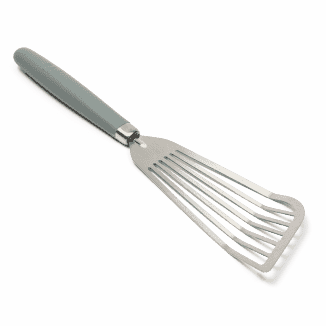
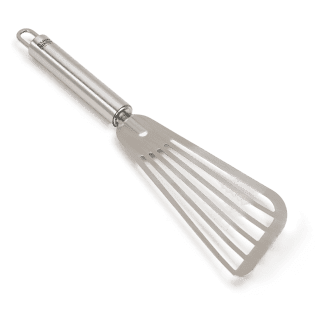
Metal spatulas are ideal for flipping and maneuvering food in and out of metal cookware. We prefer fish spatulas to conventional metal spatulas because they have long, slim heads that are thin and flexible and relatively short, easy-to-control handles. The Wüsthof Gourmet 7" Slotted Fish Spatula won our top spot with its well-proportioned, moderately flexible curved head and comfortable handle. Our Best Buy, the Misen Stainless Steel Fish Spatula, has a handle coated in especially soft, comfortable silicone; its head is designed very similarly to our winner’s but is the slightest bit narrower, which gives it slightly less surface area to hold larger foods.

A good metal spatula is an essential component of any cook’s toolkit. Often referred to as a turner or flipper—likely to avoid confusion with thicker silicone spatulas that are used to fold and scrape—it’s used to flip or transfer foods whenever we’re working with metal cookware or bakeware. (When cooking in more delicate nonstick pans, we prefer plastic spatulas.)


We reach for metal spatulas when grilling or cooking in cast iron, stainless steel, or carbon steel.
What Are the Different Types of Metal Spatulas?
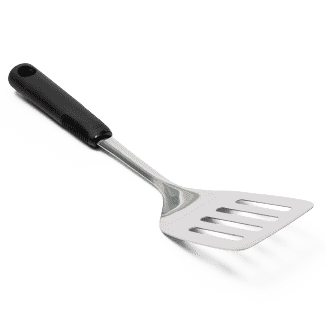
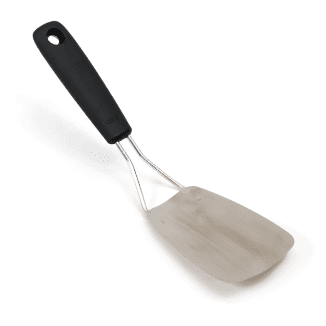
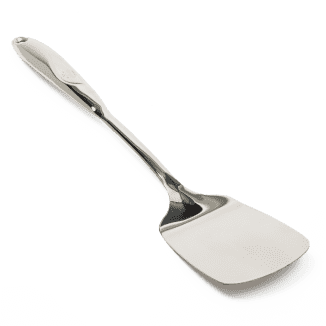
Half of the spatulas in our lineup were conventional metal ones that featured sturdy square or rectangular heads, some slotted and some solid. The other half were fish spatulas. Often found in restaurant kitchens, these spatulas feature long, tapered, slotted heads; as their name implies, they are traditionally used to lift and support slender fish fillets. Their unique head shape makes them versatile beyond handling just fish, however; they excel at flipping and moving foods of different shapes and sizes, from wide but delicate pancakes to hefty burgers. We think fish spatulas are the overall superior choice due to several key factors, which we’ve outlined below.

What to Look for
- Spacious, Long Heads: In general, we preferred spatulas with plenty of surface area for holding and flipping food, which usually meant fish spatulas. The heads of fish spatulas are roomy—on average, they provide about 12 square inches of surface area among the models we tested, compared to 11 for the conventional models. Fish spatula heads are also particularly long; the models in our lineup had heads that measured about 5.5 inches on average. This length lets them act as extensive landing strips with enough space for food to travel along.


Bigger spatula heads (usually those from fish spatulas) provided more surface area for food to travel along.
- Flared Head Shapes: Fish spatulas have a unique head design, with a slim profile that tapers in toward the base. This shape allows them to nimbly navigate even the tightest spaces, such as the 8-inch cast-iron skillet we used to make over-easy eggs.
- Moderately Thick, Flexible Heads: Most of the fish spatulas we tested had heads that were from 0.8 to 0.9 millimeters thick, making them thin and flexible enough for us to slip easily and precisely under food without tearing or bumping it. At the same time, the heads were thick and substantial enough to support heavier foods and do a little scraping when foods stuck.
- Short Handles: Shorter handles (measuring from 4.5 to 5 inches long) allowed us to move our hands closer to the action and gave us more control for flipping and scooping food. All of the fish spatulas we tested had shorter handles, adding to this category’s overall superiority.


Short handles (left) cramped large hands, while long handles (right) put our hands too far from the food, reducing our control. Our favorite handles (center) were big enough for large hands and made of grippy silicone or plastic.
- Moderately Thick, Textured Handles: We also prized spatulas with handles of moderate thickness, about 2.5 to 3.25 inches around. Our favorite handles were made of textured wood or plastic, which were easy to grasp—especially when wet or greasy.
Nice to Have
- Curved Heads: Not all fish spatulas were created equal. Among them, we preferred models whose heads curved upward slightly, affording more leverage for prying up roasted potatoes or lifting the corner of a pancake to check its browning. These curved heads also positioned our hands higher, which put us at a safer distance from hot pans.

What to Avoid
- Small, Short Heads: The heads of the conventional metal spatulas were squat and rectangular, which made them more awkward to maneuver in confined spaces. Small heads caused long fish fillets and large pancakes to drape over the spatulas’ sides a bit precariously. It was also easy for foods to hit the back ends of shorter heads as we slid the spatulas underneath, denting softer items such as pancakes or cookies and knocking burgers and other heavier foods backward onto the cooking surface.
- Thick or Ultrathin Heads: Most of the conventional spatulas in our lineup had heads that were too rigid and thick (measuring more than 1 millimeter), which made it harder to get them under food without damaging it. One conventional model was too flexible and thin (0.2 millimeters), and it buckled slightly when we lifted half-pound pub burgers.
- Long Handles: The handles on most conventional spatulas were simply too long—about 8 to 10 inches long on the most unwieldy models—leaving us to poke clumsily at food from afar.
- Undersized, Oversized, or Smooth Handles: Thinner, flatter handles cramped our hands after extended use, and thicker handles were hard for smaller-handed testers to hold. Smooth metal or hard plastic handles grew slick with water or grease and became difficult to grip and control.
The Tests
- Flip and remove over-easy eggs from 8-inch cast-iron skillet
- Flip and remove pancakes from 12-inch cast-iron skillet
- Flip and remove fillets of sole from 12-inch carbon-steel skillet
- Flip and remove ½-pound pub burgers from 12-inch cast-iron skillet
- Flip and remove home fries roasted on half-size rimmed baking sheet
- Transfer soft sugar cookies baked on rimmed baking sheet to wire rack
- Have users of different hand sizes and dominant hands use each model to flip and transfer pancakes
How We Rated
- Performance: We assessed how well the spatulas flipped foods in—and removed foods from—multiple cooking vessels.
- Ease of Use: We evaluated how nimbly the spatulas maneuvered around cookware of different sizes and shapes, how comfortable they were to hold, and how much control they gave us.