America's Test Kitchen LogoCook's Country LogoCook's Illustrated Logo

Reviews You Can Trust.
See Why.

The Best Jiggers

To find the best tool for measuring spirits for cocktails, we had to rejigger our expectations.

Headshot of Miye Bromberg
By Miye Bromberg

Last Updated November 26, 2025

Editor&aposs Note:Update, November 2025:

We tested several additional jiggers, including the redesigned and metal versions of our former favorite. We now have two top choices: our longtime favorite, the OXO Good Grips Mini Angled Measuring Cup, and its newly reviewed metal sibling, the OXO SteeL Angled Jigger.

What You Need To Know

The best jiggers allow you to measure liquids accurately, easily, and neatly. We have two top choices: the OXO Good Grips Mini Angled Measuring Cup and the OXO SteeL Angled Jigger. The two models are nearly identical and handle and measure liquids equally well. The plastic version is lighter-weight and has a few more useful volume measurement markings. (In addition to fluid ounces, it also measures tablespoons, cup fractions, and milliliters, making it handy not only for cocktails but also for measuring liquids for baking and cooking projects.) The metal version is heavier, which gives it a solidity that some actually preferred, and its measurement lines are restricted to ounces and tablespoons.

A jigger is a handy bar tool used to measure small volumes of liquids for cocktails. There are several different types. Conventional jiggers are roughly hourglass- or bow tie–shaped, with one end designed to measure a larger volume (often 1.5 or 2 ounces) and the other to measure a slightly smaller one (often 1 ounce). They sometimes come with long handles that are affixed to the middle of the jigger. Japanese-style jiggers are also double-ended, but the shape of each end is slightly different: long and thin as opposed to squat, as with conventional jiggers. In addition to these two basic styles, there are also a host of more innovative designs, many of which we’ve tested over the years.

A hand uses a metal jigger to pour a liquid into a mixing glass full of mint.
We use jiggers to measure the different volumes of ingredients needed to make cocktails and mocktails.

What’s the Best Style of Jigger?

There’s no one right answer—we recommend jiggers in a variety of styles, and pretty much any of the models we tested can be successfully used to make a drink. That said, our favorite jiggers for home use are somewhat unconventional, with a unique design that essentially makes them mini measuring cups.

Why? While conventional and Japanese-style double-ended jiggers are the norm in professional bars, they’re harder for home bartenders (especially novices) to use due to their smaller openings and often minimal (or nonexistent) measurement markings. For professional bartenders, speed is a priority, as multiple drink orders must be prepared at a time. Most professional bartenders don’t have the time to carefully measure specific volumes. Instead, they’ll either eyeball the measurement of different volumes using a single conventional or Japanese-style jigger, or they’ll “double-jigger,” using two or more sizes of the same jigger to get the full range of specific volumes needed to make cocktails.

Three metal jiggers are shown against a white background: on the left, a tall Japanese jigger, in the center, a squat conventional jigger, and on the right, a measuring-cup-like jigger.
There are different styles of jiggers. While conventional and Japanese-style jiggers are commonly used by professional bartenders, our unconventional favorite (right) is easier and neater for home bartenders to use.

Double-ended jiggers are also messier. If you have to use both ends of a jigger to measure different volumes for a drink, the end you use and empty first will drip liquid as soon as you flip the jigger. This may seem like a minor point, but most testers preferred measuring tools that had just one opening; these kept their hands and counters drier and less sticky.

If you find yourself slinging dozens of drinks a night and like the visual flair of using a conventional or Japanese-style jigger, more power to you! But we think most home bartenders are better off using one of our top choices, which allow for more accurate measurements and are neater and easier to use.

What to Look for

  • Accuracy: We preferred models with markings or ends that correctly indicated the volumes of liquid measured. In our testing, almost all the jiggers we tested were accurate at each of the volumes marked.
  • Bold, Easy-to-Read Interior Measurement Markings: Models with bold, clearly marked volume measurement lines were easiest to read. We also preferred those that provided plenty of specific volumes (¼ ounce, ½ ounce, ¾ ounce) so that we didn’t have to estimate volumes in between those indicated or use two jiggers, in the case of the conventional and Japanese-style models. And we preferred models where these bold measurement lines were in the interior of the jigger. This allowed us to see from above whether we’d filled the jigger to the right level; a few transparent models had measurement lines and numbers on their exteriors, which forced us to squat down to measurement-line level to make sure we’d gotten the correct volume. While we don’t mind doing this occasionally for accurate measuring when cooking or baking, it was awkward to do repeatedly while making cocktails.
A hand pours an amber liquor into the top of a cocktail shaker from a clear jigger.
Our favorite jigger, seen here, is especially easy to fill and pour from, with bold measurement markings. 
  • Durability: In our experience, most measurement markings will fade over time and repeated washing, especially if you run your jiggers through a dishwasher regularly. Still, we preferred those with markings that didn’t disappear after the 15 washes we performed over the course of testing.
  • Wide Mouths: The larger the opening on the end or mouth of a jigger, the easier the jigger was to fill. We preferred models with mouths measuring at least 2 inches across.
a tall, slender metal jigger with "small mouth" written over it on the left, a larger, more squat plastic jigger with "wide mouth" written over it on the right.
Jiggers with small mouths (left) were harder to fill neatly than jiggers with wide mouths (right).

What to Avoid

  • Faint, Crowded, or Nonexistent Measurement Markings: These made it hard to measure different volumes easily or accurately. Two of the jiggers we tested had no measurement lines at all, so we just had to remember the total volume held by each end and estimate any smaller measurements. Another had lines but no numbers inscribed next to them. Still others had numbers that were hard to read because they’d been etched into or molded out of the material used to make the jigger. And another had so many measurement lines in such short order that it was difficult to tell at a glance which was which.
Three jiggers sit on a grey surface. The one on the left is a metal jigger and has just one etched measurement marking. The one in the middle is glass and has many red measurement markings. And the one on the right is made of translucent plastic with hard-to-read etchings.
Many jiggers were just plain hard to use, with either not enough measurement markings (left), too many markings (center), or markings that were hard to read (right).
  • Small Mouths: Jiggers with openings measuring 1.6 inches across or less made for small targets, requiring us to aim our bottles and pour from them very carefully.

The Tests

  • Evaluate accuracy at each measurement line with a lab-grade digital scale
  • Pour large and small volumes of gin directly from a bottle into each jigger
  • Pour large and small volumes of simple syrup from a bottle with a pourer into each jigger
  • Have testers with different levels of bartending experience use each jigger to make a sidecar
  • Wash 15 times in the dishwasher

How We Rated

  • Markings: We rated the jiggers on how useful, accurate, and easy to read their markings were.
  • Neatness: We rated the jiggers on how much of a mess they produced during use.
  • Ease of Filling: We rated the jiggers on how easy they were to fill.
Everything We Tested

Good 3 Stars out of 3.
Fair 2 Stars out of 3.
Poor 1 Star out of 3.

Highly Recommended

  • Markings
  • Neatness
  • Ease of Filling

Co-WinnerOXO Good Grips Mini Angled Measuring Cup

This small, inexpensive plastic beaker has bold, clearly marked lines and numbers that can be read from above; a single wide mouth made it a breeze to fill, and a tiny spout ensured a clean pour every time. In addition to the ounce lines you'll need for making cocktails, the beaker also has volume lines for tablespoons, fractions of a cup, and milliliters, so you can use it to measure liquids in the kitchen as well. Better still, the lines are positioned in such a way that no one set of measurements obscures another, making each set equally easy to read and use. Note: November 2025. Responding to customer complaints about fading and eroding measurement lines, OXO recently improved this model, fully encapsulating the measurement markings in plastic so that they won’t disappear with use. We’ve tested this new version and find it to be better than ever.

Model Number: 1102640

Opening Diameter: 2.5

Price at Time of Testing: $4.99

  • Markings
  • Neatness
  • Ease of Filling

This small, inexpensive plastic beaker has bold, clearly marked lines and numbers that can be read from above; a single wide mouth made it a breeze to fill, and a tiny spout ensured a clean pour every time. In addition to the ounce lines you'll need for making cocktails, the beaker also has volume lines for tablespoons, fractions of a cup, and milliliters, so you can use it to measure liquids in the kitchen as well. Better still, the lines are positioned in such a way that no one set of measurements obscures another, making each set equally easy to read and use. Note: November 2025. Responding to customer complaints about fading and eroding measurement lines, OXO recently improved this model, fully encapsulating the measurement markings in plastic so that they won’t disappear with use. We’ve tested this new version and find it to be better than ever.

Model Number: 1102640

Opening Diameter: 2.5

Price at Time of Testing: $4.99

  • Markings
  • Neatness
  • Ease of Filling

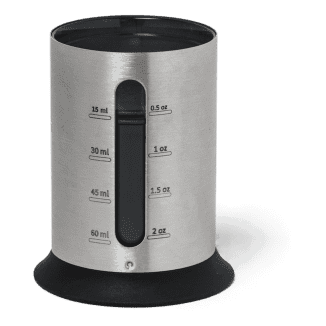
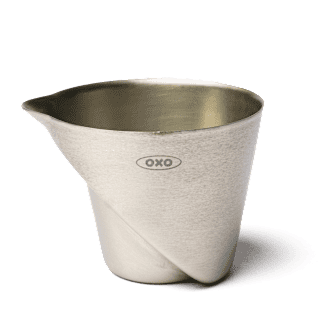
Co-WinnerOXO SteeL Angled Jigger

This metal measuring cup is nearly identical to its plastic counterpart and is just as easy to use. Bold, accurate measurement lines on the interior of this pitcher-shaped model indicate the most useful volumes for making cocktails. In addition to these ounce measurements, it also has volume lines for tablespoons, making it useful for measuring other liquids for cooking and baking tasks. (Because it’s opaque, this mini measuring cup lacks the milliliter and cup-fraction measurements that its clear plastic sibling has on its exterior.) A large opening makes it easy to fill, and a small spout makes for tidy pouring. It’s a touch heavier than its plastic co-winner, weighing 2 ounces instead of just 1 ounce, but some users liked how substantial this extra weight made it feel.

Model Number: 1233080V2

Opening Diameter: 2.5 in

Price at Time of Testing: $10

  • Markings
  • Neatness
  • Ease of Filling

This metal measuring cup is nearly identical to its plastic counterpart and is just as easy to use. Bold, accurate measurement lines on the interior of this pitcher-shaped model indicate the most useful volumes for making cocktails. In addition to these ounce measurements, it also has volume lines for tablespoons, making it useful for measuring other liquids for cooking and baking tasks. (Because it’s opaque, this mini measuring cup lacks the milliliter and cup-fraction measurements that its clear plastic sibling has on its exterior.) A large opening makes it easy to fill, and a small spout makes for tidy pouring. It’s a touch heavier than its plastic co-winner, weighing 2 ounces instead of just 1 ounce, but some users liked how substantial this extra weight made it feel.

Model Number: 1233080V2

Opening Diameter: 2.5 in

Price at Time of Testing: $10

Recommended

  • Markings
  • Neatness
  • Ease of Filling

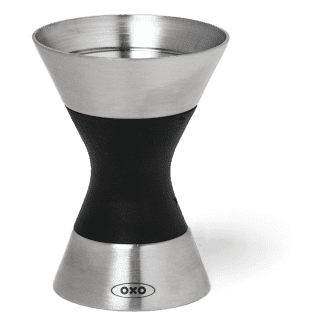
OXO Steel Double Jigger

Because it's double-ended, this jigger drips when you use one end after the other. Apart from that, it's a great conventional option with wide openings and volume lines and numbers that are fairly easy to read, if a bit paler than we'd prefer. And with a rubbery belt spanning its middle, this jigger was easy to grasp, even when wet.

Model Number: 3105000

Opening Diameter: 1.8 and 2.2 in

Price at Time of Testing: $8.95

  • Markings
  • Neatness
  • Ease of Filling

Because it's double-ended, this jigger drips when you use one end after the other. Apart from that, it's a great conventional option with wide openings and volume lines and numbers that are fairly easy to read, if a bit paler than we'd prefer. And with a rubbery belt spanning its middle, this jigger was easy to grasp, even when wet.

Model Number: 3105000

Opening Diameter: 1.8 and 2.2 in

Price at Time of Testing: $8.95

  • Markings
  • Neatness
  • Ease of Filling

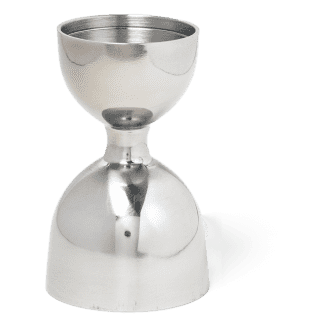
Cocktail Kingdom Classic Leopold Jigger

Testers loved the way this heavy, well-balanced, hourglass-shaped jigger felt in their hands, and its relatively large openings were easy to fill. Unfortunately, there were no numbers to go with the volume lines, forcing us to try to remember which line was which. And because the jigger is double-ended, it dripped when we switched ends.

Model Number: Stainless Steel JIG-LEO-0102ST

Opening Diameter: 1.6 and 1.9 in

Price at Time of Testing: $18.99

  • Markings
  • Neatness
  • Ease of Filling

Testers loved the way this heavy, well-balanced, hourglass-shaped jigger felt in their hands, and its relatively large openings were easy to fill. Unfortunately, there were no numbers to go with the volume lines, forcing us to try to remember which line was which. And because the jigger is double-ended, it dripped when we switched ends.

Model Number: Stainless Steel JIG-LEO-0102ST

Opening Diameter: 1.6 and 1.9 in

Price at Time of Testing: $18.99

  • Markings
  • Neatness
  • Ease of Filling

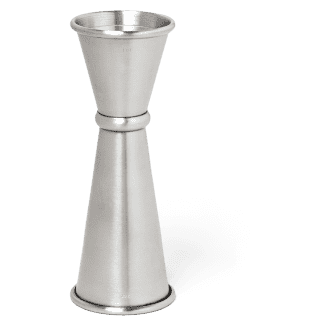
Cocktail Kingdom Japanese Style Jigger

This tall, elegant Japanese-style jigger was mostly enjoyable to use, though many users disliked the fact that its double-ended construction flicked liquid at us whenever we switched from one side to the other. The volume measurements provided are useful and accurate, if a bit hard to read because they were etched into the interior of the jigger. The openings of each end are just large enough that we could fill them easily.

Model Number: JIG-JAP0102ST

Opening Diameter: 1.6 in

Price at Time of Testing: $13.49

  • Markings
  • Neatness
  • Ease of Filling

This tall, elegant Japanese-style jigger was mostly enjoyable to use, though many users disliked the fact that its double-ended construction flicked liquid at us whenever we switched from one side to the other. The volume measurements provided are useful and accurate, if a bit hard to read because they were etched into the interior of the jigger. The openings of each end are just large enough that we could fill them easily.

Model Number: JIG-JAP0102ST

Opening Diameter: 1.6 in

Price at Time of Testing: $13.49

  • Markings
  • Neatness
  • Ease of Filling

HIC Japanese-Style Double Cocktail Jigger

This jigger has clearly identified (if slightly faint) volume lines, but its relatively small openings made it slightly tricky to fill without spilling. Testers loved its elegant, slim profile, though a few thought its 5-inch height made it more likely to be tipped over. Because it was double-ended, it dripped when we flipped it.


Model Number: 48029

Opening Diameter: 1.5 and 1.7 in

Price at Time of Testing: $8.66

  • Markings
  • Neatness
  • Ease of Filling

This jigger has clearly identified (if slightly faint) volume lines, but its relatively small openings made it slightly tricky to fill without spilling. Testers loved its elegant, slim profile, though a few thought its 5-inch height made it more likely to be tipped over. Because it was double-ended, it dripped when we flipped it.

Model Number: 48029

Opening Diameter: 1.5 and 1.7 in

Price at Time of Testing: $8.66

Recommended with Reservations

  • Markings
  • Neatness
  • Ease of Filling

Yukiwa Stainless Steel Seamless Jigger 1 oz x 1.5 oz

This beautiful, weighty hourglass-shaped jigger felt great in our hands. Unfortunately, it had no measurement markings whatsoever, so it was hard to measure specific volumes precisely, and the end that was supposed to hold 1.5 ounces actually held slightly more, which made it less accurate than we prefer. Relatively small openings meant it was also a little tricky to fill neatly, and its double-ended construction flicked liquids on us whenever we switched from one side to the other.

Model Number: 03301170

Opening Diameters: 1.4 and 1.5 in

Price at Time of Testing: $21.50

  • Markings
  • Neatness
  • Ease of Filling

This beautiful, weighty hourglass-shaped jigger felt great in our hands. Unfortunately, it had no measurement markings whatsoever, so it was hard to measure specific volumes precisely, and the end that was supposed to hold 1.5 ounces actually held slightly more, which made it less accurate than we prefer. Relatively small openings meant it was also a little tricky to fill neatly, and its double-ended construction flicked liquids on us whenever we switched from one side to the other.

Model Number: 03301170

Opening Diameters: 1.4 and 1.5 in

Price at Time of Testing: $21.50

  • Markings
  • Neatness
  • Ease of Filling

Rabbit Adjustable Jigger

This jigger had faint but otherwise legible volume lines on its outside, and because it was single-ended, it poured neatly, keeping our hands dry and free from sticky liquid. But it was surprisingly finicky to fill and use, thanks to a small opening and a tight adjustable bottom that had to be pushed up or down to just the right level before we poured in liquid.

Model Number: W9957

Opening Diameter: 1.5 in

Price at Time of Testing: $10.11

  • Markings
  • Neatness
  • Ease of Filling

This jigger had faint but otherwise legible volume lines on its outside, and because it was single-ended, it poured neatly, keeping our hands dry and free from sticky liquid. But it was surprisingly finicky to fill and use, thanks to a small opening and a tight adjustable bottom that had to be pushed up or down to just the right level before we poured in liquid.

Model Number: W9957

Opening Diameter: 1.5 in

Price at Time of Testing: $10.11

  • Markings
  • Neatness
  • Ease of Filling

Winco Jigger 1 oz x 2oz, Stainless Steel

With no volume lines, this jigger would be fine for an experienced bartender or anyone who's happy to estimate volumes instead of measuring them precisely; its two wide mouths make it very easy to fill and empty. Most of our novice testers, however, preferred clear markings. Also, because it's double-ended, it dripped when we used both ends.

Model Number: J-5

Opening Diameter: 2 and 2.4 in

Price at Time of Testing: $8.66

  • Markings
  • Neatness
  • Ease of Filling

With no volume lines, this jigger would be fine for an experienced bartender or anyone who's happy to estimate volumes instead of measuring them precisely; its two wide mouths make it very easy to fill and empty. Most of our novice testers, however, preferred clear markings. Also, because it's double-ended, it dripped when we used both ends.

Model Number: J-5

Opening Diameter: 2 and 2.4 in

Price at Time of Testing: $8.66

Discontinued

  • Markings
  • Neatness
  • Ease of Filling

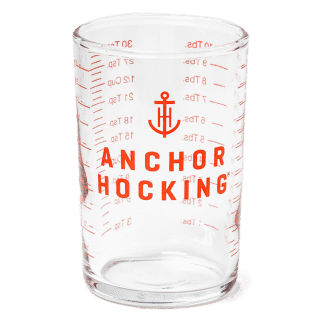
Anchor Hocking 5-oz Measuring Glass, Small

This beaker-like measuring glass had a nice wide mouth for easy filling and emptying, and lots of clearly labeled volume lines. If anything, there were too many, with the lines for ounces—the ones you'll need to make cocktails—competing for visual space on the clear glass with the additional lines for milliliters and tablespoons. Testers didn't love that they had to squat to make sure that they had filled the glass to the right volume, but they otherwise found this model neat and tidy to use.

Model Number: 91016AHG18

Opening Diameter: 2.2 in

Price at Time of Testing: $5.85

  • Markings
  • Neatness
  • Ease of Filling

This beaker-like measuring glass had a nice wide mouth for easy filling and emptying, and lots of clearly labeled volume lines. If anything, there were too many, with the lines for ounces—the ones you'll need to make cocktails—competing for visual space on the clear glass with the additional lines for milliliters and tablespoons. Testers didn't love that they had to squat to make sure that they had filled the glass to the right volume, but they otherwise found this model neat and tidy to use.

Model Number: 91016AHG18

Opening Diameter: 2.2 in

Price at Time of Testing: $5.85

  • Markings
  • Neatness
  • Ease of Filling

Uber Bar Tools ProJig MultiMeasure

The two ends of this plastic jigger were divided into separate compartments for smaller units of measurement (¼ ounce, ½ ounce, etc.). Because of this curious innovation, there was no easy way to measure a single ounce without adding the volumes of two different compartments. It was also hard to read the raised measurements on those small compartments, and they were a pain to fill separately. And because the jigger is double-ended, it dripped whenever we switched ends.

Model Number: 46/PROJIG-04 US

Opening Diameter: 0.8 to 1.9 in

Price at Time of Testing: $14.95

  • Markings
  • Neatness
  • Ease of Filling

The two ends of this plastic jigger were divided into separate compartments for smaller units of measurement (¼ ounce, ½ ounce, etc.). Because of this curious innovation, there was no easy way to measure a single ounce without adding the volumes of two different compartments. It was also hard to read the raised measurements on those small compartments, and they were a pain to fill separately. And because the jigger is double-ended, it dripped whenever we switched ends.

Model Number: 46/PROJIG-04 US

Opening Diameter: 0.8 to 1.9 in

Price at Time of Testing: $14.95

America's Test Kitchen Accolades Badge

Reviews You Can Trust

The mission of America’s Test Kitchen Reviews is to find the best equipment and ingredients for the home cook through rigorous, hands-on testing. We stand behind our winners so much that we even put our seal of approval on them. Have a question or suggestion? Send us an email at atkreviews@americastestkitchen.com. We appreciate your feedback!

The Expert

Author: Miye Bromberg

Miye Bromberg

Deputy Editor, ATK Reviews

Miye is the deputy editor for ATK Reviews. She covers bread, booze, and blades.

Miye Bromberg is the deputy editor for ATK Reviews. Areas of specialization include bread, booze, and blades. A native of New York, she now lives in Kentucky, where she spends her free time thinking about film, tending her garden, and traveling long distances to eat dosas.

*All products reviewed by America’s Test Kitchen are independently chosen, researched, and reviewed by our editors. We buy products for testing at retail locations and do not accept unsolicited samples for testing. We list suggested sources for recommended products as a convenience to our readers but do not endorse specific retailers. When you choose to purchase our editorial recommendations from the links we provide, we may earn an affiliate commission. Prices are subject to change.

Reviews You Can Trust.
See Why.

This is a members' feature.
America's Test Kitchen LogoCook's Country LogoCook's Illustrated Logo