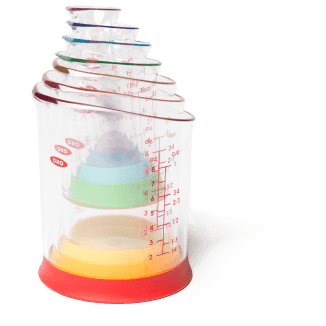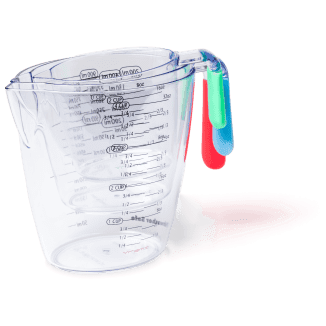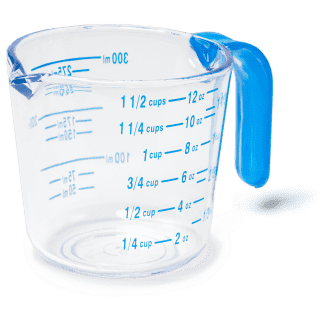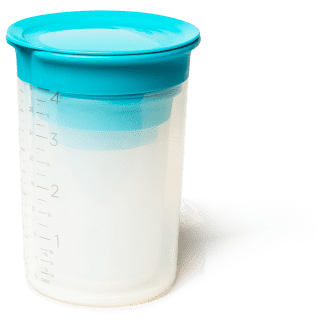



The best liquid measuring cups are accurate and easy to use. In the test kitchen, we use our winner, the Pyrex 1 Cup Measuring Cup, every day. In addition to being accurate, the measurement markings are bold and easy to read. The cup is microwave-safe and easy to clean. But we know that for many home cooks, crouching to view the Pyrex model’s measurement markings at eye level is uncomfortable. For that reason, we also recommend the OXO Good Grips 1 Cup Angled Measuring Cup, which has a secondary set of measurement markings inside that can be read from above. It stained slightly and was harder to scrape clean than our winner, but we love its lightweight construction, comfortable handle, and clever design. We also recommend the larger versions of the Pyrex and OXO cups.

Why You Need Liquid Measuring Cups
For the utmost precision—and the best results in the kitchen—you need two kinds of measuring cups. For flour, sugar, beans, grains, and other foods that can be scooped up and leveled off, dry measuring cups are best. It may be tempting, but you shouldn’t use dry measuring cups for liquids. It’s difficult to see the liquid inside the cups and easy to overfill them, which makes for both messy and imprecise measuring. For everything liquid from buttermilk to broth, we use liquid measuring cups.


We use liquid measuring cups to precisely measure and pour all sorts of ingredients, from butter for creamy sauces to tomato sauce in pasta dishes.
The Best Material for Liquid Measuring Cups
You can find liquid measuring cups made from glass, plastic, and silicone. The benefit of glass is that it’s dishwasher-safe, and many are advertised as microwave-safe too. Glass measuring cups tend to be heavy, though, and they’re fragile. Although it’s convenient to nest sets of liquid measuring cups, that risks scratching them, which can compromise the integrity of the glass. Plastic models are lighter than their glass counterparts. Even if they are described as dishwasher- and/or microwave-safe, we recommend washing them by hand and avoiding microwaves as the intense heat can cause the plastic to break down and leach. Silicone is lightweight and durable, and it can stay comfortably cool even after microwaving. The downside is that silicone isn’t transparent, so it can be harder to read the fill level, and the porous material often retains odors. Silicone can also sometimes be a bit too flexible; we’ve found that we have to hold silicone measuring cups very carefully or risk spilling the contents.
What Size Liquid Measuring Cups Do You Need?
Liquid measuring cups range from 1 to 8 cups in capacity. We recommend stocking a variety of sizes so that you can quickly and easily measure volumes both small and large.
If you’re only getting one liquid measuring cup, get one with a 1-cup capacity. These cups have the most detailed markings, typically in every quarter-cup and third-cup increment. As measuring cups increase in capacity, they generally have fewer incremental markings. The 8-cup liquid measuring cup from Pyrex, for example, only has markings for full cups.

That said, 2- and 4-cup measuring cups come in handy for measuring out large amounts of liquid, such as oil for deep frying or broth for adding to soup. With an even larger 8-cup measuring cup, you can proof dough, mix pancake batter, or brine dried beans. Just keep in mind that bigger measuring cups are heavier, and as they increase in size, they are often proportioned a bit awkwardly. We have found that the handles feel dinky in comparison to the large cups and that the pour spouts are prone to dribbling.
Getting the Most Accurate Reading from a Liquid Measuring Cup
It sounds obvious, we know, but how you look at the measuring cup matters. Here’s what to do: Place the cup on a level surface and slowly add liquid until it reaches the measurement marking, bending briefly to check it at eye level and adjusting as necessary. The surface of the liquid will curve downward slightly (this curve is called a meniscus). The trick for an accurate measurement is to line up the bottom of the curve with the desired marking.

What to Look for
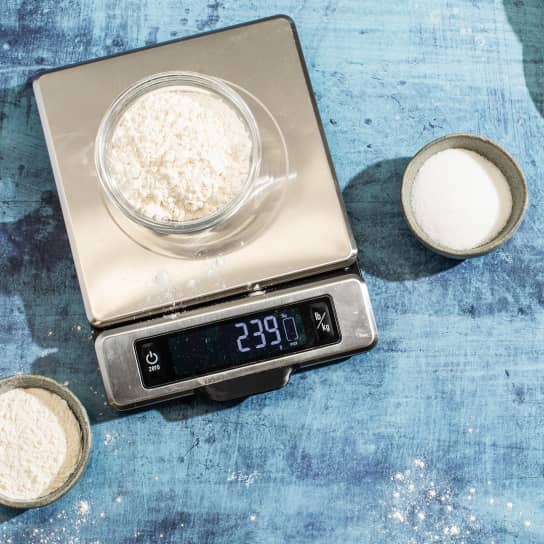
- Accurate Measurement Markings: A liquid measuring cup is only good if it’s accurate. To assess the accuracy of each cup, we used a lab-grade scale to weigh water at every cup, ounce, and milliliter marking. About half the models we tested were either spot-on or off by just a few drops.
- Bold Markings in Useful Increments: The type and style of measurement markings also mattered. A few models used tiny arrows or dashes, about ⅛ inch long, while others had lines nearly 1¼ inches long. We preferred longer, bolder lines, but any length or style was fine as long as it clearly corresponded to a boldly marked number.
- Clear Glass or Plastic: It’s important that you’re able to see the level of the liquid inside the cups. Clear glass and plastic models were easier to see through and therefore easier to use than slightly opaque silicone cups.
- Broad Openings: We liked wide openings that made it easy to pour sauce into from a large pan or a pot, as we do when reducing a glaze or pan sauce.

- Ample Headroom: If the top measurement line was too close to the cup’s rim—¼ inch or less—liquid often sloshed or dribbled down the cup’s exterior as we poured. We were better able to control the flow from cups that offered about 1 inch of clearance between the top measurement and the rim.

- Large, Easy-to-Grip Handles: We liked long, wide handles that were easy to hold and made us feel most secure.
Nice to Have
- A Set of Interior Markings: Two cups each had two sets of measurement markings: one outside, like usual, and another inside in an upward-facing position, so you don’t have to crouch to read the markings. We appreciated that we could just look down into the models with markings inside, no bending required. But there are trade-offs. The markings, which were located on a ridge inside the cup, made it hard to scrape out more-viscous ingredients, such as olive oil or buttermilk. This problem was more pronounced in large-volume versions of these measuring cups because the ridges were bigger, but we were willing to accept that trade-off.

What to Avoid
- Inaccurate Measurement Markings: On the worst models, the 1-cup markings were off by a full tablespoon, enough to negatively affect a recipe. On one cup with two sets of measurement markings, the markings on the outside of the cup were accurate, but the ones inside were not.

- Illegible, Crowded Markings: Some measurement markings were surprisingly hard to read, and some of the lines were even entirely unlabeled. If lines were stacked too close on top of each other or weren’t labeled, it was hard to know which volumes they were marking.
- Material That Stains Easily: As a durability test, we filled the cups with hot turmeric-spiked marinara (for microwave-safe models, we heated the cups and sauce in the microwave) and let them sit for 3 hours. After several spins through the dishwasher (if they were dishwasher-safe) and repeated hand-washing, one plastic measuring cup and the one silicone measuring cup were tinted or had light yellow rings.
- Messy, Imprecise Spouts: On multiple units of one model, the pour spout was off-center. As a result, it dribbled and spilled when we poured, making a mess.
The Tests
- Assess accuracy at every cup, ounce, and milliliter marking using water measured in grams on lab-grade scale
- Evaluate legibility of all measurement markings
- Use measuring cups to pour water into fine-mesh strainer set inside saucepan
- Transfer simmering water to measuring cups from 4-quart saucepan
- Use to measure oil, water, and marinara, using a spatula to empty cups after each test
- If microwave-safe: Fill with turmeric-spiked marinara and microwave until simmering, then let sit for 3 hours and then wash
- If not microwave-safe: Fill with hot mix of turmeric-spiked marinara, let sit for 3 hours and then wash
- Recruit team of testers to evaluate ease of use and legibility of markings
- Wash 30 times, using dishwasher if dishwasher-safe
How We Rated
- Performance: We assessed accuracy at each cup, ounce, and milliliter measurement marking.
- Ease of Use: We evaluated how easy it was to see and read the markings on each cup and whether the level of the liquid was clearly visible. We also assessed how easily and comfortably we could fill, pour from, and empty the measuring cups.
- Cleanup: We took into account how easy it was to clean each cup. We also noted any scuffs and scratches that appeared after repeated use.