
 Buy at Amazon
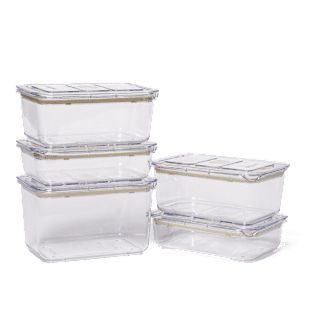
We like plastic containers as an option for food storage, particularly for on the go, because they’re lightweight and less fragile than glass. After testing a number of sets, our favorite is the Rubbermaid Brilliance Food Storage Container Set. It has five lidded containers in a variety of sizes. This high-quality set held the sauciest of foods without spilling, and it was durable, easy to use, and easy to clean. A nice bonus: The glass version of this set won our testing of Glass Food Storage Containers, and the lids for both styles of container are interchangeable.

We reach for food storage containers to store prepared foods, pantry items, leftovers, and more. Plastic containers are lighter than glass, making them a desirable alternative for transporting food outside of the home. However, plastic containers have some limitations that you should be aware of when using them. Due to growing health concerns about exposure to plastic that has been heated, we suggest never microwaving food in plastic containers or cleaning plastic containers in the dishwasher. By the same token, never transfer hot foods into plastic containers. Make sure the foods have cooled to room temperature and then make the transfer. That said, we understand the value of lightweight, durable containers and recognize that for many people they have a place in the kitchen.

What Size Food Storage Containers Should You Get?
Buying a set of food storage containers, rather than à la carte pieces, can be more economical and provide more sizing choices, so you can pack more efficiently. We focused on sets with at least five containers in different sizes to cover a range of storage needs, from a large 9-cup container big enough to hold a recipe for four, to medium containers (3.2- to 5-cup) with enough room to pack lunch for one, to smaller containers that are perfect for salad dressing or a dipping sauce.

We chose sets with a similar number of containers where possible to keep the comparison manageable, but sets vary slightly in number of pieces. We took into account the range of sizes included during testing.
Should You Avoid Plastic Food Containers?
Plastic as a material has been under fire recently, and for good reason. As we discussed in this article, micro- and nanoplastics can form when plastic containers are heated. A 2023 study showed micro- and nanoplastics can move from the containers to the foods stored in them. In addition to microplastics, toxic chemicals used in manufacturing plastic containers can leach out when heated. You can mitigate some of these risks by only using plastic food storage containers in the fridge or at room temperature and washing them by hand.

No, You Shouldn’t Microwave Plastic
Many containers say they’re “microwave-safe.” But what does that really mean?
Learn MoreWe also suggest limiting the amount of time that fatty and acidic foods are stored in plastic containers. “The chemistry of plastic is very oil-like and very much aligned with fatty food,” said Dr. Jane Muncke, managing director of Food Packaging Forum, a Zürich, Switzerland–based nonprofit that uses science and research to inform manufacturers about the environmental impacts of plastic packaging. With fattier foods, there’s a higher likelihood of chemical migration from a plastic container to the food. Acidic foods, such as tomato sauce and fruit juice, can also interact with plastic over time. With both types of food, the likelihood of chemical migration increases with exposure to heat. “With the right temperature,” Muncke said, “the molecules could migrate into foods.”
Ultimately, what you buy and use in your kitchen is a personal decision; check out our review of glass food storage containers if you’d prefer to minimize your use of plastic food storage containers or avoid them completely.
What Type of Plastic Are Food Storage Containers Made From?
Plastic is an umbrella term used to describe a group of synthesized materials; plastics can be derived from petroleum, natural gas, and animal fat. We spoke with professor Michael H. Tunick, a food science expert at Drexel University, who explained that there are many types of food-grade plastic in use and that usage has evolved over the years.
Some materials, like polyethylene terephthalate (PET), are too thin and rigid to be reusable and instead are common in single-use containers. Other plastics have gone out of style, including polycarbonate (PC), which was the most common plastic for reusable containers. Once it became common knowledge that it could degrade and release bisphenol A (BPA), a harmful chemical that disrupts hormonal activity in the human body, its popularity waned significantly. It’s still common in commercial containers, like Cambro. We didn’t include any in our testing lineup, preferring to focus instead on BPA-free products.
We found two main plastics in use during our survey of consumer containers. Polypropylene (PP), developed in the 1950s, is still used widely in reusable food storage containers because it’s sturdy and doesn’t melt when microwaved. Most of the containers we tested are made from this type of plastic.
The rest of the sets we tested were made from Tritan, a brand name for a plastic made by Eastman Chemical Company. Since its introduction in 2007, this plastic has been embraced by equipment manufacturers (such as AeroPress and YETI) because the plastic is durable and virtually as clear and easy to see through as glass.
Good storage containers seal tightly to prevent leaking. We filled a large container from each set with blue water, shook for 15 seconds, and watched for leaks.
What to Look for
- Tough, Thick Plastic: Sets made from polypropylene and Tritan were equally successful in our toughness tests; only one polypropylene set was too thin, which made it flex precariously when full.
- A Range of Sizes: Our top-rated sets had a well-calibrated range of sizes. Several sets came with a bunch of small containers and not enough medium or large.
- Gaskets: Some containers used a gasket, a soft silicone strip around the edge of the lid, to ensure a snug seal. We preferred this style over those without; they were more leakproof in our shaking and dropping tests.

- Easy-to-Clean Gaskets: Some gaskets were removable so you could clean them thoroughly. If the channels that housed those gaskets were too narrow, they trapped food and moisture and became breeding grounds for mold. For removable gaskets, wide channels were ideal. We also liked lids with gaskets that were permanently attached—a spill-proof seal and one less piece to keep track of when doing the dishes.
- Secure Latches: Some lids use latches to keep the containers closed; we preferred them, as they were more secure than press-down lids. Clamping on easily and smoothly with minimum effort was a must; some latches were a real struggle to lock into place.
We liked the latches on our winning set, which were effortless to open and close.
- See-Through Containers: We preferred transparent containers. They saved us the time of opening and closing each container to find out what was inside. Some containers were semi-transparent or frosted, and that made it harder to see and keep our food organized.
- Flat Lids: Flat lids allowed us to stack containers, so we could more effectively use our fridge and freezer space. Some containers had slightly domed lids, which made stacking precarious or impossible.

What to Avoid
- Press-Down Lids: Lids that you simply press down to close weren’t as leakproof as lids with latches in testing. They spilled liquid after just a few shakes and were also prone to popping off if dropped.
- Thin, Flexible Plastic: One set of containers used a notably thin, malleable polypropylene plastic. When we picked up the container filled with liquid, the sides caved in slightly, threatening to spill.
Other Considerations
- A Nesting Set: We checked out one nesting set, which promised to organize containers and lids into two neatly packed stacks like a set of Russian matryoshka stacking dolls. One issue emerged when we tried to pick one mid-size container and its lid out from the stack: We had to disassemble and reassemble the entire set, which was time-consuming. The concept wasn’t as user-friendly as it sounded, but it may be a good option for someone with very limited cabinet space.
The Tests
For the largest container in each set:
- Fill with water dyed blue; shake for 15 seconds to check for leakage
- Store oil-packed tuna in the fridge overnight, then wash and evaluate for lingering odor
- Store pasta sauce for several days, then wash and evaluate for lingering odor
- Open and close 100 times
- Fill with water and drop from the kitchen counter
- Fill with water, freeze overnight, and drop from a height of about 2.5 feet
- Repeat the leakage test with blue water, checking to see if the seals deteriorated over the course of testing
- Additionally, recruit testers to use a set at home for a week
How We Rated
- Performance: We assessed whether the containers sealed tightly and securely; we also tested how leakproof they remained over time.
- Ease of Use: We evaluated how easy it was to open, close, and maneuver each container.
- Durability: We considered whether the containers stood up to repeated use and whether they became damaged after we froze them and/or after we dropped them.
- Cleanup: We evaluated how easy it was to hand-wash each container and if they retained stains or odors.