
America's Test Kitchen LogoCook's Country LogoCook's Illustrated Logo

Reviews You Can Trust.
See Why.

The Best Woks

A good wok can tackle any number of cooking tasks. How do you choose the best?

Headshot of Lisa McManus
By Lisa McManus

Last Updated February 18, 2026

Editor&aposs Note:Update, February 2026:

We reviewed two additional woks and highly recommend both. Our top pick, however, remains the Taylor and Ng Natural Nonstick Wok Set.

What You Need To Know

The best woks are made from carbon steel and are lightweight and easy to maneuver. Our top pick is the Taylor and Ng Natural Nonstick Wok Set. This lightweight carbon-steel wok is a pleasure to use and arrives preseasoned, so you can start cooking right away. It also comes with cooking chopsticks and a lid, which lets you steam, braise, or even smoke foods in your wok more handily. Our Best Buys are the Joyce Chen Classic Series 14-Inch Carbon Steel Wok with Birch Handles and the IMUSA 14" Non-Coated Wok with Wood Handle, Silver. You’ll need to season both models, and they lack accessories, but they perform just as well as our top pick otherwise.

A wok is one of the single most important pieces of equipment used in a Chinese kitchen. “It’s the iron thread that links over 2,000 years of cooking in China,” said Grace Young, wok expert and James Beard Award–winning author of Stir-Frying to the Sky’s Edge (2010), The Breath of a Wok (2004), and The Wisdom of the Chinese Kitchen (1999). “In old-fashioned Chinese kitchens, it was the only tool cooks had besides a cleaver.”

We think it’s a worthy addition to any kitchen. The wok is probably best known for stir-frying, a technique that uses high heat and constant motion to create delicious, well-cooked food quickly. As deputy food editor Lan Lam explores in her article on stir-frying, the shape of the wok facilitates this cooking technique, with a hotter “sear zone” at its base and a lower-heat “steam zone” higher up on the wok’s tall sloped walls that lets food cook through. As Lam and Young explain, food stir-fried in a well-seasoned wok just tastes special, developing wok hei, a unique smoky, savory flavor that’s more complex than what you get if you cook the same foods in a skillet.

Greens and mushrooms are stir-fried in a wok using a special wok spatula.Thinly sliced meat is cooked in a red sauce inside a wok.

The wok is best known for its use in stir-frying, but it can also be used to braise, steam, and even fry ingredients as well.

But the wok’s uses aren’t limited to just stir-frying. Quoting cookbook author Florence Lin, Young says, “With one wok we can do everything.” A wok can also be used to braise, simmer, boil, poach, pan-fry, steam, and even smoke foods. Its bowl-like shape makes it especially great for deep frying foods too. As we’ve found, the wok’s sloped sides mean that you need about 30 percent less oil when frying certain foods in a wok than when frying in a 7-quart Dutch oven. (Those tall, flared sides also contain the food and oil well and protect you and the stovetop from spatters much more effectively.)

All in all, the wok is an incredibly versatile piece of cookware that we love using. If you haven’t tried one yet, you might want to.

Article

The Science of Stir-Frying in a Wok

Cooks have briskly tossed, turned, and flipped food in this vessel for centuries. We dug deep into this ancient culinary art to understand exactly why and how it works.

Learn More

What Are the Different Types of Woks?

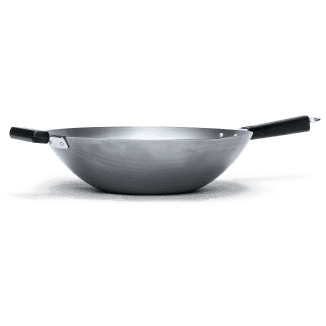
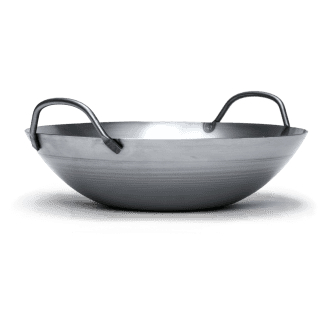
Historically, there were two main styles of woks: Cantonese-style woks, which have two small, looped handles, and Northern-style woks, which have a single long handle. Both styles had round bottoms, a feature that was designed for use over the opening in a traditional hearth stove.

Traditional round-bottomed woks are still being made today. But as our experts explained, they’re not ideal for most American kitchens, which are outfitted with gas, electric, and induction stoves, not the powerful hearth stoves these models were designed for. (American stoves have flat surfaces, whereas hearth stoves had openings cut into their surfaces for the woks to sit in.) With electric and induction ranges, the heating element only has a small point of contact on a round-bottomed wok, making it harder for the entire wok to get hot. And it’s not a good idea to use a round-bottomed wok by itself on any American-style range–it would be too unsteady. It is possible to use these woks at home under certain conditions. If you have a gas range, you can use a round-bottomed wok in conjunction with a special wok ring that mimics the opening in a hearth stove, cradling the wok over the flames. (Young cautions that the ring can put the wok farther from the heat, however, making it hard for the wok to get sufficiently hot; the same problem would be even more pronounced if you use a ring on an electric stove.) You can also use a round-bottomed wok on specially made indoor or outdoor wok burners.

Still, these special accommodations make round-bottomed woks impractical for most American households. As our experts advised us, we think most cooks are better off with a different style of wok: the Westernized flat-bottomed wok, an American invention that Young speculates might have emerged in the late 1950s and 1960s. As their name implies, these woks have flat bottoms that allow them to sit securely on American stoves. For our review, we only reviewed this style of wok.

A spoon reaches in to remove pieces of stir-fried cabbage and rice cakes from a seasoned wok.
All the models we tested were Westernized flat-bottomed woks such as the one seen here.

What’s the Best Size for a Wok?

Woks come in a wide variety of sizes. We think the best size for most households is a wok that is about 14 inches in diameter, the size that we found optimal for home cooks preparing anywhere from two to six servings.

What’s the Best Material for a Wok?

Woks can be made from several different materials. For our testing, we stuck with models made from carbon steel and two types of cast iron–both heavy American cast iron and a lighter-weight Chinese-style cast iron that Young tells us was traditionally used to make woks. Woks made from these materials are preferable because they can be used over high heat and, once thoroughly seasoned, are practically nonstick, letting food move easily. We nixed nonstick-coated woks, as these can’t be used safely at the high heat at which we sometimes use woks. We also nixed stainless-steel woks, which can be used at high heat but aren’t slick, so ingredients will stick during cooking.

A thick, heavy cast-iron wok retains and radiates intense heat after a few minutes on the stovetop, as this thermal imaging camera shows. This makes it harder to control for some of the cooking tasks we expect of a wok.

While we were able to make great food in both the carbon-steel and cast-iron woks, we preferred the models made from carbon steel. These were lighter and much more responsive to any heat shifts we made on the stove, heating and cooling quickly and thus making it easier to control the rate at which food cooked. The cast-iron woks we tested were generally heavier, even when they were made from the lighter Chinese-style material. As a result, they were slower to heat and retained that heat much longer, making it more likely that our food would accidentally overcook. They were also harder to maneuver, as we describe below.

There are a few things to keep in mind with carbon-steel woks, though. They can be harder to use and season on electric and induction stoves, though there are some workarounds, as we describe in the FAQ below.

What to Look for

  • A Broad Flat Bottom: As we’ve explained, when you’re cooking food in a wok, the flat portion at the bottom is usually the hottest area because it is in direct contact with the heat source, while the sloping walls form a slightly cooler zone. You can move food around the wok to use these zones to the best advantage. We preferred models with the widest flat surfaces, which measured 6 to 7 inches across. Having a bit more of the wok’s cooking surface at the hottest temperature helped us sear food and evaporate moisture more effectively as it cooked.
We see mushrooms cooking in a wok. A spoon/wok spatula is used to push it around.
We liked models that had especially broad flat bottoms, as these gave us more surface area to stir-fry and sauté on.
  • Moderate Weight: We preferred carbon-steel woks that weighed around 3 to 4 pounds, with a strong preference for models at the lower end of that spectrum. The lighter the model was, the easier it was to maneuver and lift with a single hand. By contrast, the cast-iron models we tried weighed about 4.5 to 12 pounds, making them harder to move and lift. (As discussed above, their heavier weight also meant they retained heat longer, making it more likely that food might overcook.)
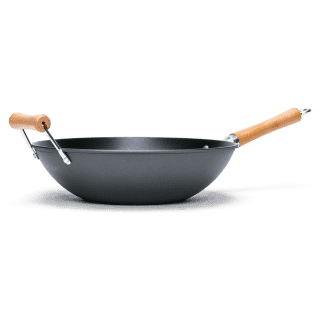
  • One Long Offset Wood Handle: We liked models that featured a main handle that was fairly long, allowing us to control and move the wok at a safe distance from the heat. Models with two small looped handles were harder to maneuver since the handles were much closer to the heat. The angle of the handle mattered too: Long handles that were level with the wok’s rim, or tilted radically upward, felt unbalanced and awkward. But woks with handles that were angled only slightly gave us better leverage and made the wok feel lighter and more balanced. Moving it felt more natural and comfortable. Finally, the material of this handle was important. We appreciated that all-metal handles were durable, but they conducted heat too easily, so we had to wrap them with a kitchen towel or pot holder in order to touch them. We preferred handles sheathed in wood, which stayed cooler during use and didn’t require this extra protection.
We see the long handles of two woks. On top, a wood handle that is offset at about a 20-degree angle, and on bottom, a plastic handle that’s offset at about a 5-degree angle.
Woks with handles that were offset from the base at a gentle angle (top) were easier to lift than those with handles that were level with the rim (bottom).
  • A Helper Handle: We also liked models that featured a looped helper handle, which made it easier for us to lift the woks off the stove when they were laden with food.

Other Considerations

  • Preseasoned versus Unseasoned Woks: All carbon-steel and cast-iron woks need to be seasoned before use. Seasoning makes the surface of your wok nonstick and protects it from rusting or leaching out unwanted metals into your food. The process of seasoning a wok is quite simple (see our article on seasoning carbon steel): Essentially, it involves heating the pan to high temperatures and oiling it. As the oil heats beyond its smoke point, it polymerizes—that is, molecules in the oil bond together and form a thin, hard layer on the surface of your pan. As you continue to cook with your pan, you build additional layers of polymerized oil, forming a thick, protective, increasingly durable nonstick surface. Most woks arrive unseasoned, but you can also find some that come preseasoned. This means that the manufacturer has already done some of the work for you, building a nonstick coating with an initial layer or layers of polymerized oil. While we generally don’t mind taking the time to season our cookware, we appreciated these preseasoned woks, which were reasonably nonstick from the get-go and allowed us to start cooking right away. Preseasoned woks may be especially welcome for cooks with electric and induction cooktops, as we’ve found it more difficult to season woks on these types of ranges. This being said, there are a few caveats to bear in mind. First, preseasoned woks are more expensive—you’re paying for the work the manufacturer’s done for you. Second, even preseasoned woks won’t have a patina that’s quite as thick or as slick as the one on a wok you’ve been using for years. Like unseasoned woks, preseasoned woks improve with use. We think preseasoning can be worth the price, particularly for electric and induction users—it gives you a leg up on the process and lets you get cooking faster. But if you are willing and able to season your own wok, we highly recommend several models; their lower price makes them especially good options.
Preseasoned carbon-steel woks (right) have a fairly nonstick finish that lets you start cooking right away. Unseasoned woks (left) must be seasoned before use.

The Tests

How We Rated

  • Performance: We evaluated the flavor and appearance of the food made in each wok.
  • Ease of Use: We evaluated how easy it was to cook in, lift, and handle each wok, including its weight, handle angle, cooking surface diameter, and any other contributing factors.

FAQs

Yes, carbon-steel woks can be used on both induction and electric stoves. (We’ve included information on every model’s induction compatibility in the chart. You can also test compatibility by seeing if a magnet will stick to the wok’s underside.) That said, there are a few things to keep in mind when using a wok with either an induction or electric stove.

For one thing, it can be difficult to season a carbon-steel wok completely, including both base and sides, on these stoves. (These days, we prefer to season our carbon-steel cookware as thoroughly as possible from the outset. This both helps improve the pans’ nonstick ability and rust resistance, but also reduces the likelihood that any metals will leach out of the pan at harmful levels, as can happen when the pan is unseasoned.) When heated, all woks typically run hotter at their bases than on their sides. This phenomenon is particularly pronounced with induction stoves, which only heat the metal they touch. (Electric stoves heat the wok’s base directly, but their plates or coils also radiate heat onto the wok’s sides, albeit at lower levels than with a gas stove.) While that higher heat lets you season the base of your wok easily on both types of ranges, it’s harder to get that heat to reach up the sides at the high temperatures required for seasoning, so the sides can take longer to develop a nonstick patina on an induction or electric stove. If you have an electric or induction stove, you might want to season your wok on a grill outside or on a friend’s gas stove, as Young recommends. It’s also possible to season your wok in the oven, though you will need to either remove any wooden handles beforehand or find a way to protect them so they don’t char in the oven. 

There are a couple of other issues beyond seasoning, though. As our senior science research editor Paul Adams explained, the bigger heat differential between base and sides created by an induction or electric stove also raises the risk that a carbon-steel wok can warp. 

This heat differential may also make it trickier to cook with a wok. It’s certainly not impossible, though. The important thing is to allow plenty of time to preheat, since the heat needs time to spread through the metal and up the sides of the wok. (You can check to see if the wok is ready by flicking a bit of water into the empty wok and watching where and how quickly it evaporates. Don’t attempt this if you’re preheating the wok with oil in it, or it will splatter.) Note that the walls don’t have to be as hot as the bottom to cook effectively; you can use the sloping sides of the wok and move food in and out of the hotter zone at the bottom.

It’s easy. We have a great article explaining the best ways to clean your wok and scrub off any stuck-on messes.

Everything We Tested

Good 3 Stars out of 3.
Fair 2 Stars out of 3.
Poor 1 Star out of 3.

Highly Recommended

  • Ease of Use
  • Performance

WinnerTaylor and Ng Natural Nonstick Wok Set

Testers agreed unanimously: This wok was one of the easiest and most comfortable to use. Its stay-cool wooden handles and light, balanced weight helped us maneuver and lift it, even when it was full of hot food. It offers the biggest flat cooking surface, and its thin, heat-responsive carbon-steel material helped us control temperatures for excellent cooking results. This was the only wok in the lineup to include a lid and one of several carbon-steel woks that was preseasoned (this is done with a high-heat process that turns the wok blue, which fades to normal brown/black with use). We appreciated this head start toward building up a nonstick surface and think it will be particularly well-appreciated by electric and induction stove owners. A clear food-grade coating is applied to protect this wok’s finish during shipping; it can be removed by heating and wiping the wok with oil. The company also sells the same wok without preseasoning (and without the blue tone that it lends to the metal). We tested it and found that it cooks and handles just like our favorite, but it requires seasoning at home, so it takes a bit longer to become slick.

Model Number: 12153

Weight: 3 lb, 4.6 oz

Materials: Preseasoned carbon steel, wood

Flat Cooking Surface Diameter: 7 in

Induction Compatible: Yes

Price at Time of Testing: $49.17

  • Ease of Use
  • Performance

Testers agreed unanimously: This wok was one of the easiest and most comfortable to use. Its stay-cool wooden handles and light, balanced weight helped us maneuver and lift it, even when it was full of hot food. It offers the biggest flat cooking surface, and its thin, heat-responsive carbon-steel material helped us control temperatures for excellent cooking results. This was the only wok in the lineup to include a lid and one of several carbon-steel woks that was preseasoned (this is done with a high-heat process that turns the wok blue, which fades to normal brown/black with use). We appreciated this head start toward building up a nonstick surface and think it will be particularly well-appreciated by electric and induction stove owners. A clear food-grade coating is applied to protect this wok’s finish during shipping; it can be removed by heating and wiping the wok with oil. The company also sells the same wok without preseasoning (and without the blue tone that it lends to the metal). We tested it and found that it cooks and handles just like our favorite, but it requires seasoning at home, so it takes a bit longer to become slick.

Model Number: 12153

Weight: 3 lb, 4.6 oz

Materials: Preseasoned carbon steel, wood

Flat Cooking Surface Diameter: 7 in

Induction Compatible: Yes

Price at Time of Testing: $49.17

  • Ease Of Use
  • Performance

Yosukata 13.5-inch (34cm) Pre-Seasoned Black Carbon Steel Wok with Flat Bottom

This carbon-steel wok was a stellar performer, arriving with a slick preseasoned surface that let us get cooking right away. (Electric and induction stove owners may find this preseasoning especially helpful, since it can be tricky to season woks on these ranges otherwise.) Its flat cooking surface is just a touch smaller and more rounded than our top pick’s but still provides ample room for searing and sautéing lots of food at a time. It’s also a few ounces heavier than our top pick, though still quite easy to maneuver. A long wooden handle, offset at a comfortable angle from the base, let us control the pan at a safe distance from the heat; a generously sized helper handle made it a breeze to lift even when laden with food. Finally, we appreciated the fact that the handles had no rivets on the interior of the wok, making this model especially simple to clean.

Model Number: n/a

Weight: 3 lb, 9 oz

Materials: Preseasoned carbon steel, wood

Flat Cooking Surface Diameter: 6.25 in

Induction Compatible: Yes

Price at Time of Testing: $59.99

  • Ease Of Use
  • Performance

This carbon-steel wok was a stellar performer, arriving with a slick preseasoned surface that let us get cooking right away. (Electric and induction stove owners may find this preseasoning especially helpful, since it can be tricky to season woks on these ranges otherwise.) Its flat cooking surface is just a touch smaller and more rounded than our top pick’s but still provides ample room for searing and sautéing lots of food at a time. It’s also a few ounces heavier than our top pick, though still quite easy to maneuver. A long wooden handle, offset at a comfortable angle from the base, let us control the pan at a safe distance from the heat; a generously sized helper handle made it a breeze to lift even when laden with food. Finally, we appreciated the fact that the handles had no rivets on the interior of the wok, making this model especially simple to clean.

Model Number: n/a

Weight: 3 lb, 9 oz

Materials: Preseasoned carbon steel, wood

Flat Cooking Surface Diameter: 6.25 in

Induction Compatible: Yes

Price at Time of Testing: $59.99

  • Ease of Use
  • Performance

Best BuyJoyce Chen Classic Series 14-Inch Carbon Steel Wok with Birch Handles

We appreciated the light weight and broad cooking surface of this thin, carbon-steel wok. It was nicely responsive to heat changes and easy to cook in, as well as comfortable to lift and handle. It quickly gained seasoning and became nonstick within a few uses. Its main handle, made of wood, stayed cool on the hot stove and was just slim enough for even testers with small hands to get a secure grip. 

Model Number: J21-9978

Weight: 3 lb, 3 ¾ oz

Materials: Carbon steel, wood handles

Flat Cooking Surface Diameter: 7 in

Induction Compatible: Yes

Price at Time of Testing: $36.81

  • Ease of Use
  • Performance

We appreciated the light weight and broad cooking surface of this thin, carbon-steel wok. It was nicely responsive to heat changes and easy to cook in, as well as comfortable to lift and handle. It quickly gained seasoning and became nonstick within a few uses. Its main handle, made of wood, stayed cool on the hot stove and was just slim enough for even testers with small hands to get a secure grip. 

Model Number: J21-9978

Weight: 3 lb, 3 ¾ oz

Materials: Carbon steel, wood handles

Flat Cooking Surface Diameter: 7 in

Induction Compatible: Yes

Price at Time of Testing: $36.81

  • Ease of Use
  • Performance

Best BuyIMUSA 14″ Non-Coated Wok with Wood Handle, Silver

We enjoyed cooking in this lightweight but sturdily constructed carbon-steel wok with stay-cool wooden handles. It was responsive to heat changes, and had a nicely broad flat cooking surface. Its sides were just a smidge lower than other woks we tested, but this presented no problems such as food or oil escaping while we were stir-frying or deep-frying. The interior quickly became nonstick after its initial seasoning and continued to build a nice natural nonstick coating within a few uses. The wok’s chunky main handle was a bit hard for testers with smaller hands to hold unless they choked up on it slightly. 

Model Number: WPAN-10018

Weight: 3 lb, ⅜ oz

Materials: Carbon steel, wood handles

Flat Cooking Surface Diameter: 7 in

Induction Compatible: Yes

Price at Time of Testing: $29.41

  • Ease of Use
  • Performance

We enjoyed cooking in this lightweight but sturdily constructed carbon-steel wok with stay-cool wooden handles. It was responsive to heat changes, and had a nicely broad flat cooking surface. Its sides were just a smidge lower than other woks we tested, but this presented no problems such as food or oil escaping while we were stir-frying or deep-frying. The interior quickly became nonstick after its initial seasoning and continued to build a nice natural nonstick coating within a few uses. The wok’s chunky main handle was a bit hard for testers with smaller hands to hold unless they choked up on it slightly. 

Model Number: WPAN-10018

Weight: 3 lb, ⅜ oz

Materials: Carbon steel, wood handles

Flat Cooking Surface Diameter: 7 in

Induction Compatible: Yes

Price at Time of Testing: $29.41

  • Ease of Use
  • Performance

Wok Shop Carbon Steel Wok with Metal Side Handle, 14" flat-bottom

This carbon-steel wok was responsive to heat, making it easy to control the temperature of the pan and get good cooking results. We liked that its long, wooden main handle stayed cool, but testers had mixed reactions to the handle’s steep offset angle. While some noted that it helped them lift and move the wok, others commented that the angle put their hands and arms in awkward positions. Combined with the fact that it’s slightly heavier than our top-rated wok, it felt just a bit less maneuverable. This wok is also available with a wooden helper handle instead of a metal one. 

Model Number: 0005

Weight: 3 lb, 14.1 oz

Materials: Carbon steel, wood (main handle)

Flat Cooking Surface Diameter: 6 in

Induction Compatible: Yes

Price at Time of Testing: $35.00

  • Ease of Use
  • Performance

This carbon-steel wok was responsive to heat, making it easy to control the temperature of the pan and get good cooking results. We liked that its long, wooden main handle stayed cool, but testers had mixed reactions to the handle’s steep offset angle. While some noted that it helped them lift and move the wok, others commented that the angle put their hands and arms in awkward positions. Combined with the fact that it’s slightly heavier than our top-rated wok, it felt just a bit less maneuverable. This wok is also available with a wooden helper handle instead of a metal one. 

Model Number: 0005

Weight: 3 lb, 14.1 oz

Materials: Carbon steel, wood (main handle)

Flat Cooking Surface Diameter: 6 in

Induction Compatible: Yes

Price at Time of Testing: $35.00

  • Ease Of Use
  • Performance

Mammafong 14" Preseasoned Blue Carbon Steel Flat Bottom Pow Wok

Lightweight and easy to maneuver, this responsive carbon-steel wok was a pleasure to use. We loved that it arrived preseasoned, as its slick coating let us start cooking immediately and gave us a head start on building a protective patina. (This is a big benefit for all cooks, but especially those with electric and induction stoves, as it can be harder to season woks on these ranges.) It has a smaller flat surface than most models, but we were still able to sear and stir-fry effectively. A long, gently angled handle meant we could manipulate the pan comfortably at a safe distance from the heat. And a helper handle aided lifting.

Model Number: n/a

Weight: 3 lb, 2 oz

Materials: Preseasoned carbon steel, eucalyptus wood handle

Flat Cooking Surface Diameter: 5 in

Induction Compatible: Yes

Price at Time of Testing: $94.99

  • Ease Of Use
  • Performance

Lightweight and easy to maneuver, this responsive carbon-steel wok was a pleasure to use. We loved that it arrived preseasoned, as its slick coating let us start cooking immediately and gave us a head start on building a protective patina. (This is a big benefit for all cooks, but especially those with electric and induction stoves, as it can be harder to season woks on these ranges.) It has a smaller flat surface than most models, but we were still able to sear and stir-fry effectively. A long, gently angled handle meant we could manipulate the pan comfortably at a safe distance from the heat. And a helper handle aided lifting.

Model Number: n/a

Weight: 3 lb, 2 oz

Materials: Preseasoned carbon steel, eucalyptus wood handle

Flat Cooking Surface Diameter: 5 in

Induction Compatible: Yes

Price at Time of Testing: $94.99

Recommended

  • Ease of Use
  • Performance

Helen's Asian Kitchen Carbon Steel Wok, 14"

While this wok cooked every dish well and was beautifully responsive to heat, it was slightly too heavy for many testers when it was full of food. We appreciated that the smooth, round bamboo handle stayed cool, but some testers felt that the handle was slightly too long, to lift one-handed.

Model Number: 97004

Weight: 4 lb

Materials: Carbon steel, bamboo

Flat Cooking Surface Diameter: 6.25 in

Induction Compatible: Yes

Price at Time of Testing: $33.49

  • Ease of Use
  • Performance

While this wok cooked every dish well and was beautifully responsive to heat, it was slightly too heavy for many testers when it was full of food. We appreciated that the smooth, round bamboo handle stayed cool, but some testers felt that the handle was slightly too long, to lift one-handed.

Model Number: 97004

Weight: 4 lb

Materials: Carbon steel, bamboo

Flat Cooking Surface Diameter: 6.25 in

Induction Compatible: Yes

Price at Time of Testing: $33.49

Recommended with Reservations

  • Ease of Use
  • Performance

Wok Shop Carbon Steel Pow Wok with Hollow Metal Handle, Made-USA, 14" flat bottom

The “pow” in pow woks refers to using its single, straight handle to flip food, which this beautifully lightweight pan is designed for; its hollow metal handle doesn’t have time to get hot when restaurant chefs are doing superfast stir-fries on high-powered stoves. But at home, with slower-moving recipes, the metal handle heats up, and that extra step of grabbing a pot holder, combined with the handle’s width, made it less comfortable and efficient than our higher-rated woks. Its carbon-steel material transferred heat rapidly for excellent cooking results.

Model Number: 0010

Weight: 2 lb, 15.4 oz

Material: Carbon steel

Flat Cooking Surface Diameter: 6 in

Induction Compatible: Yes

Price at Time of Testing: $35.00

  • Ease of Use
  • Performance

The “pow” in pow woks refers to using its single, straight handle to flip food, which this beautifully lightweight pan is designed for; its hollow metal handle doesn’t have time to get hot when restaurant chefs are doing superfast stir-fries on high-powered stoves. But at home, with slower-moving recipes, the metal handle heats up, and that extra step of grabbing a pot holder, combined with the handle’s width, made it less comfortable and efficient than our higher-rated woks. Its carbon-steel material transferred heat rapidly for excellent cooking results.

Model Number: 0010

Weight: 2 lb, 15.4 oz

Material: Carbon steel

Flat Cooking Surface Diameter: 6 in

Induction Compatible: Yes

Price at Time of Testing: $35.00

  • Ease of Use
  • Performance

Joyce Chen 22-0060 Pro Chef Flat Bottom Wok Uncoated Carbon Steel, 14-inch

Food cooked well in this wok, which felt responsive to heat and easy to control, but its square plastic handles, set level with the rim of the wok, were a bit clunky to grab and didn’t offer as much leverage as slightly angled handles on other models; combined with the wok’s weight, it felt more difficult to maneuver than higher-rated woks. Water got trapped in the handles when we washed the wok, and trickled out later.

Model Number: 22-0060

Weight: 4 lb

Materials: Carbon steel, plastic

Flat Cooking Surface Diameter: 6.25 in

Induction Compatible: Yes

Price at Time of Testing: $39.99

  • Ease of Use
  • Performance

Food cooked well in this wok, which felt responsive to heat and easy to control, but its square plastic handles, set level with the rim of the wok, were a bit clunky to grab and didn’t offer as much leverage as slightly angled handles on other models; combined with the wok’s weight, it felt more difficult to maneuver than higher-rated woks. Water got trapped in the handles when we washed the wok, and trickled out later.

Model Number: 22-0060

Weight: 4 lb

Materials: Carbon steel, plastic

Flat Cooking Surface Diameter: 6.25 in

Induction Compatible: Yes

Price at Time of Testing: $39.99

  • Ease of Use
  • Performance

Joyce Chen 14" Pre-Seasoned Flat Bottom Cast Iron Wok

We appreciated that this cast-iron wok was ready to cook with no seasoning steps on our end, but we didn’t enjoy maneuvering it, since it weighed nearly 5 pounds empty, even though it is marketed as being “lightweight” cast iron. One tester reported having to “gird” herself to pick it up. The handle also became a bit slick during cooking, making testers feel insecure about their grip. Its cast-iron material was noticeably slower to respond to temperature changes than higher-rated carbon-steel woks, and though dishes cooked acceptably, they were slightly less well seared than the foods cooked in our higher-rated woks which offered more control.

Model Number: 23-0001

Weight: 4 lb, 12.5 oz

Materials: Preseasoned cast iron, wood

Flat Cooking Surface Diameter: 6.5 in

Induction Compatible: Yes

Price at Time of Testing: $54.99

  • Ease of Use
  • Performance

We appreciated that this cast-iron wok was ready to cook with no seasoning steps on our end, but we didn’t enjoy maneuvering it, since it weighed nearly 5 pounds empty, even though it is marketed as being “lightweight” cast iron. One tester reported having to “gird” herself to pick it up. The handle also became a bit slick during cooking, making testers feel insecure about their grip. Its cast-iron material was noticeably slower to respond to temperature changes than higher-rated carbon-steel woks, and though dishes cooked acceptably, they were slightly less well seared than the foods cooked in our higher-rated woks which offered more control.

Model Number: 23-0001

Weight: 4 lb, 12.5 oz

Materials: Preseasoned cast iron, wood

Flat Cooking Surface Diameter: 6.5 in

Induction Compatible: Yes

Price at Time of Testing: $54.99

  • Ease of Use
  • Performance

Imusa USA Light Cast Iron Wok with Wood Handles, 14-inch, Black

Like the other “lightweight” cast-iron wok in our lineup, this wok arrived ready to cook, with no preseasoning steps, which we appreciated. We also liked its handsome red exterior, but like the other cast-iron woks, it was fairly heavy to lift and slower to respond to temperature changes than higher-rated woks, so it was a bit more challenging to control the cooking and get the desired level of crisp doneness for foods. Smaller-handed testers noted that its handle felt too thick and wide.

Model Number: CKG-61021

Weight: 4 lb, 6.2 oz

Materials: Preseasoned cast iron, wood

Flat Cooking Surface Diameter: 6.5 in

Induction Compatible: Yes

Price at Time of Testing: $36.88

  • Ease of Use
  • Performance

Like the other “lightweight” cast-iron wok in our lineup, this wok arrived ready to cook, with no preseasoning steps, which we appreciated. We also liked its handsome red exterior, but like the other cast-iron woks, it was fairly heavy to lift and slower to respond to temperature changes than higher-rated woks, so it was a bit more challenging to control the cooking and get the desired level of crisp doneness for foods. Smaller-handed testers noted that its handle felt too thick and wide.

Model Number: CKG-61021

Weight: 4 lb, 6.2 oz

Materials: Preseasoned cast iron, wood

Flat Cooking Surface Diameter: 6.5 in

Induction Compatible: Yes

Price at Time of Testing: $36.88

  • Ease of Use
  • Performance

M.V. Trading 14 Inches Carbon Steel Flat Bottom Wok with Two Side Handle, 14 Gauge Thickness, USA Made

Lightweight and responsive, this wok was fun to cook in but a pain to handle. The small, metal ear-shaped loop handles got hot, and gave us little control or leverage for lifting and tipping food out, unless we precariously pinched the wok and handle in one hand with a pot holder or towel. 

Model Number: CSWK14FB

Weight: 3 lb, 11.5 oz

Material: Carbon steel

Flat Cooking Surface Diameter: 6 in

Induction Compatible: Yes

Price at Time of Testing: $42.99

  • Ease of Use
  • Performance

Lightweight and responsive, this wok was fun to cook in but a pain to handle. The small, metal ear-shaped loop handles got hot, and gave us little control or leverage for lifting and tipping food out, unless we precariously pinched the wok and handle in one hand with a pot holder or towel. 

Model Number: CSWK14FB

Weight: 3 lb, 11.5 oz

Material: Carbon steel

Flat Cooking Surface Diameter: 6 in

Induction Compatible: Yes

Price at Time of Testing: $42.99

  • Ease of Use
  • Performance

Lodge 14 Inch Cast Iron Wok Preseasoned Wok with Flattened Bottom

This handsome, heavy cast-iron wok weighed more than three times as much as our top-rated wok, and while we loved its slick preseasoned surface, its thick body was quite sluggish to heat and cool, so it was harder to control the cooking temperature; we sometimes had to slide it off the burner when it threatened to scorch food. Even empty it was a bear to lift; we usually ended up scooping out food instead, while the wok continued sizzling, risking overcooking. Small looped cast-iron handles became hot.

Model Number: P14W3PLT

Weight: 11 lb, 9.6 oz

Material: Preseasoned cast iron

Flat Cooking Surface Diameter: 0 in (bottom of interior is round)

Induction Compatible: Yes

Price at Time of Testing: $49.90

  • Ease of Use
  • Performance

This handsome, heavy cast-iron wok weighed more than three times as much as our top-rated wok, and while we loved its slick preseasoned surface, its thick body was quite sluggish to heat and cool, so it was harder to control the cooking temperature; we sometimes had to slide it off the burner when it threatened to scorch food. Even empty it was a bear to lift; we usually ended up scooping out food instead, while the wok continued sizzling, risking overcooking. Small looped cast-iron handles became hot.

Model Number: P14W3PLT

Weight: 11 lb, 9.6 oz

Material: Preseasoned cast iron

Flat Cooking Surface Diameter: 0 in (bottom of interior is round)

Induction Compatible: Yes

Price at Time of Testing: $49.90

America's Test Kitchen Accolades Badge

Reviews You Can Trust

The mission of America’s Test Kitchen Reviews is to find the best equipment and ingredients for the home cook through rigorous, hands-on testing. We stand behind our winners so much that we even put our seal of approval on them. Have a question or suggestion? Send us an email at atkreviews@americastestkitchen.com. We appreciate your feedback!

The Expert

Author: Lisa McManus

Lisa McManus

Executive Editor, ATK Reviews

Lisa is an executive editor for ATK Reviews, cohost of Gear Heads on YouTube, and gadget expert on TV's America's Test Kitchen.

Lisa McManus is an executive editor for ATK Reviews, host of The Taste Test and cohost of Gear Heads on YouTube, and a cast member on TV's America's Test Kitchen. A passionate home cook, sometime waitress, and longtime journalist, she graduated from Columbia University's Graduate School of Journalism and worked at magazines and newspapers in New York and California before returning like a homing pigeon to New England. In 2006 she got her dream job at ATK reviewing kitchen equipment and ingredients and has been pretty thrilled about it ever since. Her favorite thing is to go somewhere new and find something good to eat.

*All products reviewed by America’s Test Kitchen are independently chosen, researched, and reviewed by our editors. We buy products for testing at retail locations and do not accept unsolicited samples for testing. We list suggested sources for recommended products as a convenience to our readers but do not endorse specific retailers. When you choose to purchase our editorial recommendations from the links we provide, we may earn an affiliate commission. Prices are subject to change.

Reviews You Can Trust.
See Why.

This is a members' feature.
America's Test Kitchen LogoCook's Country LogoCook's Illustrated Logo