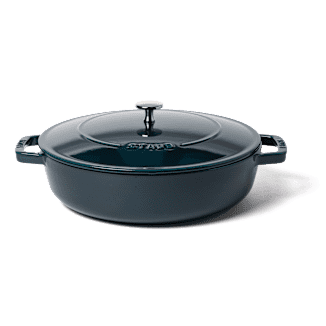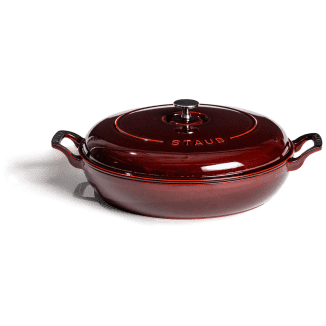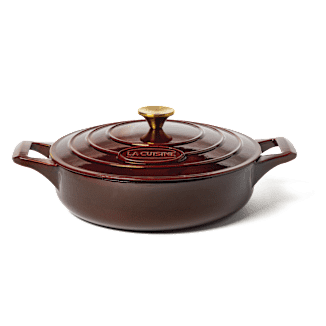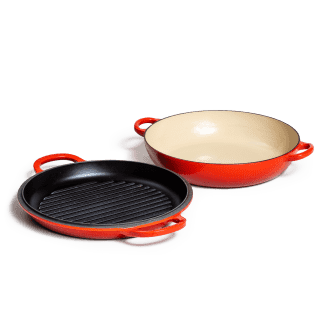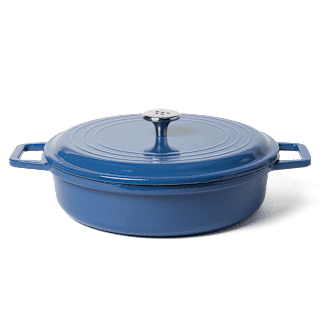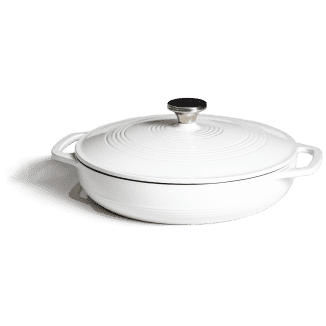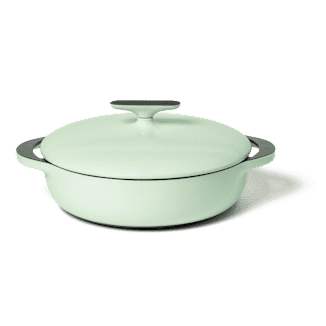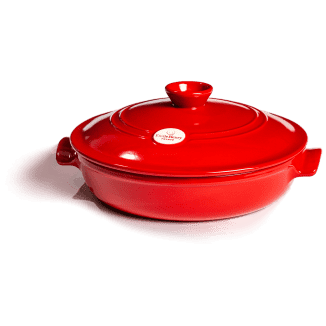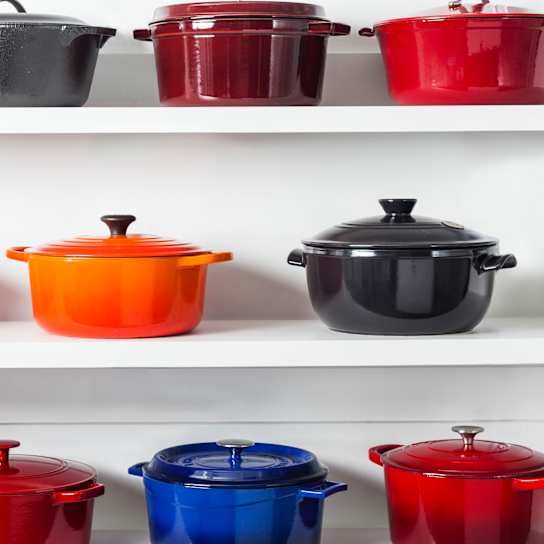

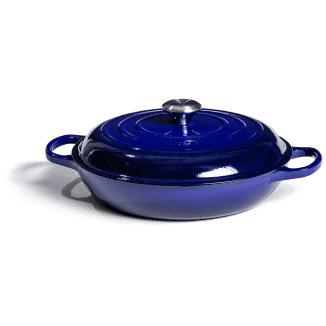

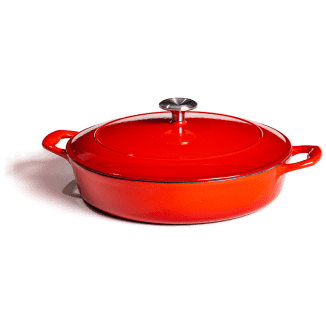

The best braisers are easy to lift and maneuver and sear, simmer, roast, and braise foods well. We think that the best option for most people is the Le Creuset Enameled Cast Iron Signature Round Braiser, 3.5 Quart. It makes excellent food for three to four people, and with large handles and a relatively light weight for its size, it’s especially easy to use. If you’d like a slightly larger braiser, we also recommend the bigger version of our winner, the Le Creuset Enameled Cast Iron Signature Round Braiser, 5 Quart. For a less expensive alternative to our winner, our Best Buy is the Tramontina Enameled Cast Iron Covered Braiser. This model is heavier than our top choice and has smaller handles, but it performs just as well. Our 5-quart Best Buy is the Crock Pot Artisan Enameled Cast Iron Braiser W/Lid, 5-Quart. It’s not as durable as others and stained a bit more, but it made great food and has nice large grippy handles.

While you can sear, simmer, roast, and braise foods perfectly well in a Dutch oven, a dedicated braiser can be a good alternative. Like Dutch ovens, braisers are usually made from enameled cast iron, which retains heat well. As a result, braisers are particularly adept at the two components of their namesake task, braising—a wet-heat cooking method that involves searing tougher cuts of meat on the stovetop and then simmering them in a relatively small volume of liquid for a long time to tenderize the meat.

Braisers have two unique advantages over Dutch ovens that make them especially good at braising. First, they have larger, broader cooking surfaces, so you can fit more pieces of food in a single layer; the bottom of a 3.5-quart braiser typically measures about 10 inches across, about an inch wider than that of the 7-quart Dutch ovens we recommend for most people. The larger cooking surface also speeds up the evaporation of liquid in the pan, which helps sauces reduce faster. Second, braisers have shorter walls, which also help accelerate evaporation and sauce reduction. In addition, these shorter walls make it easier to maneuver utensils around, as you need to do when flipping food.

A braiser can also be used for tasks beyond braising, of course. It’s great for roasting small cuts of meat and poultry in the oven or quickly simmering saucy vegetable dishes on the stovetop. Just be wary of using a braiser to cook anything with a lot of liquid, such as a soup or a marinara sauce—those short walls won’t contain spatters, as a Dutch oven’s taller ones will.
Almost all the braisers we tested performed well and made great food, so rankings were ultimately determined by small differences in ease of use and durability.

What Size Braiser Should I Get?
It depends. The size of a braiser is determined by its capacity, which is measured in quarts. You’ll most often find braisers with a capacity of 3.5 to 4 quarts, which is big enough to cook food for about three to four people. We think this size is also the most useful for the kinds of food you’re likely to cook in a braiser. If you regularly cook for five to six people, however, you might prefer a 5- to 6-quart braiser. Just know that the bigger the braiser, the more it’ll cost and weigh and the more storage space it’ll require.
Is an Expensive Braiser Worth the Money?
You don’t have to spend a lot to get a decent braiser—our Best Buys are both under $100. But from decades of testing, we’ve found that spending more money can often provide you with a few advantages.
First, durability. In our experience, enameled cast-iron vessels that cost more tend to last longer, with thicker and/or better-formulated layers of enamel that are less likely to chip. Treat a well-made braiser right and you might never have to buy another.
Second, ease of use. We’ve found that more expensive enameled cast-iron cookware sometimes weighs less than cheaper versions, which makes it easier to lift and maneuver. Our top-rated choices are two of the lightest models in their size categories.
Ultimately, the choice is up to you. Depending on your budget and needs, you can decide to invest more money for a lighter and more durable option or put up less for a model that performs just as well but is perhaps a touch heavier or prone to chipping.

What’s the Best Material for a Braiser?
As previously explained, most braisers today are made from enameled cast iron. Cast iron has excellent heat retention, which makes it great for both searing foods and maintaining temperatures for long periods, as required in braising. Cast iron is also quite durable—it’s unlikely to break, crack, or warp over time. Enameled cast iron, or cast iron with an enamel coating, has additional advantages. It doesn’t require seasoning or maintenance, as traditional cast iron does, which makes it generally easy to use. (You do need to take care not to heat the braiser empty at high temperatures because the enamel can be damaged, but this is a relatively minor precaution.)
We’ve tested ceramic braisers in the past. Ceramic is more fragile—it can crack or break if dropped or if subjected to thermal shock (going from hot to cold or cold to hot suddenly). And it doesn’t conduct heat well, so you can’t sear meat as well as you can in cast iron. Ceramic is a good insulator, though, so braisers made from it can be great for making rice, beans, or other foods that don’t need to be seared and simply simmer at lower temperatures for long periods. Overall, however, we prefer enameled cast iron for its greater versatility.
What to Look for
- Moderate Weight: Any cooking vessel made from cast iron is heavy by nature, but we prefer braisers that aren't overly ponderous. Our top choices are some of the lightest models we tested, with our favorite 3.5-quart model weighing about 12 pounds and our favorite 5-quart model just a few ounces over 15. This lower weight makes them a little easier to move and wash. While most 3.5-quart braisers weigh only a pound or two more, we’ve tested 5-quart braisers that weigh over 18 pounds, and those can be a bit more of a burden to maneuver.
- Broad Cooking Surface: We preferred braisers with generous cooking surfaces—at least 10 inches across for 3.5-quart models and 10.5 to 11 inches across for 5-quart models. These gave us room to sear or arrange lots of food in a single layer, as we often do for braising. While models with smaller cooking surfaces weren’t always bad, they accommodated less food.

- Moderately Tall, Sloped Walls: We preferred braisers with walls just tall enough to contain a full batch of ragu or chicken thighs with fennel without impeding liquid evaporation. (For 3.5- and 4-quart braisers, this meant walls measuring about 2 to 2.5 inches high; for 5-quart braisers, walls 2.5 to 3 inches high.) We also liked braisers that had sloped, as opposed to straight, walls. These made it easier for us to access food, maneuvering in with a spoon or pair of tongs to flip meatballs or chicken thighs.

- Large, Looped Handles: These are easier to grip for transporting the braisers in and out of the oven.
- Lids with Large Knobs and Smooth Undersides: We liked models that had lids with large, easy-to-grab knobs on top. We also preferred lids that had smooth undersides. Lids with grooves, ridges, and “self-basting” spikes often collected food, were harder to clean, and didn’t help the braisers cook food any better than models that lacked these features.
What to Avoid
- Small Looped and/or Tabbed Handles: These were harder to grip securely and made for somewhat more precarious maneuvering, especially when our hands were sheathed in oven mitts.

Other Considerations
- Dark vs. Light Interiors: The enamel inside a cast-iron braiser can be either light- or dark-colored. The color of the enamel doesn’t significantly affect performance, at least where most braising and roasting tasks are concerned, but each type has different pros and cons. Historically, we’ve preferred enameled cast-iron cookware with light interiors, which make it easier to monitor browning when you sear meat or sauté vegetables. The downside to light-colored interiors is that while they make it easier to track browning, the enamel itself can discolor and grow dingy over time. It’s not hard to return the enamel to its original white—we have an article on this restoration process—nor is it necessary to keep your braiser functioning well. But if aesthetics are a priority, you might prefer a braiser with a dark-colored interior. While darker interiors make it a bit harder to monitor browning, they camouflage stains much better. In the end, there’s no wrong option; choose whichever style fits your personal preferences.
The Tests:
3.5- and 4-Quart Models:
- Make One-Pan Lemon-Braised Chicken Thighs with Chickpeas and Fennel
- Brown meatballs all over and then simmer them in tomato sauce, counting how many meatballs fit in each pan
- Make Mediterranean Braised Green Beans with Mint and Feta Cheese
- Make Weeknight Roast Chicken
- Make Pork, Fennel, and Lemon Ragu with Pappardelle
- Wash each pan by hand after each test
- Whack each pan around the rim with a metal spoon 50 times
- Slam the lid down onto each pan 25 times
5-Quart Models:
- Brown meatballs all over and then simmer them in tomato sauce, counting how many meatballs fit in each pan
- Make Mediterranean Braised Green Beans with Mint and Feta Cheese
- Make Braised Beef Short Ribs
- Wash pan and lid by hand after each test
- Whack each pan with metal spoon 50 times
- Slam lid down onto pan 25 times
How We Rated
- Performance: We rated the braisers on how well they made and accommodated different foods.
- Durability: We evaluated the braisers on how well they withstood damage and staining.
- Ease of Use: We rated the braisers on how easy they were to lift, maneuver, and clean.