


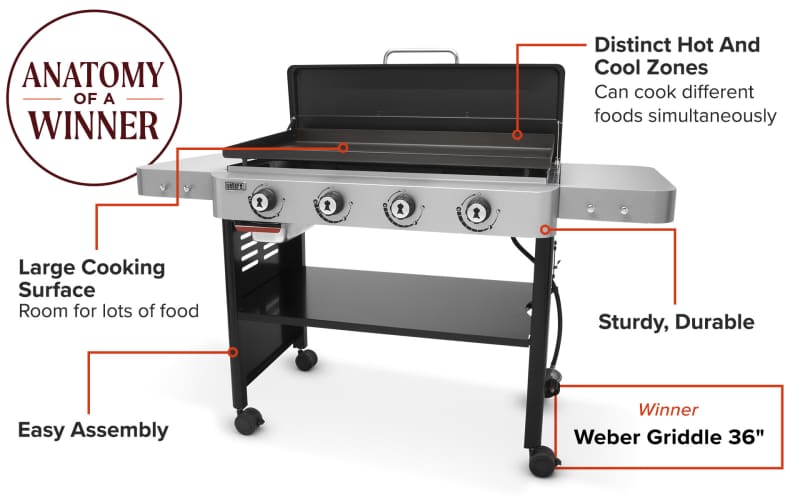
Our favorite flat-top grill is the Weber Griddle 36". It’s sturdy, well-made, and relatively simple to put together. Better still, it has a large cooking surface that allows you to make food for a crowd easily. And it has great temperature control, so you can get the whole grill ripping hot for searing off a dozen steaks or create distinct hot and cool zones for cooking different foods.
Peek into the kitchen at any busy diner and you’ll likely see a short-order cook standing in front of a flat-top griddle, employing every inch of its wide, flat cooking surface to churn out batch after batch of fried eggs, pancakes, bacon, grilled cheese sandwiches, burgers, and more. A flat-top grill is a scaled-down version of this diner appliance that replaces a grill’s grates with a flat sheet of carbon steel. Like traditional gas grills, flat-top grills are propane powered, have multiple heat zones, and are designed exclusively for outdoor use. But unlike gas or charcoal grills, flat-top grills can’t be used for barbecuing or smoking foods. Instead, they’re meant for cooking foods that are typically cooked on a griddle—pancakes and fried eggs—as well as foods that are typically grilled but are flattop-friendly—steak, burgers, and sliced vegetables. And since flat-top grills have multiple burners, they also have multiple heat zones, which, in theory, allows for searing burgers in one zone while toasting burger buns in another.
In recent years, flat-top grills have surged in popularity. They’re popular for tailgates and home entertaining alike, and influencers have filmed hours of videos dedicated to cooking anything and everything you can think of on these handy appliances. Many cooks treat the flat-top grill as an extension of their inside range, a way to bring the kitchen outdoors, where you can fry chicken or even make pasta in a pot on top of the grill without having to deal with the odors and steam you might experience inside.
One thing to note: Because all flat-top grills have carbon-steel cooktops, you’ll usually need to season them before you get started and maintain them carefully, oiling them after every use to prevent rusting. (We’ve provided instructions on how to do this in the FAQ section below.)
While flat-top grills can cost up to thousands of dollars, we limited our testing to models priced under $600.
What to Look For
- Easy Setup: None of the flattops were a breeze to put together, but some were easier than others. For obvious reasons, we prefer models that are relatively simple to assemble, taking 20 to 30 minutes as opposed to an hour or more.

The cooking surfaces of our favorite grills were big enough to fit an entire package of bacon, eight pancakes, and four eggs: enough to feed four. If you're feeding a bigger crowd, it's easy enough to cook another batch of each once the first batch is done.
- A Large Cooking Surface: We prefer models with cooking surfaces that measured at least 35 inches long by 20 inches wide (about 700 square inches), since they could easily accommodate a pound of bacon, four eggs, and eight pancakes all at one time—enough for at least four people at a time and eight if you make a second batch. Larger cooking surfaces also gave us more room to flip and maneuver food.
- Distinct Hot and Cool Zones: Larger cooking surfaces had an additional benefit: they made it possible to have separate hot and cooler zones. There’s always going to be some temperature bleed-through on a flat-top: a single piece of metal spans multiple burners, and if you’ve turned two burners to high on one half of the grill, some of that heat will carry over into the half where you’ve turned your other burners to low. Bigger cooking surfaces give you a little more latitude for a cooler zone, as you can put more distance between your hot and cool burners. Our favorite models managed to produce hot and cool zones that had at least 100 degrees of difference between them. This allowed us to set two or three burners to high heat to sear burgers and keep one or two burners on low heat to gently warm a saucepan of butter and toast burger buns.


We used an infrared thermometer to check the temperatures of the cooking surfaces of all the grills. Our favorite grills (right) had distinct hotter (red) and cooler (green) zones, which allowed us to successfully cook burgers and toast burger buns at different temperatures at the same time. The cooking surface of grills we liked less (left) appeared all red, meaning it didn't have a distinct cooler zone.
- Short Cooktop Walls: Most grills come with short walls around the perimeter of the cooktop. These are important, as they help corral food and prevent it from sailing off the griddle as you try to flip or move it.
- Burner Visibility: We liked models that let us see the burners under the cooktop, as that made it easier for us to adjust our heat to the levels we needed.
- Four Sturdy Legs with Wheels: Our favorite models had four solidly made legs that supported the heavy griddles securely. They also had four lockable wheels, so we could move the griddles easily or freeze their position.
- Two Side Tables: When you’re cooking for a crowd, you need all the counterspace you can get to rest your food. We liked models that had two side tables, as these provided zones for both raw and cooked food.
- Good Durability: The best models were made of thick, warp-proof metal that arrived in good shape and stayed intact throughout testing.
- A Fairly Tight-Fitting Lid: A flattop’s carbon-steel cooking surface can rust if water sits on it for too long. While you can alway buy a cover for your grill, we preferred models with lids that prevented water from getting onto the cooktop in the first place, but it was important that these lids weren’t too airtight—lids that seal too well can hold in air moisture, which also promotes rusting.
- Well-Designed Grease Collection Systems: Cooking on a flattop generates a fair amount of extra grease and food bits that you’ll need to get rid of. We preferred models with troughs or holes that smoothly channeled grease and food debris into a drip cup for disposal.
What to Avoid
- Smaller Cooking Surfaces: These don’t provide much of an advantage over cooking on an electric or stovetop griddle inside. With cooktops that have less than 700 square inches of space, it’s harder to cook for a crowd and to create distinct hot and cool zones.
- Grills with No Cooktop Walls: Cooktops that had no walls around their perimeters made it tricky to pick up or flip food. Too often, we scooted a spatula under an egg or pancake and ended up chasing it over the edge, not onto a plate.
- Poorly Made Models: We encountered a few models with flimsy, thin, or dented legs and other parts, which gave us some concerns about these models’ longevity.
- Badly Designed Grease Collection Systems: These made cleaning more difficult. One model featured a large well that encircled the entire cooking surface and a grease cup attached to the back of the grill’s frame. The grease cup felt flimsy. Also, if it wasn’t positioned correctly, a small gap formed between the cooktop and grease cup, which meant some grease ended up on the ground. The large well around the outside of the grill caught bits of food but didn’t add much except for a large extra part to clean.

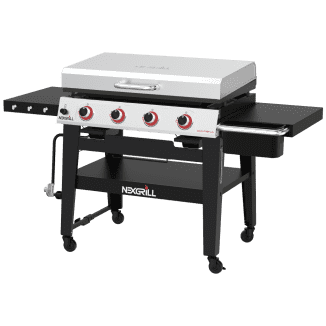
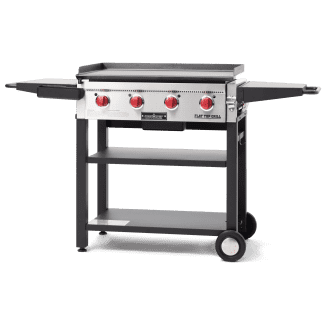
Some flat-top grills, such as the model depicted, had poorly designed grease collection systems that made cleanup harder.
The Tests
- Cook pancakes, eggs over easy, and bacon, counting how many of each reasonably fit on each grill surface
- Make Smashed Burgers
- Make Chopped Cheese Sandwiches
- Use infrared thermometer to measure grill temperature 10, 20, and 30 minutes after setting half the burners to high and half the burners to low
How We Rated
- Cooking: We rated the grills on how well they cooked different types of foods.
- Assembly: We evaluated the grills on how hard they were to put together and how long it took to do so.
- Ease of Use: We rated the grills on how easy it was to set different temperatures, protect from damage, and to clean.