
 Buy at Amazon
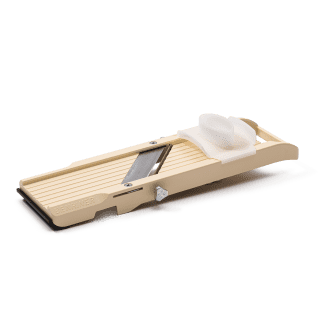
The Super Benriner Mandoline Slicer is our favorite mandoline; it had the sharpest blade we tested, slicing and making julienne from even the toughest foods as if they were butter. Better still, it slices in an incredibly wide range of thicknesses. Simple and fairly compact, it’s easy to set up, clean, and store. Just one caveat: It lacks a good hand guard, so you’ll need a cut-resistant glove to use it safely.
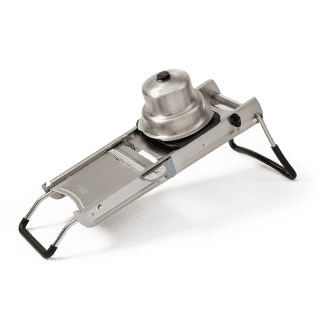
We also liked the OXO Good Grips Chef’s Mandoline Slicer 2.0; it was the easiest to use of all the models. It sliced most foods evenly and in many thicknesses; a clearly marked, accurate dial made it exceptionally easy to set just how thin or thick we wanted our food to be. It’s just not quite as sharp as the Super Benriner, so it sometimes choked on fibrous produce, and it can julienne in only two preset widths and thicknesses. It’s also more expensive and bulkier to store.
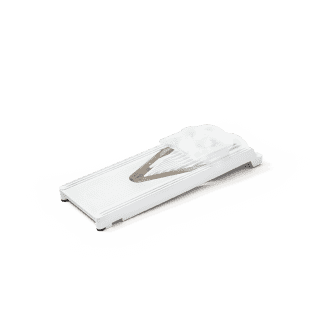
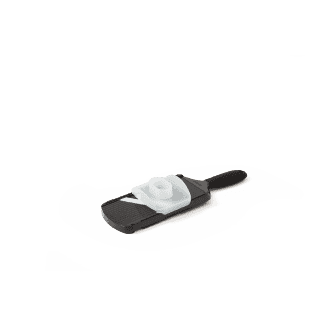
Finally, the inexpensive Kyocera Soft Grip Adjustable Mandoline Ceramic Slicer is our favorite compact mandoline. It’s much more limited than our favorites: It can make only thin slices, it can’t make julienne, and it’s too small to accommodate large produce such as eggplants. But its size and simplicity make it easy to use, clean, and store. And we think its lower price justifies its limited functionality somewhat; it still performs the difficult task of making even, paper-thin slices better than most of us can muster with a chef’s knife. If all you want is a tool that can shave vegetables or fruit into salads or make potato or other vegetable chips, this might be the mandoline for you.

At its best, a mandoline allows you to slice fruit and vegetables much more precisely, consistently, and quickly than you could with a chef’s knife. Most models operate similarly. You hold food in one hand and slide it down the mandoline’s platform and across a blade or blades, slicing it; by adjusting the height of the platform, you can control how thickly the mandoline cuts. Some have attachments that allow you to julienne or make waffle cuts as well. Used properly—and safely—the mandoline can be a magical device, turning out paper-thin or chunky slices that look like they’ve been cut by a machine and in record time. But too often, these tools disappoint us; They cut poorly, skid around, or are just plain dangerous to use. We tested a host of products to find the best options on the market.
What to Look For
- The Ability to Cut in a Wide Range of Thicknesses: All the mandolines came with blades for slicing, the task we use a mandoline for most frequently. The ability to slice in different thicknesses was our top priority, so we privileged it above other functions in our review. The best mandolines let you cut gossamer-thin shavings of fennel for salad, thick slabs of eggplant for parmigiana, and everything in between. Our two highest-rated models can produce slices from about half a millimeter thick to 7.5 to 9.5 millimeters thick (or from about 0.02 to 0.4 inches); testers particularly liked our top choice precisely because it had no preset thickness settings, allowing for infinitely customizable slice thickness.


We preferred mandolines with straight blades (left), as we had to work harder to push food through V-slicers (right), and the results were often less even.
- Sharp, Straight Blades: Sharp blades are essential, allowing you to cut delicate tomatoes and tough, fibrous celeriac alike. Most mandoline blades can’t be removed for sharpening; few users are likely to sharpen those that can be either. So, if the blade isn’t sharp from the outset, it’s never going to be. We also preferred models that had straight blades that extended diagonally or horizontally across the body of the mandoline; we found that these cut food more evenly than V-shaped blades.
The best mandolines were razor-sharp, cutting delicate tomatoes cleanly.
- A Wide, Rigid Platform: The platform—the area of the mandoline that the food passes over before getting to the blade—should be big enough to accommodate the largest food you plan to cut on it. We preferred mandolines with platforms measuring 3.5 to 4 inches across, as these could hold both medium-size eggplant and smaller foods such as carrots or fennel bulbs. That said, if you don’t mind sacrificing the ability to cut larger foods, a smaller model can serve you just fine, and its more compact footprint means it’ll be easier to store as well. We also liked mandolines with platforms that were relatively rigid. If a mandoline platform is too flexible, it can sag as you press food against it, slicing unevenly as a result. The best models had platforms that were braced underneath by support beams or several sets of screws so that they stayed perfectly still as food passed over, ensuring nice, even slices.
- Rubber Feet or Stands: You don’t want the mandoline to move while you’re using it, as that can lead to uneven slices—or danger for your fingers. Rubbery feet or kickstands provided enough traction to keep our favorite mandolines from budging on the table. Although we had more flexibility to position mandolines that lacked these features (using them vertically, at an angle, or over a bowl), we often had to work harder to keep them steady during slicing, as they slipped around more.


Mandolines with kickstands were easy to position at a comfortable fixed angle. Mandolines that lacked them could be set in more positions but were sometimes harder to stabilize while cutting.
Nice to Have
- Clear, Accurate Measurement Settings: These help you set the machine to the exact thickness you want. Unfortunately, not all mandolines have these measurements—and those that do aren’t always accurate.
- A Spring-Loaded Hand Guard: Using a mandoline can be risky—after all, you’re repeatedly moving your hand over a blade. To help protect you, most mandolines come with hand guards that both hold the food and provide a barrier between you and that blade. Unfortunately, most of these guards are next to useless. We didn’t rule out models that lacked good hand guards, as you can always use a cut-resistant glove to protect your hands while slicing. But two of the mandolines we tested came with innovative spring-loaded guards that not only protected our hands but also helped advance the food they were holding, so we were able to cut the produce items down to their very ends, with little waste. The only disadvantage to these guards is that it can be fatiguing to maintain tension on them for extended periods (say, while slicing two pounds of potatoes for gratin).
The hand guards included with many of the mandolines were not very good. Most were a pain to use and had prongs that failed to spear the food securely, as seen here.
- Extra Blades: We primarily use our mandolines for slicing, but we liked models that came with extra blades for making julienne or thin strips of vegetable. We found these useful for salads and slaw; as vegetable noodles; and if thick enough, for french fries. Blades for crinkle or waffle cuts were lower priority, but we enjoyed those that had them.

Extra blades that could make waffle cuts weren't essential, but they were fun to have.
What to Avoid
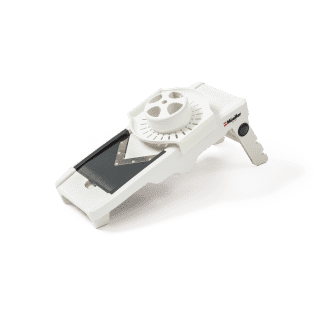
- V-Slicers: V-slicer mandolines have two blades that connect in a V-shape near the center of the mandoline. In our testing, we found that these models struggled to cut tougher foods. Why? With V-slicers, food encounters two blades simultaneously, on either side of the V. The more blade the food touches at the same time, the more friction and resistance it has to overcome, resulting in more force being needed to push the food through. Mandolines with single blades have less for food to fight against, making it easier to slice. Even when these V-slicers managed to cut the food, they didn’t always do so evenly—and evenness is essential for uniform cooking and attractive presentation. In general, if either the blade or the platform isn’t stiff and rigid as food passes over it, it can sag under the pressure, making the food slice unevenly as a result. Because V-slicers have very little support at the crux of their Vs, the blades and/or platforms tend to slump, turning out slices of food with wavy, V-shaped indents as a result.


V-slicers sliced food unevenly, leaving V-shaped indents where their blades or platforms sagged during cutting.
The Tests
- Slice tomatoes at thinnest setting (variable)
- Slice beets 1/16th-inch thick
- Slice fennel 1/16th-inch thick
- Slice potatoes ⅛-inch thick
- Slice eggplant ¼ inch thick
- Julienne carrot and daikon
- Julienne celeriac
- Wash according to manufacturer’s instructions 10 times
How We Rated
- Sharpness: We rated the mandolines on how sharp their blades were.
- Performance: We rated the mandolines on how easily and consistently they cut a wide range of produce.
- Ease of Use: We evaluated the mandolines on how easy to set up, use, clean, and store they were.
- Versatility: We rated the mandolines on whether they could make cuts in a wide range of thicknesses; extra cuts were also considered.
- Stability: We evaluated how securely the mandolines sat on the counter.