

 Buy at Amazon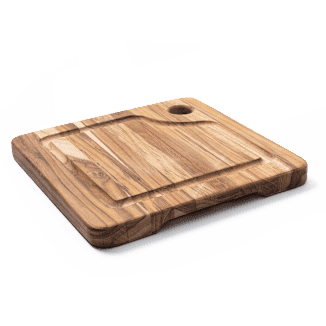
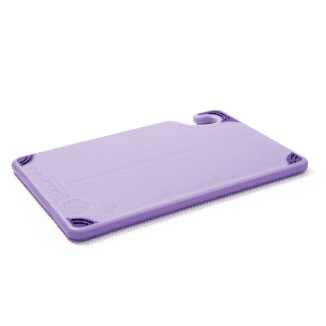
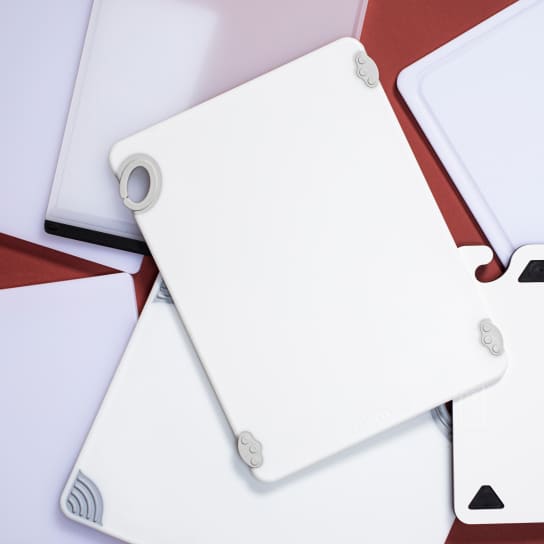
The best bar boards are stable on the counter and offer ample space for various small tasks. Our favorite plastic bar board is the OXO Good Grips Prep Cutting Board; it had a moderately large surface and sat securely on the counter, thanks to its rubber grips. Our top wood bar board is the reversible Teakhaus Square Marine Board with Juice Canal; it provided sufficient surface area to chop small foods and it was handsome enough to double as a serving board.

Bar boards are the littlest members of the cutting board family—the baby boards, if you will. As their name suggests, they were originally used in bars for cutting citrus and small fruit for garnishes. But they’re handy in the kitchen as well. Petite and lightweight, they’re perfect for any tiny task you might have: cutting an apple, slicing some cheese, or mincing a few herbs to put on your lunch. They’re also highly portable, making them a great choice for picnics or other on-the-go slicing and dicing.
Bar boards come in a range of sizes, but we focused on models that were about half the size of our favorite small cutting board, which measures about 14 by 11 inches, or even smaller.

What’s the Best Material for a Bar Board?
Plastic is most common for boards this size, but we also considered wood, bamboo, and paper composite boards. We didn’t have strong preferences when it came to material. All the boards proved equally durable, with every model scarring when we used a serrated knife to cut baguettes on them. But none of the boards warped or cracked, even after 25 washes.
Different materials have different advantages. Plastic and paper composite boards require no special maintenance and are easy to clean—both types can be thrown in the dishwasher. And they didn’t stain or retain odors after our chipotle test.
By contrast, wood and bamboo boards require a little more maintenance; you must oil them periodically to keep water out so that they don’t warp or crack. They also required a few extra washes to remove chipotle stains and odors.

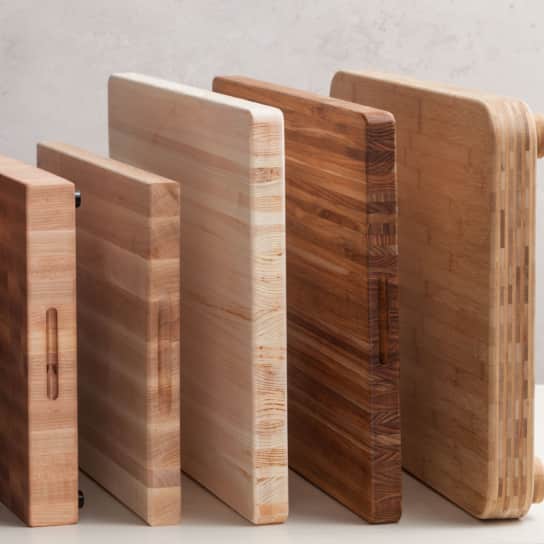
Nonetheless, wood and bamboo boards are more handsome than the plastic boards, ideal for use as mini cheese plates or small serving platters—a nice bonus in our book. And it was a little quieter to cut on them than on the plastic or paper composite models, which sometimes made loud clacking noises under our knives, particularly when we used extra force to slice salami or cheese.
Ultimately, the choice of material is up to you. If you prefer a low-maintenance board with a utilitarian look, choose plastic. If you’re fine with occasional maintenance and you prefer a board that can easily go from the countertop to the table, then wood or bamboo may be the right choice for you.
What to Look for
- Moderately Large Surface: We wanted a board that was small—but not, as it turned out, too small. A bar board should be big enough to not only hold a lemon but also have the space to hold the wedges as we cut sections. We preferred boards that were at least 64 square inches in area, or about the size of a large paperback book. Our favorite boards were some of the largest we tested—the biggest was about the size of an iPad—but still small enough to fit comfortably in a handbag or backpack.


The smallest boards didn’t provide enough room for a lemon. Bigger boards easily held more food.
- Stability: As with all cutting boards, stability is critical. You don’t want your board slipping around when you’re cutting. The most stable models had rubber grips that anchored the boards to the counter. Weight was a factor too. Heavier models stayed put better than lighter-weight ones.
Nice to Have
- Reversibility: As in other cutting board reviews, we slightly preferred bar boards that were reversible since we could use both sides.
What to Avoid
- Small Surface Area: One of the boards was the size of a postcard, so tiny that an 8-ounce block of cheddar cheese didn’t entirely fit on it.
- Smooth, Slippery Boards: Ultra-lightweight boards without rubbery grips slid around the counter when we minced ingredients on them. One board was somewhat heavy for its size, but the lack of grips made it slide a little during more vigorous testing.
Other Considerations
- Juice Grooves: Some boards had sides with juice grooves, or trenches around their perimeters, that collected any liquid runoff from the foods we were cutting. We liked having this feature, as it helped keep our counters clean when cutting juicy lemons into wedges, and it might also prove useful when slicing a cooked chicken breast or pork chop. But a juice groove wasn’t strictly necessary. We didn’t penalize boards without them.

The Tests
- Cut a lemon into wedges
- Chiffonade basil
- Mince a shallot
- Slice salami
- Slice a block of cheddar cheese
- Slice half a baguette
- Leave chipotle in adobo on the boards overnight and then wash them
- Wash each board according to the manufacturer’s instructions 25 times
How We Rated
- Ease of Use: We rated the boards on how well they accommodated foods of different (small) sizes, how pleasant they were to cut on, and how easily they resisted stains and odors.
- Stability: We rated the boards on how securely they sat on the counter.
- Versatility: We rated the boards on how easily they could be used for both cutting and serving foods.