

 Buy at Amazon
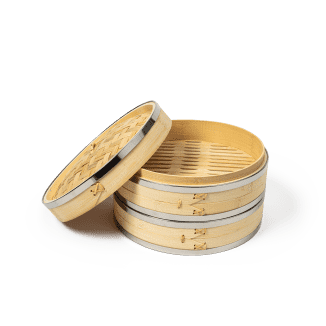
Bamboo steamers are great for cooking lots of food efficiently. Our favorite is the Juvale 10 Inch Bamboo Steamer with Steel Rings for Cooking. It does an excellent job of steaming different foods, and it’s well-made and durable to boot.

Originally from China, bamboo steamers are perhaps best known today as the vessels used to cook and serve many popular dim sum dishes. Because they’re made up of bamboo tiers with level interior surfaces, they’re ideal for steaming any food that needs to sit flat during cooking, such as dumplings or bao, or food that might break or become misshapen in a collapsible steamer with a curved base, such as fragile fish fillets. While you can get bamboo steamers in many sizes and configurations, they’re most commonly available as sets of two or three 10-inch round bamboo tiers—a size that is compatible for use with a 14-inch wok or a 12-inch skillet or sauté pan, among other vessels. Each tier provides about 68 square inches of surface area—roughly the same surface area as our favorite metal steamer. But because the tiers are stackable, you can double and triple the capacity as needed. Cooking dumplings for a crowd? Use two or three tiers. A piece of salmon for one? A single tier will do.

The separate tiers have another advantage: You can steam foods with different cooking times simultaneously, removing tiers as each food finishes cooking. Just be aware that foods take longer to cook the farther they are from the heat source. Another advantage is that the bamboo absorbs some of the steam during cooking, preventing condensation from dripping back onto your food and getting it wet. And of course, the steamers are pretty enough that you can serve food right out of them at the table.
You can use one, two, or sometimes even three tiers, depending on how much food you’re cooking.
A few caveats: Because they’re made of a natural fiber, bamboo steamers are more fragile than metal steamer baskets—they must be washed and dried carefully between uses so that they don’t warp, crack, or develop mold. They can absorb odors from your food or cooking liquid, though at least in our experience, these odors faded after a few washes and didn’t transfer to subsequent foods we cooked. Finally, bamboo steamers take up a bit more room in your cabinet; unlike those metal steamer baskets, they’re not collapsible.

How to Use and Care for Your Bamboo Steamer
Using a bamboo steamer couldn’t be easier. Here’s what you need to know to get started.
Learn MoreWhat to Look For
- Solid Construction: A good steamer should have relatively smooth surfaces with few loose fibers and have tiers that fit together easily and securely.
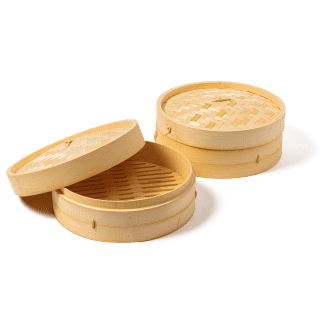
- Tiers with Metal Bands: Models made entirely of bamboo are prone to warping, as their fibers absorb water during steaming or washing. If an all-bamboo steamer is solidly made, you can sometimes avoid this problem—one of the models we tested was fine after 10 washes. But two other all-bamboo models, less well-made, warped slightly over time, making it harder to fit one tier over another snugly so that steam wouldn’t escape. This slight warping didn’t significantly affect their performance—both still trapped plenty of steam and cooked food quickly. Still, they were a little annoying to put together, as we had to fuss a bit more to get the tiers to align. The tiers of a few models were reinforced with metal bands around their tops and/or bottoms. These metal bands helped prevent warping and kept the tiers aligned better over the course of 10 washes.

Tiers with metal bands (left) kept their shape better, so they were easier to keep aligned after multiple uses.
- Thick, Glued Bamboo Slats: The base of each steamer tier has slats that allow steam to come through. Models with thick, Popsicle-stick-like slats that were glued to each other side by side proved more durable than thinner, reedlike slats that were tied together with bamboo ribbons.

We preferred tiers with thick, Popsicle-stick-like slats (top left), as they held up to repeated use better than those with thinner slats tied together with bamboo ribbons (bottom right).
What to Avoid
- Poor Construction: Some of the steamer baskets just weren’t made as well as the others. They arrived with tiers that didn’t stack securely or were made from bamboo that was discolored or brittle or had lots of loose fibers that we had to remove before using them. Because bamboo is a natural material, it’s normal for a steamer to have a few loose fibers, but any more than a few becomes a pain to deal with, as you have to pick them off carefully to avoid getting them in your food.

- Thin, Hand-Tied Bamboo Slats: We didn’t love tiers made with thin, reedlike bamboo slats that were secured to each other using even thinner hand-tied ribbons of bamboo. These slats were flimsy, and some of the ribbons broke or shredded over the course of 10 washes. These models also had more nooks and crannies for water to linger and mold to develop in, too.

How to Hack a Bamboo Steamer for Dumplings
Don’t have one? No problem. We teach you how to mimic a bamboo steamer using what you already have in your kitchen.
Learn MoreOther Considerations
- Number of Tiers: We think two 10-inch tiers provide plenty of room to steam enough food for four to six people. But if you think you might want to cook for even more folks, consider investing in a model that has three tiers. While it depends somewhat on what you cook, the food on the bottom tiers will be done faster than the food on the top; you may need to remove or reconfigure the steamer tiers over time to cook everything as efficiently as possible.

- Tier Depth: Most models had tiers that were 1.6 to 2 inches deep. This proved more than adequate for steaming dumplings and small bao. But if you regularly cook taller foods (big mantou, for example), you might like a model with higher walls.
The Tests
- Steam bao in one tier
- Steam dumplings in two tiers (or three tiers if possible)
- Wash and dry 10 times
- Winner only: Cook salmon in one tier and greens in the other. Evaluate for odor retention. Wash once and steam dumplings; evaluate for odor transfer.
How We Rated
- Performance: We evaluated how well the bamboo steamers cooked different foods.
- Durability: We rated the steamers on how well their tiers aligned and maintained their shape after extended use and multiple washes.


 Buy at Williams Sonoma