America's Test Kitchen LogoCook's Country LogoCook's Illustrated Logo

Reviews You Can Trust.
See Why.

The Best Smokers Less Than $500

Ready to get serious about making barbecue at home? These entry-level smokers are your best bets.

Headshot of Miye Bromberg
By Miye Bromberg

Last Updated June 24, 2025

What You Need To Know

You can smoke food really well on a charcoal or gas grill, but if you love barbecue and make it often, there are a few reasons to invest in a dedicated smoker. Most good smokers can maintain lower temperatures than a grill can—from 225 to 250 degrees, the low-and-slow temperature range barbecue experts recommend for turning tough cuts of meat tender without drying them out. (On grills, smoking temperatures range from 275 to 325 degrees.) In addition, most smokers allow you to maintain temperatures more consistently and precisely than you can on a grill. Many also have larger fuel capacities (unlimited with electric models), so you won’t have to worry as much about running out of heat during long cooking times. 

Smokers are generally categorized by the type of fuel they use: charcoal, gas, or electricity. On a broad scale, they all work similarly. The fuel provides the smoker with heat, turning it into a vented oven. You add wood chunks or chips directly on top of that fuel or contain them in metal pans suspended over the heat. The wood heats up, producing the smoke that is essential to barbecue flavor.

We smoked sides of salmon in all the smokers to see how well the models were able to maintain low temperatures for short periods and to see how the salmon's smoke flavor differed.

Each type of fuel has different advantages and disadvantages. To learn which smoker best fits your needs, read on.

Charcoal Smokers: Great Barbecue, a Little Work

Pros: Of the three types of smokers tested, charcoal smokers produced the best-tasting barbecue, hands down. No matter what we cooked, tasters unanimously preferred the food cooked in charcoal smokers; it was consistently deeper in flavor than food cooked in gas or electric smokers. It wasn’t just smoky, it tasted of the fire—rich and woodsy, with extra charred and caramelized notes.

Despite a slight difference in operating temperature, both of the charcoal smokers we tested made delicious, good-looking chicken.

This is because charcoal makes more—and better—smoke than gas or electricity does. It burns wood at hotter temperatures, creating a greater volume of smoke with a more varied, aromatic array of flavor molecules. And as author and barbecue expert Meathead Goldwyn hypothesizes, charcoal itself may serve as an additional source of flavor, as it contains complex organic molecules that contribute new aromas when burned.

Charcoal smokers such as the one on the right not only make different smoke than gas and electric models—they make more of it, too.

Another plus: Charcoal smokers are usually simple metal vessels, so they’re easy to assemble and maintain. They also have fewer parts that can break or get damaged.

Tasters unanimously preferred the flavor of ribs cooked on charcoal smokers.

Cons: As a fuel source, charcoal is messy and fussier to use. With many charcoal models, you’ll need to adjust the air intake vents periodically to maintain a low heat. Depending on the length of your cooking time and the weather, you may need to configure your charcoal and wood in different ways to achieve the temperature you want or occasionally add more charcoal and wood midcooking.

our favorite charcoal smokers by weber and pit barrel

Our Favorite Models: If flavor is your priority, charcoal is the way to go. We think a little babysitting is a small price to pay for exceptional barbecue. Our favorite smoker overall is the Weber Smokey Mountain Cooker Smoker 22". While it requires some attention to maintain your cooking temperature, it produces amazing food and is roomy enough to make lots of it. We also loved the 18.5" Classic Pit Barrel Cooker. It’s a great no-frills model and produces food that rivals our winner’s. It lacks temperature controls and runs hotter than most smokers, but for some, this lack of control might actually be an advantage—you can’t fuss even if you wanted to. Just load the smoker with food and walk away; when you return, there’s perfect barbecue.

Gas Smokers: Good Barbecue, Convenience

Ribs made in a gas smoker (top) weren't as smoky or deeply flavored as ribs cooked in charcoal smokers (bottom) but were still very tasty.

Pros: The differences between charcoal and gas smokers reflect those between charcoal and gas grills. Gas smokers are easier and less messy to use. Propane tanks provide lots of fuel (we used ours for more than 20 hours during testing and still had more than half a tank left). Like gas grills, the best gas smokers are mostly set-and-forget. You turn on the gas and set your target temperature, which it achieves quickly and then maintains. It’s possible to stay in your desired cooking zone with no adjustments—a more hands-off experience than charcoal.

Gas smokers excel at maintaining low temperatures, so salmon cooked in one (left) was exceptionally moist and tender, though not as smoky as salmon cooked in a charcoal model (right).

Cons: Because gas smokers maintain lower temperatures effortlessly, food cooked in them can be especially tender and moist—it just isn’t quite as richly flavored or intensely smoky as food cooked in a charcoal smoker.

Gas smokers often come in cabinet-style designs, resembling mini fridges with shelves that your food sits on as it’s being smoked. They can be harder to assemble—the model we tested took about an hour and a half to put together. Often, the pans used to hold wood chips or chunks are small; you’ll need to refill them periodically to ensure that you get smoke flavor. With the model we tested, we replenished the wood chunks every hour.

our top gas smoker by masterbuilt

Our Favorite Model: The Masterbuilt MPS 340/G ThermoTemp XL Propane Smoker is a fine option for folks who don’t mind sacrificing a little flavor for convenience. It’s a pain to assemble, but it turns out succulent, lightly smoked barbecue with little or no babysitting needed.

Electric Smokers: Easy to Use, Mediocre Barbecue

Finished ribs in a cabinet-style electric smoker

Pros: At best, electric smokers are even easier to use than gas smokers. Like gas smokers, you can set and forget them, and because they’re good at maintaining low temperatures, your food will always come out tender and moist. Better still, they pull an unlimited supply of electricity straight from your outlet—you’ll never have to replenish your fuel.

Chicken cooked in an electric smoker (left) wasn't nearly as smoky or richly flavored and colored as chicken cooked in a charcoal smoker (right).

Cons: The food they make just doesn’t taste like barbecue. With the model we tested, everything we cooked tasted only very faintly smoked, even though we fed the smoker a constant stream of wood. Sometimes we couldn’t tell the food had been smoked at all.

Because the wood in an electric smoker never burns outright, food cooked in an electric smoker (right) lacks the coveted smoke ring found in barbecue cooked in a charcoal or gas smoker (left).

This is because the smokers' electrical heating elements never get the wood hot enough to burn outright. Instead, the wood just smolders, generating weak smoke without the array of flavor molecules produced in wood burned in charcoal or gas smokers at higher temperatures, as Goldwyn and food scientist Greg Blonder have shown. In addition, the food cooked in an electric smoker lacks a smoke ring. Because the wood smolders in an electric smoker, the chemical reactions required to form that smoke ring never occur.

our top electric smoker by Bradley

Our Favorite Model: If you really want to make barbecue and space or fire hazards are issues, the Bradley Smoker Original 4 Rack Electric Smoker is an acceptable option. You won’t get competition-worthy barbecue, but it’s compact and easy to use.

FAQs

Some manufacturers recommend “seasoning” their smokers before use, a process that involves spraying the interior of the smoker with oil and then running the smoker at high heat for a few hours. As food scientist and barbecue expert Greg Blonder advised us, this isn’t necessary—seasoning won’t improve the performance or the longevity of the unit. That said, he does recommend skipping the oil and running your smoker at high heat before your first use. It’ll burn off any residual chemicals or machine oil that were left over from manufacturing.

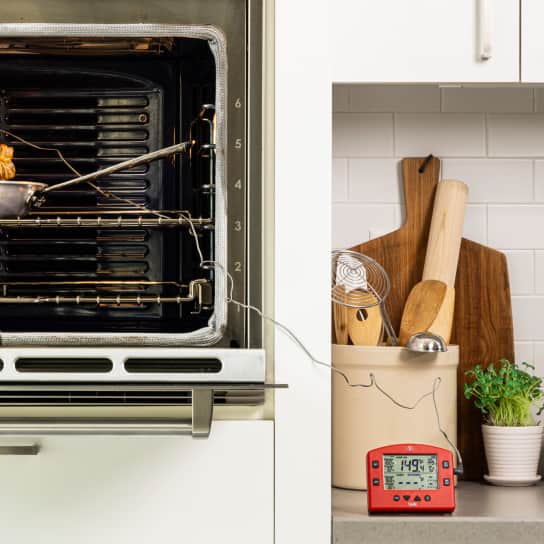
A Remote-Probe Thermometer: We highly recommend using at least a two-channel remote thermometer to monitor both your smoker’s ambient temperature and the temperature of the food you’re cooking. Although most smokers come with built-in thermostats, they are often inaccurate, or accurate only for the area they’re located in. If you plan to smoke only one food at a time, the ThermoWorks Smoke 2-Channel Alarm is a good choice. If you’re getting serious about barbecue and want to smoke multiple foods at once, monitor the temperature in different areas of your smoker, or generally have more data on your cooking, we think the FireBoard2 more than justifies its higher cost.

Grill Gloves: Smokers stay cooler than grills, but they can still get plenty hot; these will protect your hands. 

Grill Tongs: These long tongs allow you to safely move and flip your food. 

A Chimney Starter: We recommend using a chimney starter to ignite charcoal briquettes. Our full-size favorite, the Weber Rapidfire Chimney Starter, works just fine. But if you smoke a lot of food, the half-size Weber Rapidfire Compact Chimney Starter is ideal, since you don’t need to light quite as many briquettes when using a smoker, and this model’s smaller profile makes it easier to maneuver in more awkward spaces such as the bottom of the Pit Barrel Cooker. 

Charcoal Starter: You can use newspaper to light your chimney starter, but these paraffin cubes are easier to use and more convenient.

Many foods taste best when they’re freshly made. With BBQ, there’s a scientific explanation. Read our article on the scientific reason why fresh BBQ tastes so good.

Everything We Tested

Good 3 Stars out of 3.
Fair 2 Stars out of 3.
Poor 1 Star out of 3.

Highly Recommended - Charcoal

  • Performance
  • Assembly
  • Ease of Use

Best OverallWeber Smokey Mountain Cooker Smoker 22"

The Weber Smokey Mountain, or WSM, has been around for 40 years, and for good reason: It’s a durable, well-designed charcoal smoker that makes great-tasting, competition-worthy barbecue. Like most charcoal models, this cylindrical bullet smoker does have a learning curve: You’ll need to monitor the temperature inside and periodically adjust the air intake vents in order to get the heat level you want. (A port built into the side of the smoker makes it especially easy to insert a probe for monitoring those temperatures, and a large water pan helps keep those temperatures steady once you’ve achieved them.) A generously sized charcoal basket lets you smoke for long periods without having to replenish your fuel or wood—we were able to cook for 10 hours easily. If you do need to add briquettes or wood, the process is simple: Just open a door in the body of the smoker and chuck them in. We wish the door sealed more tightly, as smoke and heat escaped easily around its edges, making us burn through briquettes and wood faster. While disposing of charcoal is messy, the smoker separates into three parts to make it easier to access those ashes for disposal. The WSM comes in three sizes. The 22-inch model we tested is the largest. With two grates arranged one over the other, it can smoke multiple racks of ribs, many pork butts, and at least two spatchcocked turkeys at a time. It’s easy to assemble and comes with a warranty that covers different parts for two to 10 years.

Model Number: 731001

Fuel Capacity: 19 qt (about 320 briquettes)

Features: 2 grates, water pan, door for adding charcoal/wood, port for inserting temperature probes, thermostat on lid

Price at Time of Testing: $459.00

  • Performance
  • Assembly
  • Ease of Use

The Weber Smokey Mountain, or WSM, has been around for 40 years, and for good reason: It’s a durable, well-designed charcoal smoker that makes great-tasting, competition-worthy barbecue. Like most charcoal models, this cylindrical bullet smoker does have a learning curve: You’ll need to monitor the temperature inside and periodically adjust the air intake vents in order to get the heat level you want. (A port built into the side of the smoker makes it especially easy to insert a probe for monitoring those temperatures, and a large water pan helps keep those temperatures steady once you’ve achieved them.) A generously sized charcoal basket lets you smoke for long periods without having to replenish your fuel or wood—we were able to cook for 10 hours easily. If you do need to add briquettes or wood, the process is simple: Just open a door in the body of the smoker and chuck them in. We wish the door sealed more tightly, as smoke and heat escaped easily around its edges, making us burn through briquettes and wood faster. While disposing of charcoal is messy, the smoker separates into three parts to make it easier to access those ashes for disposal. The WSM comes in three sizes. The 22-inch model we tested is the largest. With two grates arranged one over the other, it can smoke multiple racks of ribs, many pork butts, and at least two spatchcocked turkeys at a time. It’s easy to assemble and comes with a warranty that covers different parts for two to 10 years.

Model Number: 731001

Fuel Capacity: 19 qt (about 320 briquettes)

Features: 2 grates, water pan, door for adding charcoal/wood, port for inserting temperature probes, thermostat on lid

Price at Time of Testing: $459.00

  • Performance
  • Assembly
  • Ease of Use

Best No-Frills Charcoal Model18.5" Classic Pit Barrel Cooker

The Pit Barrel Cooker, or PBC, is a cult favorite among barbecue enthusiasts. It’s an incredibly simple smoker—essentially a metal barrel—and can be used pretty much right out of the box, no assembly required. Relatively compact, it holds an impressive amount of food: You can either use the standard cooking grate or hang food from two rods, a configuration that gives you a lot of vertical space for, say, a large turkey or eight racks of ribs. Important to note: There’s no way to control or adjust the heat once the charcoal is lit, and the temperature runs a bit hotter than ideal—between 250 and 300 degrees with higher spikes. As a result, the food we made consistently cooked faster than in other models and sometimes turned out a bit drier. Still, some tasters preferred the food made in it to the food made in our winner, finding it to have a more charred, “grilled” flavor, likely because fats and juice from meat drip directly onto the hot briquettes, creating an additional source of smoke. To some, the lack of temperature control is an advantage: You just add the food and walk away, no fussing possible. A few small quibbles: The charcoal sits at the bottom of the barrel. If you need to add briquettes during cooking, there’s no way to do this without taking out all the food on top first. And once you’re done cooking, you’ll have to invert the whole unit to pour out the ashes—a task that can be unwieldy since the smoker weighs about 40 pounds empty. (Some users vacuum up the ashes or buy the company’s ash pan, available separately, to avoid this.) It comes with just a one-year warranty, though we’ve heard that the customer service is generally very responsive.

Model Number: 18.5" Classic Pit Barrel Cooker

Fuel Capacity: About 9 qt (about 150 briquettes)

Features: 1 grate, 2 rods, and 8 hooks for hanging food vertically

Price at Time of Testing: $349.99

  • Performance
  • Assembly
  • Ease of Use

The Pit Barrel Cooker, or PBC, is a cult favorite among barbecue enthusiasts. It’s an incredibly simple smoker—essentially a metal barrel—and can be used pretty much right out of the box, no assembly required. Relatively compact, it holds an impressive amount of food: You can either use the standard cooking grate or hang food from two rods, a configuration that gives you a lot of vertical space for, say, a large turkey or eight racks of ribs. Important to note: There’s no way to control or adjust the heat once the charcoal is lit, and the temperature runs a bit hotter than ideal—between 250 and 300 degrees with higher spikes. As a result, the food we made consistently cooked faster than in other models and sometimes turned out a bit drier. Still, some tasters preferred the food made in it to the food made in our winner, finding it to have a more charred, “grilled” flavor, likely because fats and juice from meat drip directly onto the hot briquettes, creating an additional source of smoke. To some, the lack of temperature control is an advantage: You just add the food and walk away, no fussing possible. A few small quibbles: The charcoal sits at the bottom of the barrel. If you need to add briquettes during cooking, there’s no way to do this without taking out all the food on top first. And once you’re done cooking, you’ll have to invert the whole unit to pour out the ashes—a task that can be unwieldy since the smoker weighs about 40 pounds empty. (Some users vacuum up the ashes or buy the company’s ash pan, available separately, to avoid this.) It comes with just a one-year warranty, though we’ve heard that the customer service is generally very responsive.

Model Number: 18.5" Classic Pit Barrel Cooker

Fuel Capacity: About 9 qt (about 150 briquettes)

Features: 1 grate, 2 rods, and 8 hooks for hanging food vertically

Price at Time of Testing: $349.99

Recommended - Gas

  • Performance
  • Assembly
  • Ease of Use

Easiest to UseMasterbuilt MPS 340/G ThermoTemp XL Propane Smoker

It took us about an hour and a half to put this gas smoker together, but we were glad we did. It’s very easy to use: Just turn on the gas and select your temperature. A clearly marked dial lets you set specific temperatures with a fair degree of accuracy. We rarely needed to make adjustments to keep the temperature in range, even during long cooking times. Four slide-out racks were easy to load with food and gave us plenty of room for smoking lots of food at a time—the unit is big enough to accommodate a 15-pound turkey or four racks of ribs. Two doors latch tightly to keep heat and smoke in: A big glass door lets you see the food as it’s cooking, and a smaller one lets you access the wood chip chamber without letting out too much heat from the main cooking area. The wood chip chamber itself is a little small, so you’ll need to use wood chips or small wood chunks and replenish them periodically. Generally, the chamber held enough chips to provide an hour's worth of smoke. Because this smoker was great at maintaining lower temperatures, it produced exceptionally moist, tender barbecue. The food itself was more lightly smoked and less complex than food made in the charcoal models, but it was still tasty. Be aware that this gas smoker has more parts that need to be cleaned or washed after use, but the racks and water and drip pans can all go in the dishwasher. (You’ll still need to scrub off any grease that collects in the bottom of the unit, though.)

Model Number: MPS 340/G

Fuel Capacity: Propane tank

Features: 4 cooking racks, water pan, wood chip pan, drip tray

Price at Time of Testing: $399.99

  • Performance
  • Assembly
  • Ease of Use

It took us about an hour and a half to put this gas smoker together, but we were glad we did. It’s very easy to use: Just turn on the gas and select your temperature. A clearly marked dial lets you set specific temperatures with a fair degree of accuracy. We rarely needed to make adjustments to keep the temperature in range, even during long cooking times. Four slide-out racks were easy to load with food and gave us plenty of room for smoking lots of food at a time—the unit is big enough to accommodate a 15-pound turkey or four racks of ribs. Two doors latch tightly to keep heat and smoke in: A big glass door lets you see the food as it’s cooking, and a smaller one lets you access the wood chip chamber without letting out too much heat from the main cooking area. The wood chip chamber itself is a little small, so you’ll need to use wood chips or small wood chunks and replenish them periodically. Generally, the chamber held enough chips to provide an hour's worth of smoke. Because this smoker was great at maintaining lower temperatures, it produced exceptionally moist, tender barbecue. The food itself was more lightly smoked and less complex than food made in the charcoal models, but it was still tasty. Be aware that this gas smoker has more parts that need to be cleaned or washed after use, but the racks and water and drip pans can all go in the dishwasher. (You’ll still need to scrub off any grease that collects in the bottom of the unit, though.)

Model Number: MPS 340/G

Fuel Capacity: Propane tank

Features: 4 cooking racks, water pan, wood chip pan, drip tray

Price at Time of Testing: $399.99

Recommended with Reservations - Electric

  • Performance
  • Assembly
  • Ease of Use

For Cooks with Limited SpaceBradley Smoker Original 4 Rack Electric Smoker

This compact cabinet-style electric smoker promised an effortless barbecue experience. It was easy to set up, and electricity provides an unlimited source of fuel. An automated system continuously feeds wood “bisquettes” (compressed wood disks) through the smoker, so you’ll never have to replenish your wood supply during cooking, as you do with other models. (You will have to empty the water pan that collects the bisquettes every hour, though, and the bisquettes themselves aren’t cheap—at about $0.67 per bisquette, you can spend about $12.00 for a 6-hour cooking time.) But there were a few catches. Our unit shorted out and had to be turned back on every 20 minutes. Its temperature dial lacks any temperature settings, so you’ll have to experiment to figure out how hot each position is. As with most electric smokers, it excelled at maintaining low temperatures, so food cooked in it was always moist and tender. But because its heating element didn't actually get the wood hot enough to burn outright, that food had little to no smoke flavor and no smoke ring, despite the constant flow of bisquettes. If you are determined to buy a smoker but live somewhere where you can’t use gas or charcoal, this electric smoker is a decent, compact option—just know that because it's small, you’ll have to cut racks of ribs in half to fit them on two shelves. Turkey is not an option.

Model Number: BS611

Fuel Capacity: Unlimited (electricity)

Features: 4 cooking racks, water pan, automatic wood bisquette advance system

Price at Time of Testing: $429.00

  • Performance
  • Assembly
  • Ease of Use

This compact cabinet-style electric smoker promised an effortless barbecue experience. It was easy to set up, and electricity provides an unlimited source of fuel. An automated system continuously feeds wood “bisquettes” (compressed wood disks) through the smoker, so you’ll never have to replenish your wood supply during cooking, as you do with other models. (You will have to empty the water pan that collects the bisquettes every hour, though, and the bisquettes themselves aren’t cheap—at about $0.67 per bisquette, you can spend about $12.00 for a 6-hour cooking time.) But there were a few catches. Our unit shorted out and had to be turned back on every 20 minutes. Its temperature dial lacks any temperature settings, so you’ll have to experiment to figure out how hot each position is. As with most electric smokers, it excelled at maintaining low temperatures, so food cooked in it was always moist and tender. But because its heating element didn't actually get the wood hot enough to burn outright, that food had little to no smoke flavor and no smoke ring, despite the constant flow of bisquettes. If you are determined to buy a smoker but live somewhere where you can’t use gas or charcoal, this electric smoker is a decent, compact option—just know that because it's small, you’ll have to cut racks of ribs in half to fit them on two shelves. Turkey is not an option.

Model Number: BS611

Fuel Capacity: Unlimited (electricity)

Features: 4 cooking racks, water pan, automatic wood bisquette advance system

Price at Time of Testing: $429.00

America's Test Kitchen Accolades Badge

Reviews You Can Trust

The mission of America’s Test Kitchen Reviews is to find the best equipment and ingredients for the home cook through rigorous, hands-on testing. We stand behind our winners so much that we even put our seal of approval on them. Have a question or suggestion? Send us an email at atkreviews@americastestkitchen.com. We appreciate your feedback!

The Expert

Author: Miye Bromberg

Miye Bromberg

Deputy Editor, ATK Reviews

Miye is the deputy editor for ATK Reviews. She covers bread, booze, and blades.

Miye Bromberg is the deputy editor for ATK Reviews. Areas of specialization include bread, booze, and blades. A native of New York, she now lives in Kentucky, where she spends her free time thinking about film, tending her garden, and traveling long distances to eat dosas.

*All products reviewed by America’s Test Kitchen are independently chosen, researched, and reviewed by our editors. We buy products for testing at retail locations and do not accept unsolicited samples for testing. We list suggested sources for recommended products as a convenience to our readers but do not endorse specific retailers. When you choose to purchase our editorial recommendations from the links we provide, we may earn an affiliate commission. Prices are subject to change.

Reviews You Can Trust.
See Why.

This is a members' feature.
America's Test Kitchen LogoCook's Country LogoCook's Illustrated Logo