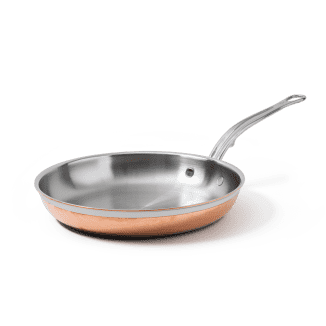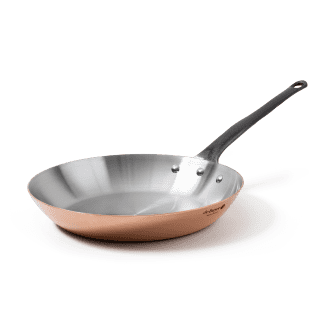
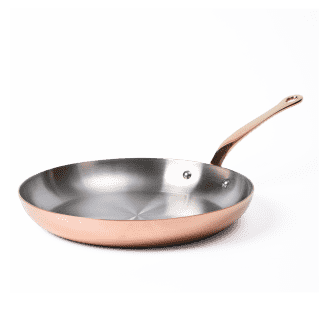
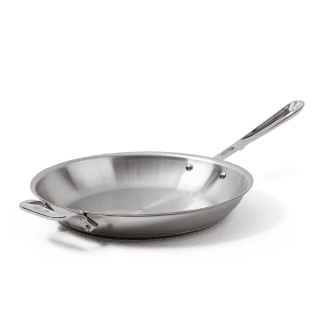
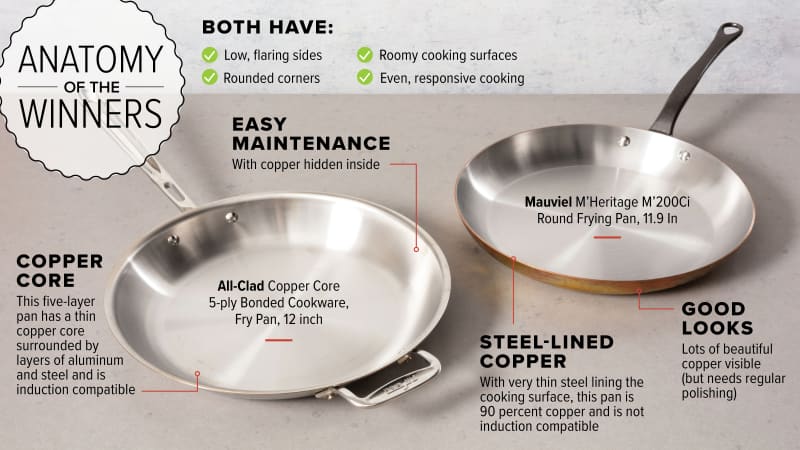
We fully recommend most of the pans we tested. Which you choose depends on how you want to use it. For excellent heat transfer and remarkably even cooking, without any special maintenance, choose a multilayer pan with the copper mostly hidden away at the core. In this style, we love the All-Clad Copper Core 5-ply Bonded Cookware, Fry Pan, 12 inch. If you want to see plenty of copper on your skillet, don’t mind occasional polishing to maintain its luster, and can handle a heavier pan, go for the Mauviel M'Heritage M'200Ci Round Frying Pan, 11.9 In. Made of copper with a thin lining of stainless steel, it combines steel’s nonreactive, durable construction with copper’s responsiveness, so it cooked food evenly and adjusted quickly when we changed heat settings on the stove. Its generous cooking surface fit plenty of food without crowding, and its low, flaring sides helped evaporate steam, so food browned deeply. It’s also a beautiful piece of cookware.

Copper cookware has always been associated with fine cooking, from classic French restaurants to Julia Child, who famously displayed rows of the gleaming golden pans on her kitchen walls. Copper cookware has been used for thousands of years; copper pots have been excavated from Roman ruins, and copper plays a big part in American history. Today, with prices in the hundreds of dollars for a single skillet, what besides nostalgia and aesthetics does a copper skillet offer home cooks? We bought a variety of copper skillets and brought them into the test kitchen to find out. We also compared their performance with our favorite fully clad stainless-steel skillet.
Here are some things to know about copper skillets.
- Speed: Copper is one of the fastest cookware materials for heat transfer, second only to silver. It’s more than 1.5 times as fast as aluminum and about 25 times faster than stainless steel. When placed on a burner, a copper skillet heats up very quickly, and when the flame is turned down, it cools fast, too. This responsiveness to the stove’s heat settings gives the cook excellent control and is what makes copper cookware a pleasure to use.
- Beauty: Copper’s rich color speaks for itself.
- Weight: Copper is dense, which makes it heavy. The copper skillets in our lineup averaged nearly twice the weight of our winning stainless-steel skillet. A closer comparison might be cast-iron pans.
- Needs Polishing: Copper starts to look splotchy the minute you use it, and it will tarnish and darken over time (see “How can I polish tarnished copper pans?”).
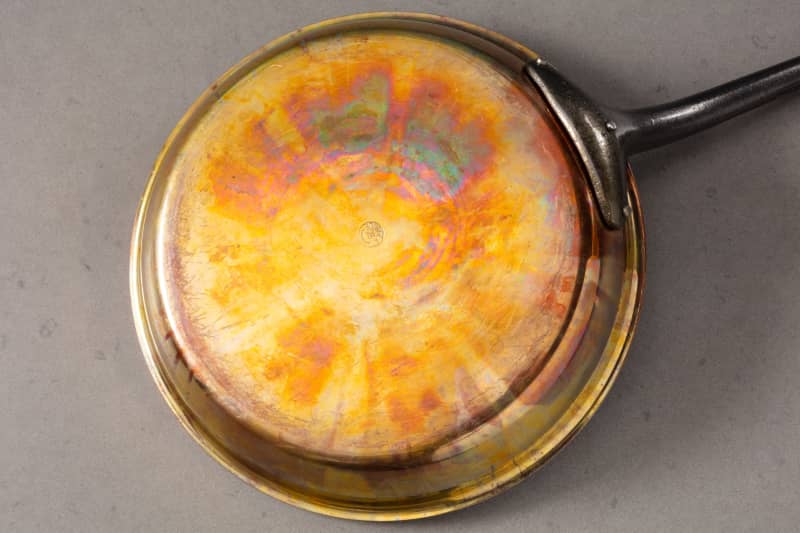
- Not Dishwasher-Safe: Harsh chemicals in dishwashing detergent will tarnish and wear away the copper.
- Most Are Not Induction Compatible: Copper is not magnetic, so it won’t work on induction stoves. If this is important to you, we found a few models that include magnetic steel to make them compatible.
- Reactivity: Copper is highly reactive to acids such as citrus, vinegar, and tomatoes and will leach into foods when in direct contact with them. Copper is poisonous when ingested in large quantities. That’s why copper cookware is almost always lined.
- Lining Matters: For centuries, the only choice for lining copper cookware was tin, but in recent years, stainless steel has become common. A third option is to cover the copper entirely by making it the core layer of a multiclad pan. We bought some of each to compare (see “Can I cook in an unlined copper pan?”).

What we learned: Once you line the copper pan with another metal, it changes how the pan transfers and retains heat, which affects cooking results. (Note: Copper pans can be lined with silver, which is highly durable and even faster than copper at transferring heat, but it is vastly more expensive. If price is no object, you can opt for solid silver cookware, but an 11.5-inch skillet costs $5,500.00. We did not test these.)


Copper transfers heat very quickly. A steel lining (left) helps hold and spread the heat throughout the pan. A tin lining (right) does not. As a result, steel-lined pans were less responsive but cooked more evenly. Tin-lined pans were super-responsive but cooked slightly less evenly.
What to Look For

- Steel-Lined Copper Skillets: Unlike tin linings, which are fragile (see “Tin Linings” below), stainless-steel linings are durable. However, stainless steel is 25 times slower to transfer heat than copper, and even a thin layer of steel puts the brakes on. Steel also retains heat, so steel-lined copper pans can’t cool as quickly when heat is lowered. Because this is a known drawback, this type of pan is usually marketed with descriptions of how thin manufacturers have made the steel layer, such as “90 percent copper, 10 percent steel.” However, we discovered that steel offers a benefit: As it slows copper’s quick vertical transfer of heat (up from the burner to the food), it forces heat to travel sideways through the copper, spreading rapidly across the cooking surface, making it cook more evenly and reducing hot spots.
OR look for:
- Copper-Core Skillets: With copper in the center of a multiclad pan, you don’t have to worry about copper’s reactivity to acidic foods or copper maintenance. The pans in our lineup with copper cores sandwiched them between layers of aluminum and then steel, resulting in five-ply pans. Because aluminum also transfers heat rapidly, this combo gets a turbocharge in responsiveness. Adding a top and bottom layer of steel helps spread heat sideways through the pan and even allows the pan to be induction compatible. The pans we tested, which had a fairly thin, 1-millimeter copper layer at their core, cooked remarkably evenly. They were easy to maintain and were lighter and more maneuverable than pans made principally from copper. For sheer cooking performance, this is probably the best choice. The downside? With less exposed copper, they weren’t as beautiful.
- Wide Cooking Surface: Our top-rated pans offered plenty of cooking space.


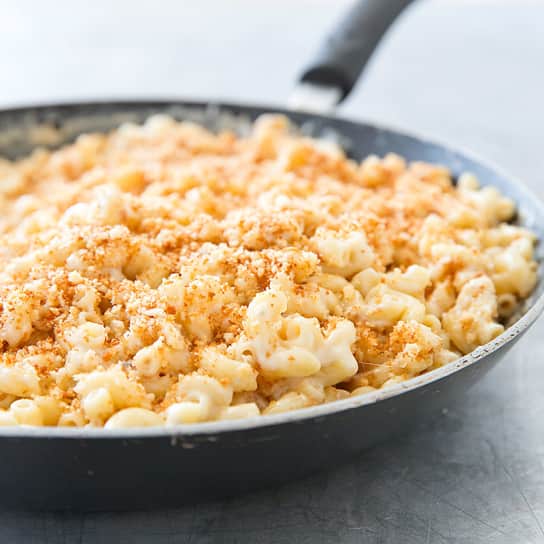
We made Three-Cheese Skillet Macaroni and Pan-Seared Chicken Breasts with Browned Butter Sauce in each skillet and preferred pans with wider, more spacious cooking surfaces. Narrow cooking surfaces crowded food and made us worry about spilling over the sides.
- Low, Flared Sides: These make it easier to reach under food with a spatula and help moisture evaporate so that food browns more quickly.
- Curved Corners: Sweeping a spatula around the pan without missing any food is easier with rounded rather than L-shaped sides.
Nice to Have
- Steel Handles: Pans in our lineup had either stainless-steel or cast-iron handles. While cast-iron handles on copper are traditional and beautiful, steel handles are lighter and slower to heat up on the stovetop, minimizing the need for pot holders. That said, our two favorite pans had one of each type.
- Induction Compatibility: If you have an induction stove, choose a copper-core pan with an outer layer of ferromagnetic steel.
What to Avoid
- Tin Linings: In order to compare this traditional type of lining, we tested one tin-lined skillet, by House Copper, against the rest of the lineup. This deep, heavy, handmade pan is gorgeous, and would work well as a braising pan. The biggest issue about tin lining in a copper skillet? Tin melts at just 450 degrees, a temperature easily reached in a frying pan when there isn’t much liquid or food covering its surface. In order to protect the tin lining, we couldn’t prepare all the recipes we made in the other copper skillets in our lineup: Tasks such as toasting panko, searing chicken breasts, and finishing mac and cheese under the broiler were off-limits. Despite being very careful and constantly checking the surface temperature as we worked, we did damage the tin lining while browning butter. Copper pans can be re-tinned, so the damage is not permanent. But we would rather not have to worry so much about what should be a workhorse pan.

- Narrow Cooking Surfaces: We find that small cooking surfaces limit the capacity and versatility of a pan, and crowded food steams rather than browns.
- High Sides: Tall sides discourage browning since they trap condensation, and they are awkward when reaching under food.
- L-Shaped Corners: This shape makes it harder to sweep a spatula around the skillet without leaving food behind.


We preferred skillets with rounded interior corners (right) to L-shaped corners (left), where food can get trapped when you swipe a spatula around the pan.
- So-Called “Copper” Nonstick Pans: Contrary to the way they are marketed, there are no copper skillets lined with nonstick coatings; these are aluminum or steel pans with copper-colored polytetrafluoroethylene or ceramic nonstick interiors and do not share any of the characteristics of real copper pans.
The Tests
- Pan-sear chicken breasts and make a pan sauce in each skillet
- Prepare skillet macaroni and cheese on the stovetop, browning the topping under the broiler
- Cook caramel sauce in each skillet
- Have additional testers make browned butter and provide feedback on the skillets' ease of use
- Wash the skillets by hand after each test
- Heat each skillet with canola oil, recording the temperature changes on an infrared camera
How We Rated
- Performance: We evaluated the skillets’ responsiveness to heat changes, the evenness of cooking and browning across their surfaces, their capacities, and their versatility.
- Ease of Use: We assessed factors such as shape, comfort, weight, and the balance of each skillet and handle.