 Buy at Amazon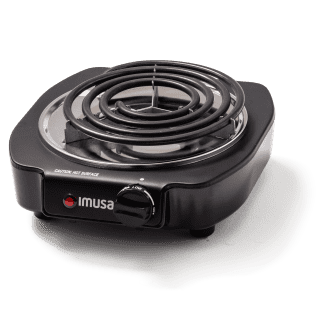

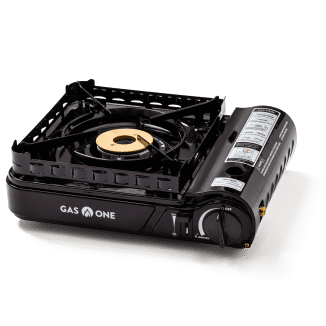
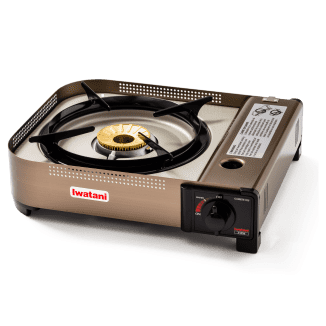
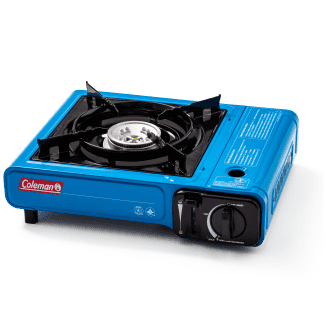
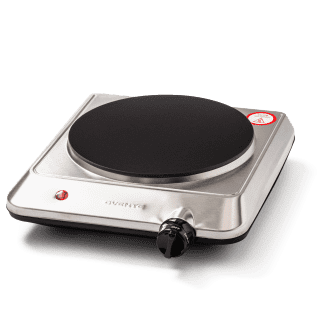
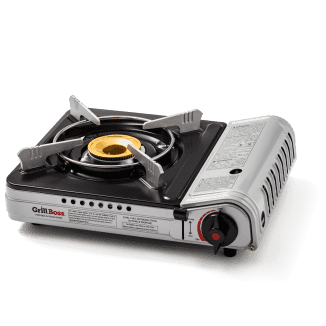
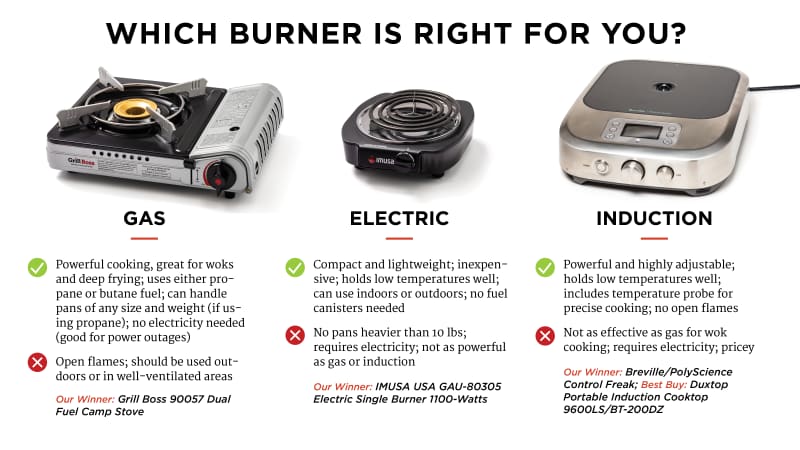
We tested electric- and gas-powered portable burners to learn the pros and cons of each style and compared them to our winning and Best Buy portable induction burners. Our top-rated gas burner, the Grill Boss 90057 Dual Fuel Camp Stove, offers the flexibility of using either butane or propane. Powerful and easy to use and clean, it aced every cooking test. (Note: Gas burners should be used outdoors or in a well-ventilated area.) Our top-rated electric burner, the IMUSA USA GAU-80305 Electric Single Burner 1100-Watts is inexpensive and tiny and got the job done. It was simple to operate and maintain. If you can’t have a gas burner in your space and want even more power at your disposal than our winning electric burner has to offer, an induction burner is a great choice.
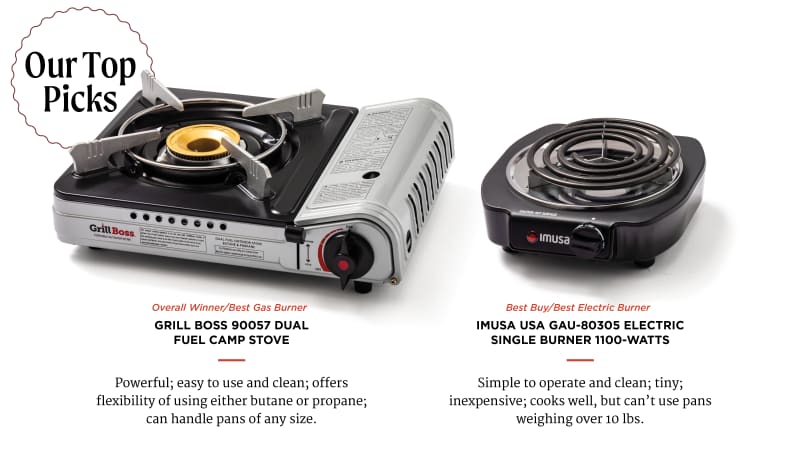
A portable burner is useful as a spare stove on holidays and during power outages, when traveling in an RV, for cooking tableside or outdoors—even just for messy frying projects in the backyard. They can be perfect in tiny kitchens or for access to a different technology (gas, induction, electric) than what’s installed in your kitchen.
We’ve previously tested and recommend portable induction burners. This time, we’re branching out to include gas and electric models, which are often less expensive and offer different advantages. The models in our lineup were priced from about $12 to about $110. On our wish list: plenty of cooking power, excellent temperature control, simple operation, and easy maintenance.
What to Look For
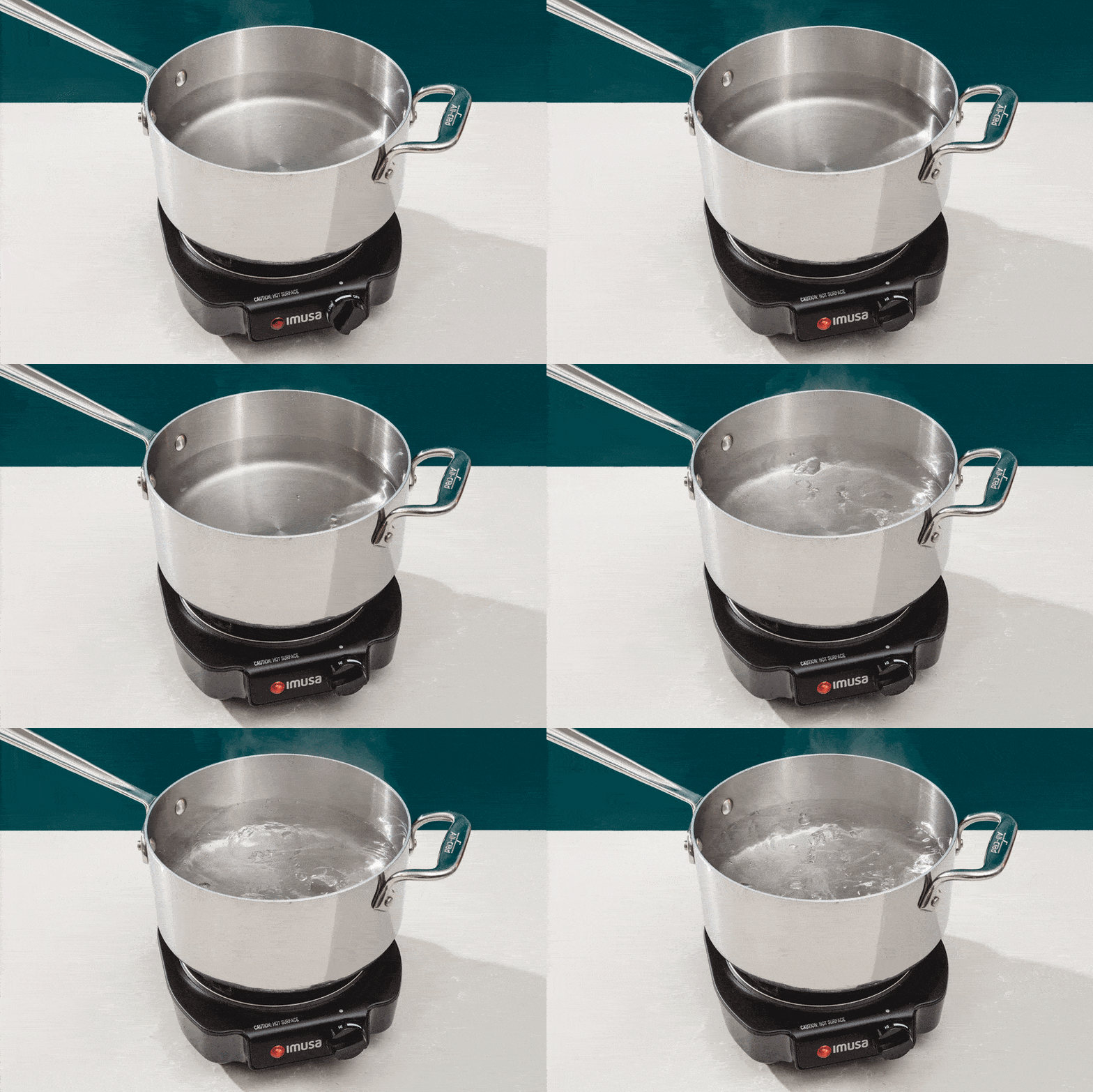
- Powerful Heating: Of the electric models, only our favorite had enough oomph to boil, stir-fry, and sear effectively. It had the highest wattage, and outshone its electric competition every time we used it. That said, it also took three times as long as the gas burners to boil water. Our gas burners ranged in power from 7,600 BTUs to 15,000 BTUs, and all boiled faster and heated more powerfully than the electric burners. Even the weakest (and least expensive) gas burner heated well.
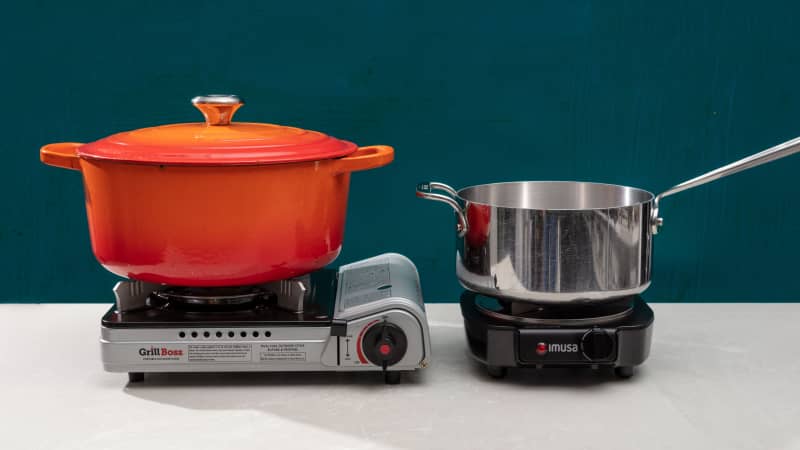
- Dual-Fuel Burners: We tested with a variety of pans from skillets to saucepans to Dutch ovens, but not every burner could handle them all. This affected what we were able to cook on them. One small electric model had a weight limit, eliminating Dutch ovens (or stockpots full of food or liquid). Others limited pan sizes—or should have. The weakest electric burners only heated a small area, giving us a hotspot in the middle of a 12-inch skillet; they fared better with small pans. Gas burners using butane forbid pans larger than 9 to 10 inches across, because wider pans can extend over the fuel canister (which sits in a chamber next to the burner) and overheat the fuel, risking explosion. We found one style that works with any cookware: dual-fuel gas burners. Their sturdy construction can support even the heaviest pots, and they can operate on either butane or propane. If you choose propane instead of butane, you can use larger pans. That’s because propane tanks don’t sit in the fuel chamber next to the burner; they attach externally using a connector that keeps them far from the flame. (Note: You can find propane-only burners on the market, but they are generally very large, not tabletop burners, and are used for tasks such as deep-frying turkeys.)
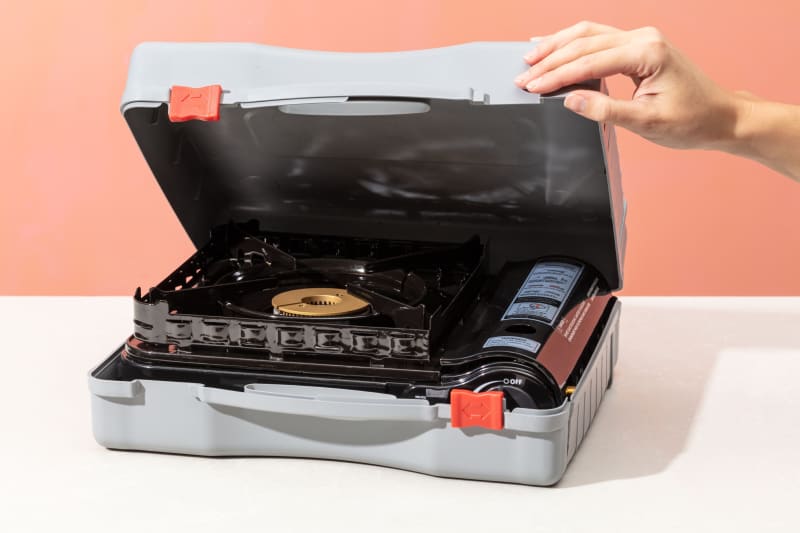
Dual-fuel gas burners give you more options, since they can run on butane or propane. You can’t use wide pans that overhang the fuel tank when cooking with butane (enclosed on the right side of the burner), because they can make butane canisters dangerously hot. But if you switch to propane, which attaches safely away from the burner, you can use pans of any size. Our winner by Grill Boss includes a long flexible hose for propane tanks.
- Responsive Heat Adjustability: Every model we tested had a single dial to adjust the heat level, but our preferred models allowed for a bit more fine-tuning and worked at both very high and low settings. On the most powerful gas burners, we actually had to dial down from their maximum setting to prevent flames licking up the sides of pans. But some struggled to stay lit at their lowest settings. Electric models did better than gas at very low settings.
- Easy Cleaning: The cooking surfaces of our favorite gas burners lifted off for easy scrubbing. Our favorite electric model was simple to wipe clean.
- Reliable Power Source: If you want a burner to cook during emergencies and power outages, get a gas burner (and plenty of fuel canisters). You’ll need to plug in electric burners, but remember that their power cords are short to prevent tripping. Manuals advise against using extension cords, but if you do, choose a heavy-duty, grounded model rated for high power—and keep it safely out of the way.
Nice to Have
- Carrying Case: Gas-powered burners all came with hard plastic briefcase-like carrying cases, which were helpful for keeping them clean and their parts organized between uses. Keeping gas burners clean and unobstructed (not dusty, rusty or clogged with food residue) is important to their continued safety and smooth operation.
What to Avoid
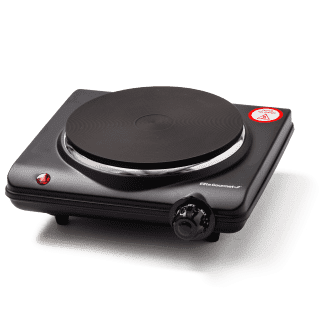
- Limited Power: Some burners were simply too weak. We boiled 2 quarts of water in an identical pan on every burner, but two electric models failed to boil, no matter how long we waited. While both had 1,000-watt heating elements, they also clearly had internal safety switches that shut off power to cool down the appliance cyclically, whenever the water got much above 200 degrees. (Backup copies performed the same.) We didn’t even attempt to deep-fry on these.
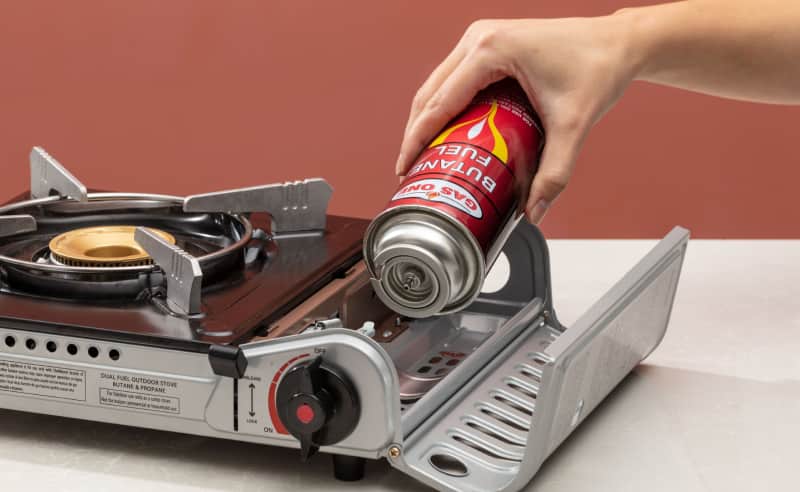
- Single-Fuel Gas Burners: These are fine if you’re OK with using only smaller cookware that’s less than 9 to 10 inches across the base. The problem is, wider pans overhang the butane tank, which is inserted right next to the burner, and trap heat that can make the canister dangerously hot, risking explosion. We prefer gas burners that are “dual-fuel,” meaning they can use either butane or propane. Propane tanks attach outside the cooktop, using a hose or tube that keeps it well away from the flames, so you can use cookware of any size or width.
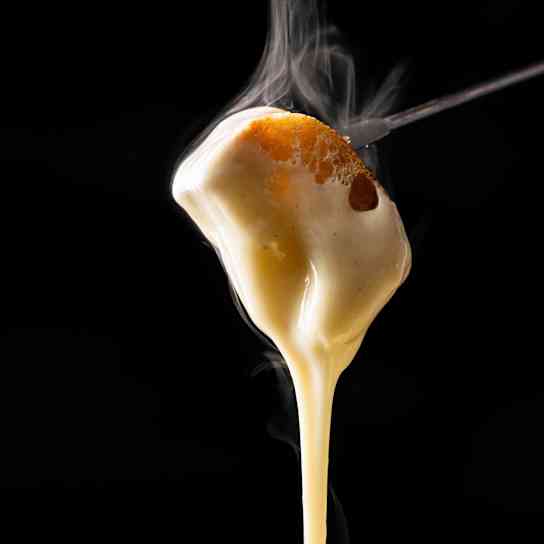
- Poor Heat Control: In our fondue test, we set all burners to low, hoping to keep the cheese creamy and hot for up to 2 hours, but some stayed too hot and couldn’t maintain a consistent low temperature, leaving us with boiling, broken, greasy fondue. Worse, some gas models’ flames extinguished at their lowest settings, which is dangerous with gas still flowing. One electric model’s lowest setting was too low, so fondue cooled and stiffened until we adjusted heat upwards. To safely maintain low heat for an extended time, we have a slight preference for electric models, but no matter what fuel is used, we would not leave lit burners unattended.
We made cheese fondue on each burner and tried to hold it on a very low heat for at least an hour, but some could not maintain a steady low setting; they overheated and broke the fondue into a greasy mess. This burner scorched the fondue and then went out when we set it on low.
- Unstable Burners: When burner surfaces had slick, flat tops, pans slid around as we stirred, and any cookware that wasn’t perfectly flat felt tippy.
- Hard-to-Clean Designs: Splatters and crumbs are a part of cooking, but having to detail every nook and cranny of the cooker should not be. Some surfaces trapped food or stayed smudged no matter how we cleaned them. Our preferred gas burners had lift-off tops that could go right into the sink for scrubbing; our winning electric model had a very small surface that didn’t tend to catch splatters and was simple to clean.


Many gas burners were easy to clean; their tops lifted right off to be scrubbed in the sink. This one did not detach for cleaning, and its cracks and crannies trapped food residue.
- Hot Surfaces: The appliance body surrounding the heating element on two electric burners became very hot to the touch whenever we cooked on them. Both came with warning stickers, but we’d prefer if they were better designed for safety. These same models also frequently overheated, prematurely cycling power off to cool down, so water never boiled.
The Tests
- Boil 2 quarts water in 3-quart saucepan, noting time elapsed
- Simmer water to track hot spots and heating patterns
- Sear hamburgers in 10-inch skillet
- Make Cheese Fondue and keep at low simmer up to 2 hours
- Cook Xīhóngshì Chao Jīdàn (Chinese Stir-Fried Tomatoes and Eggs) in wok
- Test pan compatibility with variety of cookware (7¼-qt Dutch oven, 10-in and 12-in skillets, 3-qt saucepan)
- Deep-fry Fried Zucchini Sticks in Dutch oven on compatible burners
How We Rated
- Performance: Burners that had plenty of cooking power to cook well and efficiently, allowing us to sear and fry, but also maintain low simmering temperatures over time, and that provided consistent, uniform heat scored highest.
- Ease of Use: We preferred burners that were easy to set up and break down, securely supported cookware, and felt simple and intuitive to control and set at various heat levels as needed.
- Cleanup: Burners that were easy to clean and maintain rated highest.
- Pan Compatibility: We preferred burners that let us use more types of pans without limitations.
- Time to Boil Water: We timed each burner with the same 3-quart clad saucepan and 2 quarts of water.