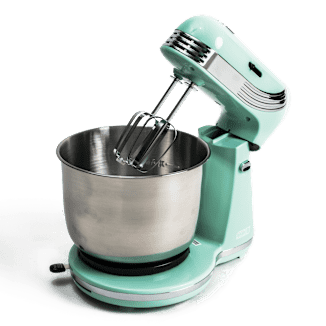


 Buy at Sur La Table
 Buy at Amazon

We tested stand mixers of nearly every size and price to make recommendations that truly suit your needs. If you often do a lot of heavy-duty, large-batch baking, especially breads, we suggest investing in the Ankarsrum Original 6230 Creme and Stainless Steel 7 Liter Stand Mixer. For solid performance at a moderate price, we suggest the KitchenAid Classic Series 4.5 Quart Tilt-Head Stand Mixer. If space constraints are a concern, consider the petite KitchenAid Artisan Mini 3.5 Quart Tilt-Head Stand Mixer. And if you’d like a lighter-weight model, try the NutriMill Artiste Stand Mixer. Weighing seven pounds less than our overall winner, it was easy to use and did a good job mixing cookie dough, cake batter, pizza dough, and bread dough. Finally, if you only occasionally bake a cake or a batch of cookies, consider skipping a stand mixer altogether and choose a hand mixer.
A stand mixer is essential for serious home bakers. It should be able to do tasks large and small, from whipping a pair of egg whites to kneading double batches of dough. But deciding which to buy has never been more complicated. KitchenAid dominates the market, but other manufacturers offer machines that promise to knead, whip, and mix with even more ease, sometimes at lower prices. Newer features include bowl-scraping beaters, stainless-steel tools, timers that automatically shut off mixing, lights that illuminate the action, extra bowls and covers, and accessories that expand the versatility of this appliance. Before you choose, it’s important to consider what kind of baking you plan to do: You’ll need plenty of power (and may need to spend more) if you do frequent, heavy-duty, big-batch projects but perhaps less power for occasional baking. Given the dizzying range of features and considerable cost of stand mixers, we shop carefully—and test exhaustively—to ensure you can choose from our winners with peace of mind.
The Scoop on the Newest KitchenAid Stand Mixer

KitchenAid recently released the Artisan Plus model, which adds slightly more power and new bells and whistles to the Artisan line. Among the changes, a new paddle trimmed on both sides with silicone fins helps scrape down bowl sides more effectively. (The wattage is slightly boosted to help counter extra drag created by these silicone scrapers.) A twist of the knob on the power lever gives you the option of gliding smoothly between speeds or having distinct stopping points at each level; we saw no real difference in this much-touted option. It also includes a bowl light, and all of the attachments are stainless steel.
Under the hood, the Plus contains a black plastic box with a circuit board that sits atop the same mechanical parts (including the lever to control speed) that you find in the original Artisan. What does it mean to have more electronics in the motor? According to Zach Dinicola, a Douglass, Kansas-based stand mixer repair expert known as YouTube’s Mr. Mixer, “By moving to an electronic system it’s going to force people’s hands [to buy a new machine] when they break and they cannot do their own repairs.”
The Bottom Line: Its performance is on par with the previous Artisan model. We recommend it, but it’s not our favorite KitchenAid mixer.
What Size Stand Mixer Should I Get?
Stand mixers come in a range of sizes, typically identified by the capacity of the mixer bowl. The stated capacities of the stand mixers we tested ranged from 3½ to 7 quarts. The size you should get depends on several factors, including the volume of baking you do, your storage capabilities, and your budget. In general, the bigger the capacity of your mixer, the more space it will take up and the heavier and more expensive it will be.
One thing to keep in mind is that the capacity advertised by the manufacturer isn’t always the true capacity that the mixer bowl can put to use. We measured each bowl and found that no model made use of its bowl’s total volume; some use barely more than half. To get a rough estimate of the actual capacity of any mixer bowl, you can usually subtract 2 quarts from the stated capacity.
If you frequently make large batches of bread or pizza dough, choose a mixer with a stated capacity of at least 5 quarts (and an actual capacity of about 3 quarts or more). We prefer larger models with even larger capacities (7 quarts stated capacity and 5 quarts actual capacity.) For those with less kitchen storage and who want to save space and money, a smaller mixer will be sufficient for single batches of bread or dough or cookie and cake batter.
What Are the Different Types of Stand Mixers?
Typically, stand mixers come in three styles: planetary, motor-in-base, or spiral. All styles have several basic components: a bowl, a base, and various attachments including beaters, whisks, and dough hooks. The three types of stand mixers differ depending on where the motor is located and whether it’s the bowl or the attachment (or both) that move during use.

Planetary stand mixers, such as the well-known KitchenAid mixers, are the most common type on the market. This kind of mixer has a motor located in the head. The bowl remains stationary and the attachment moves during use. It is called “planetary” mixing because the attachment spins on its axis while also circling the bowl, like a planet orbiting the sun. There are two kinds of planetary mixers: tilt-head and bowl-lift.
- On tilt-head models, the entire top of the mixer lifts up from the bowl, tilting back to offer access to the bowl for adding ingredients or scraping them down. These mixers are typically smaller, lighter, and less powerful than other types of mixers. They typically max out at a 5-quart capacity. The downside to them is that to tilt the head back, you need a lot of overhead clearance; most home cooks will have to pull a stand mixer out from under any cabinets. The upside? It’s easier to get at the bowl because the top lifts out of the way.
- Bowl-lift models use a crank to lower the bowl when adding ingredients or affixing the attachments and then raise it during use. These mixers are bigger, heavier, and more powerful. Their size ranges from 5 to 8 quarts (commercial models can be even bigger), but they don’t need any additional space overhead since only the bowl moves. Their weight means they’re less likely to rock and “walk” during heavy mixing. Because the top of the mixer doesn’t move away from the bowl, it can be a little finicky to switch the attachment or add ingredients.
“Motor-in-base” mixers are the second-most common type of mixer. There isn't an official industry term for this type of mixer, but we use this name because it aptly describes the positioning of the motor in the base with the bowl on top. When in use, the bowl spins and the attachment stays stationary. All the motor-in-base mixers we tested also include an optional extra attachment (either a dough hook extender or dough knife) to be used with the dough hook. This attachment allows you to make dough more quickly than in a planetary mixer—in our testing, it produced a double batch of pizza dough 8 minutes faster than our favorite KitchenAid model. That’s because the extra attachment increases physical interactions between the components of the dough, speeding up hydration and increasing aeration so that it comes together faster, explained Paul Adams, ATK’s science editor. Motor-in-base mixers have an additional advantage: unlike planetary mixers, very little of the machine is hovering over the bowl and impairing the user’s view or ability to reach it with a utensil. As a result, these models offer the easiest access to ingredients. They also tend to be lighter in weight than planetary and spiral models of comparable size.

Spiral mixers were historically limited to commercial kitchens and have correspondingly large capacities. They often look similar to planetary mixers because their heads tilt upward to offer access to the bowl. However, unlike planetary mixers, both the bowl and the attachment spin during use, which helps to more efficiently blend ingredients. Some commercial spiral mixers have two separate motors, one in the head and one in the base, but the spiral mixer we tested had just one motor in the base that powered both the bowl and the attachment. In addition to common attachments such as a whisk, dough hook, and beater, spiral mixers typically have an additional special feature—a breaker bar. The breaker bar is a vertical piece of metal that can be attached to the head of the mixer when you use the dough hook; it can be removed when you’re using other attachments. The breaker bar remains stationary within the bowl and helps push the dough down so that it doesn’t climb up the attachment. Similar to the dough knife or dough hook extender attachment in motor-in-base mixers, it also helps to manipulate the dough even further for faster development. As a result, the spiral mixer we’ve tested made dough as quickly as our top motor-in-base model, if not a little faster.
With spiral mixers (left), both the bowl and the attachment spin during use. With planetary mixers (right), such as those from KitchenAid, only the attachment moves while in use.
We like models in all three styles; choose whichever works best for your budget, preferred use, and kitchen space.
What to Look for
- Mixing Power: The point of having a stand mixer is powerful, hands-off mixing. Higher wattage is one sign of more available power. But how the mixer uses that power determines its performance: It can either rotate attachments quickly or put more force behind fewer, slower rotations. This second function—rotational force—is called torque, the true measure of a stand mixer’s success, said Bridget Smyser, mechanical and industrial engineering professor at Northeastern University. Torque determines why some machines with 350 watts of power shut down while making stiff Bagel Bread dough and others with just 250 watts kneaded the same dough perfectly.
It’s easy to spot mixers that translate power into speed instead of torque: Their attachments visibly slow and struggle under a heavy load, like dough, which pushes against the machine and increases stress on the motor.
When a mixer slows or stalls, not only is dough undermixed but the strain makes the motor more likely to burn out, said Ruqiang Feng, emeritus professor of mechanical and materials engineering at the University of Nebraska–Lincoln. In testing, some mixers shut down during kneading when the motor was on the verge of burnout, and resumed working only after cooling down. Ultimately, testing is the only way to know if a mixer has enough torque for true mixing power.
Kneading dough is where mixing power matters most.
- No Speed Limits: If you do a lot of heavy-duty baking, including breads and pizza doughs, this is an important consideration. KitchenAid places a restriction on all of its stand mixers for kneading: Don’t exceed speed 2 when kneading dough with the dough hook. (While KitchenAid formerly put restrictions on the length of time you could knead your dough, recommending that you not exceed 4 to 6 minutes at a time, in 2024 it revised its recommendations and now puts no specific time limit on kneading.) During testing, we were able to make a double batch of high-hydration pizza dough in our top-rated KitchenAid mixer at speed 2, but it took significantly longer than in machines that were able to knead the dough at higher speeds. The Ankarsrum has no such limitations and is a great choice for kneading dough. This is why it is our ultimate winner.

3 Common Stand-Mixer Problems and How to Fix Them
These easy tips can keep your beloved stand mixer out of the repair shop and working for many years to come.
Learn More- Adjustable Tool Height: When whisks, paddles, and dough hooks rode closer to the bowl’s bottom and walls, mixers worked faster and more thoroughly. But not all mixers came with tool distances perfectly set; on these, we often found unmixed pockets of ingredients and constantly had to stop and scrape. We preferred mixers that let us manually change the bowl-to-attachment distance. This distance can shift over time and with use, so adjustability is a desirable trait. Several mixers—at every price—lacked that option and fell short.
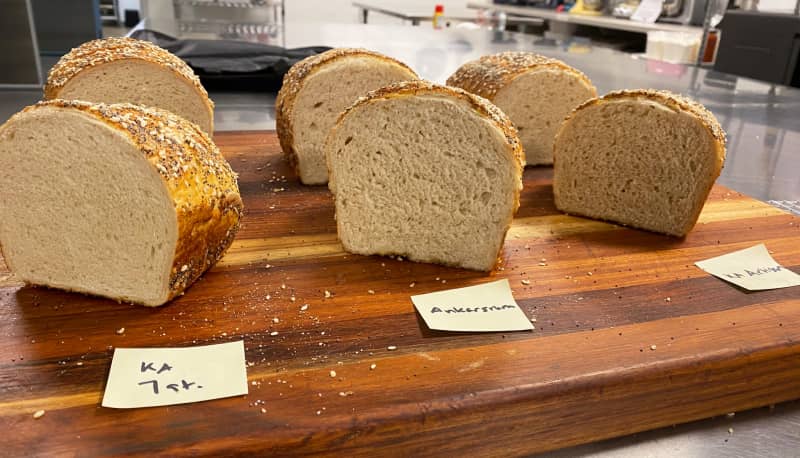
- Distinct Speeds: Some mixers didn’t change much from one speed to the next. Slow starts were important to avoid sending ingredients flying. The number of speeds mattered less than if they progressed, something that’s hard to discern without testing.
- Stainless-Steel Tools: We liked uncoated stainless-steel whisks, paddles, and hooks. Steel is nonreactive and durable. Coated aluminum parts often chip over time, and we’d rather not find bits in baked goods. Uncoated aluminum tools can oxidize if left wet and form a grayish residue that can come off in food.

- Intuitive Controls and Handling: We appreciated simple controls. Some models always took extra steps to get going. Bowls and tools should go on and off without a fight. Tilt-head releases should work smoothly.
Nice to Have
- Big Vertical Bowl Handles: Vertical handles made bowls easier to control while scraping or pouring batter. Tiny horizontal handles (or none) strained hands.
- Scraper Beaters: All models had mixing paddles, but some included extras with silicone fins that scraped the bowl, making mixing faster and easier, which was especially nice when mixing cake batter and cookie dough for which overhandling the dough is not desirable.
What to Avoid
- Weak, Walking Mixers: If your mixer can barely manage when the going gets tough, it’s not worth it. A mixer that moves across the counter while working is dangerous and potentially catastrophic if it were to walk off the edge. While heavier mixers are less likely to walk, it’s no guarantee of power. Again, since you can’t tell this in the store, read on for our testing results.
A stand mixer that walks and rocks while mixing is a sign that it’s underpowered and lacks torque, the force that pushes dough around the bowl. Mixers that are more powerful, with more torque, also tend to be heavier and are far less likely to rock or walk while mixing.
- Key Pieces Made from Plastic: Plastic parts are lighter and easier to handle, but when key pieces, like the hub to attach a whisk, are thin plastic, we worry about durability.
Minor Flaws
- Noise Level: We used a decibel meter while whipping egg whites. Most were moderate (mid- to high-70s, equivalent to the sound of a dishwasher), but a few were loud (low-80s, like a busy city street). While no mixer is silent, we’ve noted which ones were especially loud in the chart describing each model we tested.

Other Considerations
- Controls Location: There’s clearly no consensus about where mixer controls should be (up high, down low, in the back, on the left or right side) or where manufacturers expect the cook to stand in relation to the mixer—we saw every configuration. Bear this in mind if you have strong preferences or a specific spot where you’ll need to place your mixer. Controls located at the top and rear were hard for shorter testers.
- Weight: In our years of testing, we’ve found that heavier stand mixers rock and walk less during heavy-duty mixing; the motor power goes into moving the dough, not the machine. However, some home cooks may prefer a lighter machine for maneuverability reasons. For these lighter machines, we found suction feet to be helpful in anchoring the stand mixer to the counter. There are some downsides to suction cups, though. With heavier mixers, suction feet were more of a hindrance, as they made it very difficult to lift the hefty machine off the counter. And suction cups generally can lose their grip when they get flour on them, so you’ll need to keep them clean.

- Glass, Stainless-Steel, or Plastic Bowls: Glass bowls are much heavier and more fragile than metal bowls, which makes them harder to handle and potentially short-lived. Some cooks may like being able to easily see inside (and it’s nice for videos), but we’d recommend sticking with lighter-weight, more durable steel bowls. We’ve also tested some mixers with plastic bowls. Those we tested were reasonably durable, though their material may make them more vulnerable to cracking than stainless-steel models.

- Fingerprint-Concealing Finishes: Choosing your stand mixer’s color is fun. Dark, matte finishes looked dusty when flour wafted over and showed every buttery fingerprint. Glossier finishes were more forgiving.
- Dishwasher-Safe Parts: Dishwasher-safe parts are convenient, but after dishwashing we’ve found that coated tools (such as paddles and dough hooks) had often become chipped and damaged, and uncoated aluminum oxidized and blackened in the dishwasher. We preferred plain stainless-steel tools that were dishwasher-safe, but it may be best to wash all parts by hand to keep them in good condition.
- Optional Accessories: Some brands offer extra accessories (purchased separately) that attach to a hub on the mixer’s motor to use it for power, including pasta rollers, ice cream makers, meat grinders, blenders, citrus presses, grain mills, and more. All KitchenAid mixers work with about 10 accessories. Others, including Ankarsrum and Cuisinart, also make proprietary attachments; a few brands include a universal hub that can take attachments from other brands, including the KitchenAid accessories. We’ve noted in the chart which mixers give you these options.
The Tests
- Whip two egg whites to stiff peaks
- Whip 1.5 cups heavy cream
- Whip 4 egg whites while adding hot sugar syrup to make meringue
- Cream butter and sugar for cookie dough
- Reverse-cream butter and sugar for cake batter
- Mix and knead double batch of sticky, high-hydration pizza dough
- Mix and knead stiff, dry Bagel Bread
- Measure decibels while whipping two egg whites at highest speed
- Have additional testers of varying skill levels use each mixer in a simple test and collect their feedback
- Make 10 additional batches Bagel Bread dough plus 2 additional batches pizza dough in top performers
- Hand-wash all parts after each test
How We Rated
- Performance: We evaluated the whipping, creaming, and kneading abilities of each model, including whether they struggled to complete any tasks.
- Ease of Use: We considered the comfort and intuitiveness of operating and handling each mixer and its parts.
- Cleanup: We assessed how easy the mixers and their parts were to clean and maintain in good working order.
- Weight: We weighed each machine with its standard bowl but no attachments.


 Buy at KitchenAid

 Buy at Ooni
 Buy at Nutrimill
 Buy at Breville