Key Ingredients for Biscuits, Cornbread, and Soda Bread


Here is a rundown of some of the ingredients that you’ll need to make the biscuits, cornbread, and soda bread in this class.
Baking Soda

Baking soda is a leavener that provides lift to quick breads. When baking soda, which is alkaline, encounters an acidic ingredient (such as buttermilk), carbon and oxygen combine to form carbon dioxide. The tiny bubbles of carbon dioxide then lift up the dough. It also promotes browning. We use baking soda in conjunction with baking powder for the best rise in the cornbread featured in this class.
Double-Acting Baking Powder

Double-acting baking powder has two acids added to the baking soda: The second acid (often sodium aluminum sulfate) begins to work when the dish is put in the oven, after the temperature has climbed above 120 degrees. Most supermarket brands are double-acting baking powder. We recommend using it in all recipes—baked goods rise higher since most of the rise with baking powder occurs at oven temperatures. Baking powder partners up with baking soda to create the best texture for the soda bread in this class.
Buttermilk

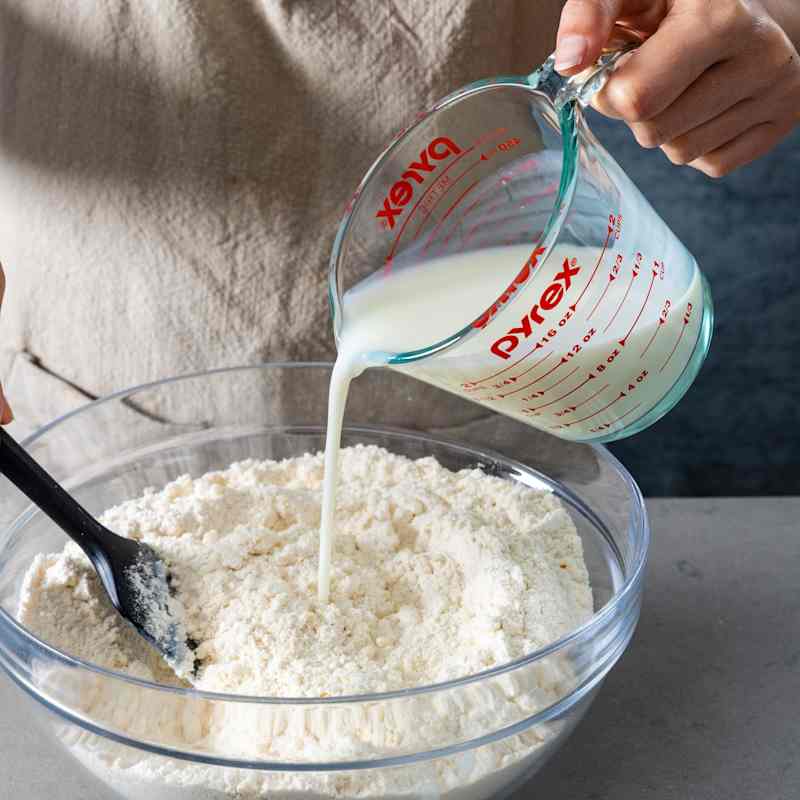
In the old days, buttermilk was simply the liquid left behind after cream was churned into butter. Today the vast majority of commercial buttermilk is a fermented product made by culturing whole, low-fat, or nonfat (skim) milk. Lactic-acid producing bacteria are added to milk, the milk is heated to 72 degrees, and the harmless bacteria convert lactose (milk sugar) to lactic acid, which gives the final product a slightly thickened, rich texture, and tangy, somewhat salty flavor. The ripening process is complete within 14 hours, at which point the milk is cooled to 45 degrees to halt fermentation. Sometimes butter flakes (also called liquid butter) are added to give the velvety liquid a "churned" look and feel. More often than not, salt and/or citric acid is added to enhance flavor. Buttermilk provides the tang and lightness in the biscuits featured in this class; to learn more check out the lesson titled All About Buttermilk.
All-Purpose Flour

All-purpose flour has a moderate protein level (9 to 12 percent). We prefer unbleached flour over bleached because we've found that bleached flour sometimes carries off-flavors that can be detected in simple recipes like bread or biscuits. In the test kitchen, we develop recipes with widely available Pillsbury unbleached (10.5 percent protein). Gold Medal unbleached (10.5 percent protein) offers comparable results. If you use a higher protein all-purpose flour (such as King Arthur, with 11.7 percent protein) in our recipes, the results may be slightly drier and chewier. You can lower the protein content of higher protein all-purpose flour by replacing 1 tablespoon of flour per cup with 1 tablespoon of cornstarch. All-purpose flour is our choice for the biscuits in this class as its neutral taste lets the buttery flavor and buttermilk tang take center stage.
Whole-Wheat Flour

Whole-wheat flour has a high protein level (about 13 percent) and a distinctive flavor and texture because it is made from the entire wheat berry. A wheat berry has three elements: the outer bran layer, the germ, and the endosperm (white flours are ground solely from the endosperm). Whole-wheat flour behaves very differently from white flour. That said, you can often replace up to one-third of the all-purpose or bread flour in a recipe with an equal amount of whole wheat flour and obtain good results. Whole-wheat flour, along with wheat germ, gives the soda bread in this class its nutty flavor and wholesome texture.
Cornmeal

Cornmeal can be labeled anything from yellow grits to polenta to corn semolina, which is why we recommend you forget the names. Avoid instant and quick-cooking, which are parcooked and comparatively bland. We prefer degerminated cornmeal, in which the hard hull and germ are removed from each kernel. We have found coarser grains are best for polenta and grits, while finer grinds work in baked goods, like the cornbread in this class.
Wheat Germ

Wheat germ is the flavorful center of the wheat kernel. The germ is milled out when making white, refined flour, but is left in whole-wheat flour. Wheat germ can be found in either the health-food section or baking section of your supermarket. Added to rustic doughs, it provides a nutty flavor and hearty texture. We love what it adds to the brown soda bread in this class.
Butter

When shopping for butter, you can buy salted or unsalted butter. In many markets, you can also buy cultured butter (which has been lightly fermented). We use regular unsalted butter for baking and save cultured butter (either unsalted or salted) for spreading on toast. Butter can pick up off-flavors and turn rancid when kept in the refrigerator for longer than a month. If you don’t use a lot, store butter in the freezer for up to 4 months in a zipper-lock bag and thaw sticks as needed. Modest amounts of butter add balanced richness to the soda bread and cornbread in this class.
Shortening

To make shortening, soybean and cottonseed oils are put through a process of partial hydrogenation, creating a partially hydrogenated fat (a source of trans-fat.) Recently a trans-fat free shortening has hit the market, and is made from nonhydrogenated sunflower and soybean oils and from cottonseed oil that has been through a process of complete hydrogenation. This creates a saturated fat which is considered “healthier” than trans fats. For the best balance of flavor and texture we augment the butter in the biscuits in this class with a touch of shortening.