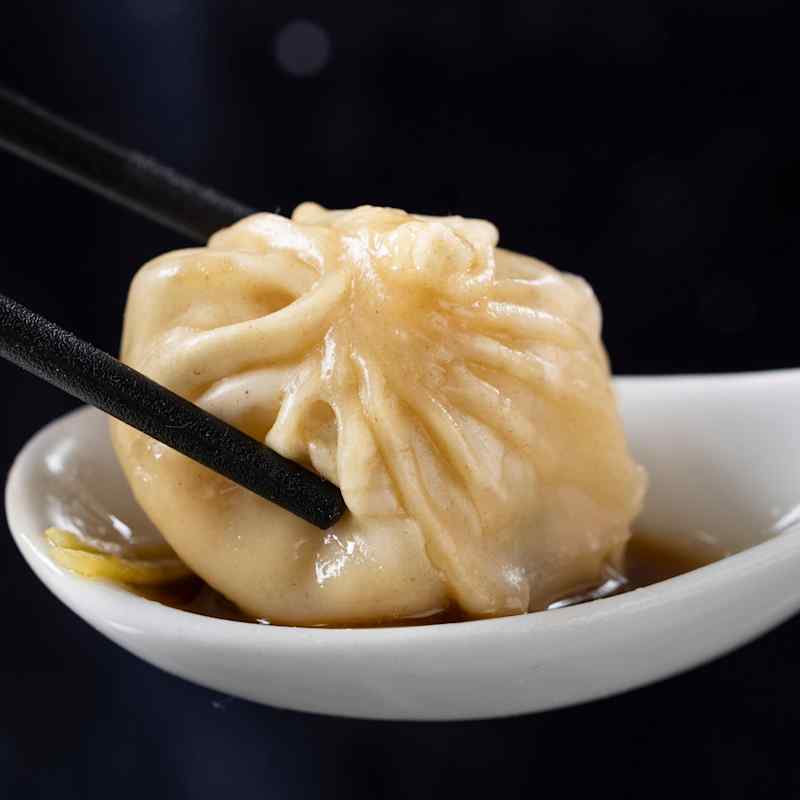
SCIENCE: Why Our Dumplings Are So Juicy

Gelatin Magic: Learn why the addition of this ingredient can be the difference between dry dumplings and those that are juicy and tender.
For dumpling filling that is extra-tender and juicy we turn to a favorite ATK trick for avoiding dry meat - adding unflavored gelatin. Gelatin can hold up to 10 times its weight in water, and when added to meat it suspends the juices in a mesh-like, semisolid state that prevents them from leaching out. This translates to a moist dumpling with a luxuriant texture.
What is Gelatin?

Gelatin is made by boiling collagen-rich animal tissue in water to unravel the collagen into long protein strands. The gelatin is then extracted from the liquid and dried to create granules (powder).
How Gelatin Works

Achieving properly gelled gelatin is a two-step process.
The gelatin must be bloomed, or hydrated, in cool water. The cool water penetrates slowly through each granule of gelatin, ensuring that it hydrates fully and dissolves. (If you skip blooming and add gelatin directly to hot water, the surface of each granule will rapidly hydrate and stick to its neighbors in clumps, while the interiors of the granules remain unhydrated and undissolved.
The gelatin must be heated. This causes the protein molecules to dissolve so that the mixture is fluid. Then, as the mixture cools to about body temperature, the strands tangle together, forming a mesh that slows the flow of the liquid, thickening it. Finally, after enough time has elapsed, that mesh is sturdy enough to stop the liquid from flowing altogether, turning it into a solid gel.