Supermarket Cuts of Beef and Pork

Understanding what cut of beef or pork to buy at the supermarket is the starting point to your next great meal.
Beef Chuck-Eye Roast (Primal Cut: Chuck)

This boneless roast is cut from the center of the first five ribs (the term “eye” refers to any center-cut piece of meat). It is very tender and juicy but also contains an excessive amount of fat. This cut should be trussed using kitchen twine, so if the butcher has not done it for you, do it yourself. It is also called boneless chuck roll and boneless chuck fillet. We like the chuck-eye roast for its compact, uniform shape, deep flavor, and tenderness in pot roast. This is our top choice for stewing and braising.
Beef Rib Roast, First-Cut (Primal Cut: Rib)

Butchers tend to cut a rib roast, which consists of ribs 6 through 12 if left whole, into two distinct cuts. The more desirable of the two cuts consists of ribs 10 through 12. Since this portion of the roast is closer to the loin end, it is sometimes called the “loin end.” Other butchers call it the “small end” or the “first-cut.” Whatever it is called, it is more desirable because it contains the large, single rib-eye muscle and is less fatty.
Beef Tenderloin (Primal Cut: Short Loin)

The tenderloin (also called the whole filet) is the most tender piece of beef you can buy. Its flavor is pleasantly mild, almost non-beefy. Unpeeled tenderloins (above photo) come with an incredibly thick layer of exterior fat still attached, which should be removed. Peeled roasts have scattered patches of fat that need not be removed. This roast can be cut into individual steaks to make filets mignons.
Beef Top Sirloin Roast (Primal Cut: Sirloin)

This cut from the hip area tastes incredibly meaty and has plenty of marbling, which makes for a succulent roast. Aside from the vein of gristle that runs through it, which we found slightly unpleasant to eat, the roast was tender and juicy, with big, beefy flavor. Other parts of the sirloin are lean and tough, but top sirloin roast is one of our favorite inexpensive roasts.
Beef Eye-Round Roast (Primal Cut: Round)

This boneless roast is quite inexpensive but not nearly as flavorful as the top cuts. However, it does have a nice shape that slices neatly, making it a better choice than other round or rump roasts. In order to make this lean cut as tender as possible, roast it in a very low oven.
Beef Brisket (Primal Cut: Brisket)

This large, rectangular cut weights 13 pounds, so it is often divided into two subcuts, the flat cut (pictured here) and the point cut. The flat cut is leaner, thinner, and more widely available. When shopping for flat-cut brisket, look for a roast with a decent fat cap on top. The point cut is well marbled and thicker; if you can find it, you can use it in place of the flat-cut brisket in most recipes; however, the cooking time might need to be extended slightly.
Beef Sirloin Steak Tips (Primal Cut: Sirloin)

Steak tips, also known as flap meat, can be sold as whole steaks, cubes, or strips. They are a well marbled, wallet-friendly, and super beefy in flavor.
Beef Rib-Eye Steak (Primal Cut: Rib)

Cut from the rib area just behind the shoulder, a rib-eye steak is essentially a boneless piece of prime rib. This pricey, fat-streaked steak is tender and juicy, with a pronounced beefiness. In the West, rib-eyes are sometimes labeled Spencer steaks; in the East, they may be called Delmonico steaks.
Beef Strip Steak (Primal Cut: Short Loin)

Available both boneless and bone-in, this moderately expensive steak is also called top loin, shell, sirloin strip, Kansas City strip, or New York strip. Cut from the shell muscle that runs along the middle of the steer’s back, strip steaks are well-marbled, with a tight grain, pleasantly chewy texture, and big, beefy flavor.
Beef Skirt Steak (Primal Cut: Flank)

This long, thin steak is cut from the underside (or “plate”) of the animal. Also known as fajita or Philadelphia steak, it has a distinct grain and an especially beefy taste. As its alias implies, sliced skirt is a good option for fajitas, but it can also be cooked as a whole steak.
Beef Flank Steak (Primal Cut: Flank)

Flank steak, aka jiffy steak, is a large, flat cut from the underside of the cow, with a distinct longitudinal grain. Flank steak is thin and cooks quickly, making it ideal for the grill. Although very flavorful, flank is slightly chewy. It should not be cooked past medium and should always be sliced thinly across the grain.
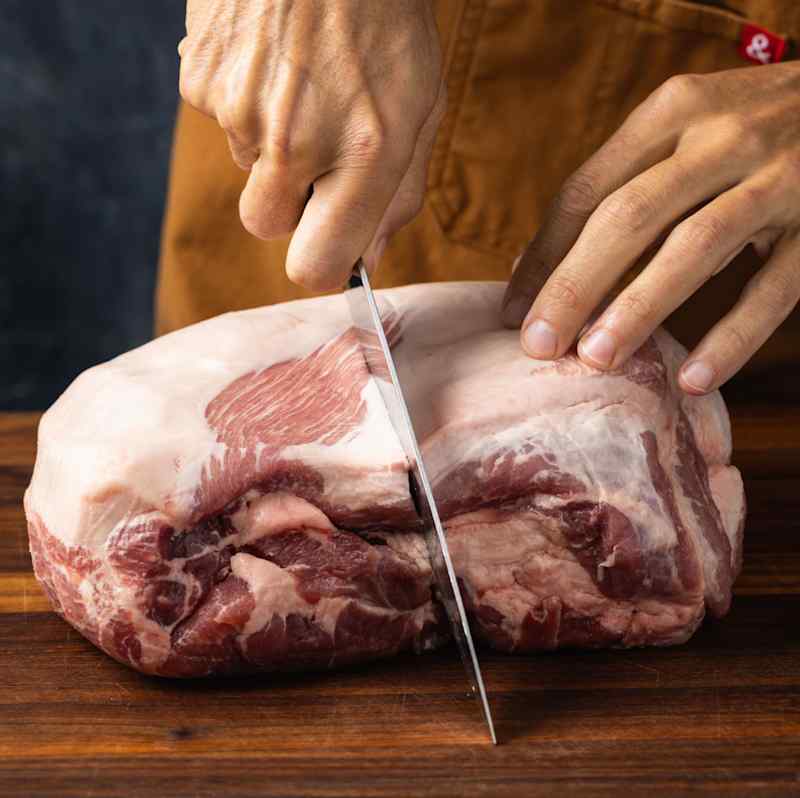
Pork Butt (Primal Cut: Blade Shoulder)

This large, flavorful cut (often labeled Boston butt at markets) can weigh as much as 8 pounds when sold with the bone in. Many markets take out the bone and sell this cut in smaller chunks, often wrapped in netting to hold the roast together. This cut is ideal for slow roasting, barbecuing, stewing, or braising. Use it for pulled pork and other shredded pork dishes, like carnitas.
Pork Picnic Shoulder (Primal Cut: Arm Shoulder)

This affordable cut (often labeled “picnic roast” at markets) can be sold bone-in or boneless. It is rich in fat and connective tissue. Use it like pork butt for barbecuing, braising, or other slow-cooking methods.
Pork Center-Cut Loin Roast (Primal Cut: Loin)

This boneless roast is widely available and a good choice for roasting. We prefer the more flavorful boneless blade roast, but the two cuts can be used interchangeably. Make sure to buy a center-cut roast with a decent fat cap on top.
Pork Tenderloin (Primal Cut: Loin)

This lean, delicate, boneless roast cooks very quickly because it’s so small, usually weighing just about 1 pound. Since there is very little marbling, this roast (which is equivalent to beef tenderloin) cannot be overcooked without ruining its texture. Tenderloins are often sold two to a package. Many tenderloins sold in the supermarket are enhanced; look for one that has no ingredients other than pork on the label.
Pork Belly (Primal Cut: Side)

The fatty, succulent pork belly has become a hugely popular restaurant cut. Chefs braise and sear sections of the belly to create a dish that’s crisp on the outside and unctuous within. Bacon is pork belly that’s been salted, (usually) sugared, and smoked. Pancetta, sometimes called Italian bacon, is similar but not smoked.