

Recipe By Andrea Geary
Published on August 29, 2024
Croissants can be a culinary triumph—or a waste of time. Our recipe guarantees success.
Time
11 hr 30 minYield
Makes 22 croissantsWhy This Recipe Works
The layered structure that characterizes croissants is formed through a process called lamination: A relatively lean yeasted dough is wrapped around a block of butter, and then the package is rolled out and folded repeatedly to form paper-thin layers of dough separated by even thinner layers of butter. Due to increasing gluten formation, the dough becomes more difficult to roll with every turn, so we were relieved to find that three turns was sufficient to yield a light pastry made up of hundreds of delicate layers. High-protein all-purpose flour struck the right gluten balance: enough to support all that butter but not so much that we struggled with the dough. Using the right butter was important, too. The higher water content of conventional butter caused it to break up in the dough, which meant that the dough layers stuck together, resulting in less lift. Using higher-fat European butter worked much better and was worth the extra expense. Lastly, giving the dough and butter packet a couple of intense 30-minute chills in the freezer brought the two components to a more comparable consistency, making it easier to maintain distinct layers.
Ingredients
Equipment

Instructions
Cook along with these step-by-step instructions



- Whisk flour, yeast, and salt together in bowl of stand mixer. Whisk milk, sugar, and melted butter in 4-cup liquid measuring cup until sugar has dissolved. Using dough hook on low speed, slowly add milk mixture to flour mixture and mix until cohesive dough starts to form and no dry flour remains, about 2 minutes, scraping down bowl as needed. Increase speed to medium-low and knead for 1 minute. Cover bowl tightly with plastic wrap and let dough rest for 30 minutes.
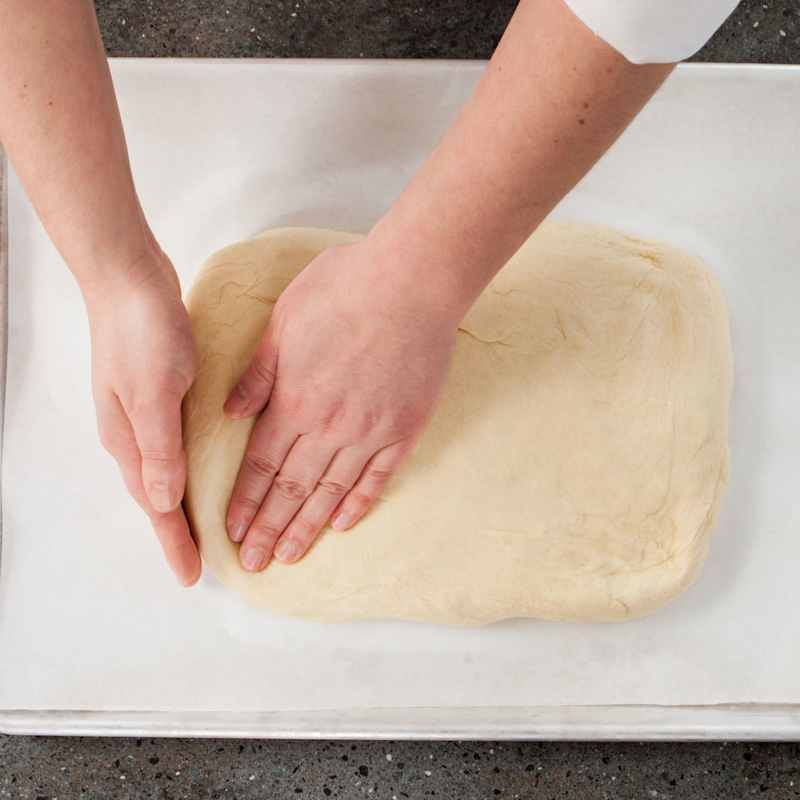
- Transfer dough to parchment paper–lined rimmed baking sheet and press into 10 by 7-inch rectangle, about 1 inch thick. Wrap tightly with greased plastic and refrigerate for 2 hours.
- Meanwhile, fold 24-inch length of parchment in half to create 12-inch rectangle. Fold over 3 open sides of rectangle to form 8-inch square with enclosed sides. Crease folds firmly.
- Place chilled butter directly on counter and beat with rolling pin until butter is just pliable but not warm, about 60 seconds, then fold butter in on itself using bench scraper. Beat into rough 6-inch square.
- Unfold parchment envelope. Using bench scraper, transfer butter to center of parchment, refolding at creases to enclose. Turn packet over so that flaps are underneath, and gently roll until butter fills parchment square, taking care to achieve even thickness. Refrigerate for at least 45 minutes.
- Transfer dough to freezer and chill for 30 minutes. Transfer dough to lightly floured counter and roll into 17 by 8-inch rectangle, with long side parallel to counter edge. Unwrap butter square and place in center of rectangle. Fold 2 sides of dough over butter so they meet in center. Press seam together with your fingertips.
- Using rolling pin, press firmly on each open end of dough packet. Roll dough into 24 by 8-inch rectangle, with short side parallel to counter edge. Fold bottom third of dough over middle, then fold upper third over it like business letter to form 8-inch square. Turn dough 90 degrees counterclockwise and repeat rolling and folding into thirds. Return dough to parchment-lined sheet, wrap tightly with greased plastic, and return to freezer for 30 minutes.
- Transfer dough to lightly floured counter so that top flap of dough is facing right. Roll dough into 24 by 8-inch rectangle, with short side parallel to counter edge, and fold into thirds. Return dough to baking sheet, wrap tightly with plastic, and refrigerate for at least 2 hours or up to 24 hours.
- Transfer dough to freezer and chill for 30 minutes. Transfer dough to lightly floured counter and roll into 18 by 16-inch rectangle, with long side parallel to counter edge. Fold upper half of dough over lower half. Using ruler, mark dough at 3-inch intervals along bottom edge with bench scraper (you should have 5 marks). Move ruler to top of dough, measure in 1½ inches from left, then use this mark to measure out 3-inch intervals (you should have 6 marks).
- Starting at lower left corner, use pizza cutter or chef’s knife to cut dough into triangles from mark to mark. You will have 12 single triangles and 5 double triangles; discard scraps.
- Unfold double triangles and cut into 10 single triangles (making 22 equal-size triangles in total). If dough begins to soften, return to freezer for 10 minutes. Cover all triangles loosely with greased plastic.
- Cut ½ inch slit in center of short end of 1 dough triangle (keep remaining triangles covered). Grasp triangle by 2 corners on either side of slit and stretch gently.
- Grasp bottom point of triangle and stretch. Place triangle on counter so point is facing toward you and fold both sides of slit down.
- Positioning palms on folds, roll partway toward point. Gently grasp point again and stretch. To finish, continue to roll, tucking point underneath. Curve ends gently toward one another to create crescent shape. Repeat with remaining triangles.
- Place 12 croissants on 2 parchment-lined rimmed baking sheets, spaced about 2½ inches apart, 6 croissants per sheet. Cover loosely with greased plastic and let rise until nearly doubled in size, 2½ to 3 hours. (Unrisen croissants can be refrigerated for up to 18 hours; let rise at room temperature for 3 to 3½ hours before baking.) Place remaining 10 croissants on separate parchment-lined rimmed baking sheet, spaced about 1 inch apart. Wrap tightly with greased plastic and freeze until solid, about 2 hours. Transfer frozen croissants from baking sheet to zipper-lock bag and return to freezer. (Frozen croissants can be stored in freezer for up to 2 months. Arrange on 2 sheets as directed and increase rising time by 1 to 2 hours.)
- Adjust oven racks to upper-middle and lower-middle positions and heat oven to 425 degrees. Gently brush croissants with egg mixture. Place croissants in oven and reduce temperature to 400 degrees. Bake for 12 minutes, then switch and rotate baking sheets. Continue to bake until deep golden brown, 8 to 12 minutes. Transfer croissants to wire rack and let cool for 15 minutes. Serve warm or at room temperature.
Ask ATK
Have a Question?
We’d love to hear from you! Drop us a message anytime and we’ll get back to you. We’re here to help!





217 Comments