Mozzarella
By America's Test KitchenPublished on May 31, 2018
Yield
Makes about 1 1/2 pounds
Ingredients
Before You Begin
It's critical to use fresh homogenized and pasteurized milk here; do not use ultra-pasteurized or ultra-heat-treated (UHT or long-life) milk, as the milk will not coagulate properly. Make sure to use a Dutch oven that is at least 6 quarts to ensure all the liquid for stretching will fit. Mozzarella is best eaten fresh. If you don't want to eat the entire batch the day you make it, save and refrigerate half the curds (don't stretch them) for up to three days. When you want to make the second batch, dissolve 3 tablespoons salt in 12 cups hot water and use this as your stretching liquid.
Instructions
- Dissolve citric acid in ¼ cup water. Place colander over large, deep bowl. Fill second large bowl with cold water and refrigerate until needed. Combine milk and heavy cream in 6-quart (or larger) Dutch oven, and thoroughly stir in citric acid solution for at least 30 seconds. Heat over medium heat, stirring frequently, until mixture registers 90 degrees. Remove pot from heat. Dilute rennet in remaining ¼ cup water and stir into milk mixture for exactly 30 seconds. Cover pot and let sit, undisturbed, for 10 minutes.
- Remove lid and use your fingers to gently pull curd from sides of pot to check for set. Curd should be slightly firm and custardlike and whey should be clear. (If curd is not set, cover pot and let sit for 5 minutes before retesting set.) Using long flat metal spatula, gently cut curd into 1-inch blocks. Gently twist pot back and forth to release curds from side of pot and let sit until curds separate, 2 to 3 minutes. Return pot to very low heat and slowly bring whey to 105 to 107 degrees, 15 to 20 minutes (check temperature of whey, not curds); as whey comes up to temperature, occasionally twist pot to gently and evenly distribute warming whey. Remove pot from heat and let curds sit for 3 minutes.
- Using slotted spoon, gently transfer curds to prepared colander. Very gently press down on curds to drain off whey. As curds drain, gently press into a large cake, until curds form a cohesive mass and whey no longer runs out of curds when pressed, 5 to 7 minutes. Reserve whey. Transfer curds to cutting board and cut into 1-inch pieces.
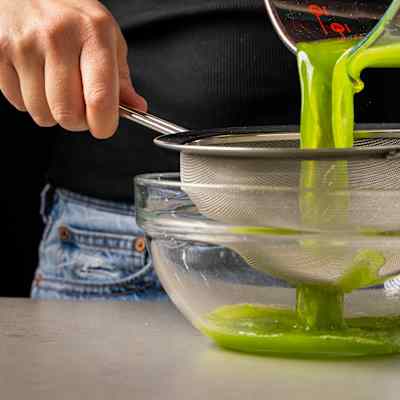
- Set fine-mesh strainer over bowl. Return reserved whey to pot, then pour all whey through strainer, discarding solids. Return strained whey to clean Dutch oven and stir in 12 cups water and salt. Heat whey to 180 degrees over medium-high heat.
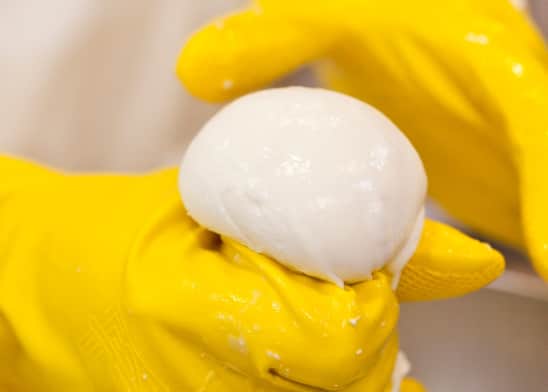
- Wearing double layer of thick rubber kitchen gloves, transfer half of curd pieces to clean bowl and pour half of hot whey mixture over curds. Using rubber spatula, press curds together against sides of bowl until melted and pliable, about 1 minute. Pull and stretch mozzarella, repeating until curds are stretchy and strands are smooth and shiny, 4 to 5 minutes. If curds begin to break instead of stretch, let curds rest in hot whey for 30 seconds to reheat before stretching again.
- Pull off small pieces of mozzarella and stretch and form into 2-inch balls. Quickly submerge balls in prepared bowl of cold water to chill and set. Discard stretching liquid, then transfer remaining curd pieces to bowl. Return remaining whey mixture to 180 degrees over medium-high heat and pour over curds. Repeat stretching, shaping, and cooling steps.


Yield
Makes about 1 1/2 poundsIngredients
Ingredients
Ingredients
Why This Recipe Works
The first key to making good mozzarella is realizing that Italian mozzarella is made with water buffalo milk, which has more fat than cow's milk. So using whole milk plus heavy cream makes it taste more authentic. Second, know what you are getting into. Recipes abound online, all proclaiming, “It's easy! It's fun!” Well, I've got news: They lie. It took immeasurable patience and I don't know how many gallons of milk before I got it right. Perfecting mozzarella is definitely a touch, feel, and learn process. Don't get down when your first try fails. Once you get it right, you'll be handsomely rewarded with delectable cheese. Even when it is a disaster—which can result, as I learned, from making a variety of mistakes, from overcoagulating the milk to letting the curd get too hot to letting the curd get too cold or not removing enough whey—the curds are still delicious.





13 Comments