Plum-Ginger Pie with Whole-Wheat Crust
By Leah ColinsPublished on August 29, 2019
Time
2¾ hours, plus 3 hours chilling and 4 hours cooling
Yield
Serves 8
Ingredients
Dough
20 tablespoons (2½ sticks) unsalted butter, chilled, divided1 ½ cup (8¼ ounces/234 grams) whole-wheat or rye flour 1 cup (5 ounces/142 grams) all-purpose flour 2 tablespoons sugar 1 teaspoon table salt ½ cup (4 ounces/113 grams) ice water, dividedFilling
¾ cup (5¼ ounces/149 grams) sugar 3 tablespoons cornstarch 2 teaspoons grated lemon zest plus 1 tablespoon juice1 teaspoon grated fresh ginger ¼ teaspoon ground ginger ¼ teaspoon table salt 2 ½ pounds (1134 grams) plums, halved, pitted, and cut into ¼-inch-thick wedges1 large egg, lightly beaten with 1 tablespoon waterBefore You Begin
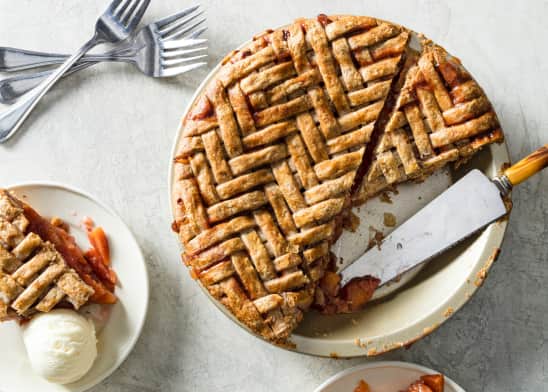
We think our whole-grain pie crust made with whole-wheat flour pairs particularly well with this filling, but you can use any double-crust pie dough. The method here produces a standard lattice top; for the herringbone lattice crust shown in the photo, see "Making a Herringbone Lattice" below.
Instructions
- For the pie dough: Grate 4 tablespoons butter on large holes of box grater. Transfer to freezer. Cut remaining 16 tablespoons butter into ½-inch cubes; set aside. Pulse whole-wheat flour, sugar, and salt in food processor until combined, 2 pulses. Add cubed butter and process until homogeneous paste forms, about 2 minutes. Using your hands, carefully break paste into 2-inch chunks and redistribute evenly around processor blade. Add all-purpose flour and pulse until mixture is broken into pieces no larger than 1 inch (most pieces will be much smaller), 4 to 5 pulses. Transfer mixture to medium bowl. Add grated butter and toss until butter pieces are separated and coated with flour.
- Sprinkle ¼ cup ice water over mixture. Toss with rubber spatula until mixture is evenly moistened. Sprinkle remaining ¼ cup ice water over mixture and toss to combine. Press dough with spatula until dough sticks together. Use spatula to divide dough into 2 even pieces. Transfer each piece to separate sheet of plastic wrap. Working with 1 piece at a time, draw edges of plastic over dough and press firmly on sides and top to form compact, fissure-free mass. Press 1 piece into 5-inch disk. Press remaining piece into 5-inch square. Wrap separately in plastic and refrigerate dough for at least 2 hours or up to 2 days. Let chilled dough sit on counter to soften slightly, about 10 minutes, before rolling. (Wrapped dough can be frozen for up to 1 month. If frozen, let dough thaw completely on counter before rolling.)
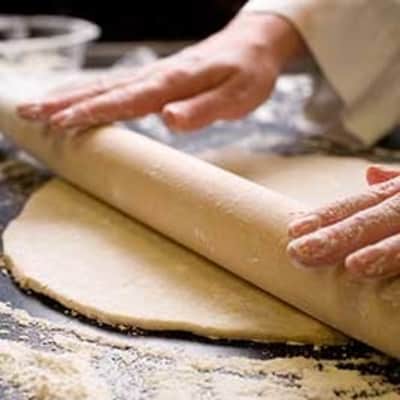
- Line rimmed baking sheet with parchment paper. Roll dough square into 10½ by 14-inch rectangle on well-floured counter. Transfer dough to prepared sheet and refrigerate for 10 minutes. Meanwhile, roll dough disk into 12-inch circle on well-floured counter. Loosely roll dough around rolling pin and gently unroll it onto 9-inch pie plate, leaving at least 1-inch overhang around edge. Ease dough into plate by gently lifting edge of dough with your hand while pressing into plate bottom with your other hand. Trim overhang to ½ inch beyond lip of plate. Wrap dough-lined plate loosely in plastic and refrigerate until dough is firm, about 30 minutes.
- Transfer chilled dough rectangle, still on baking sheet, to counter. Using pizza wheel, fluted pastry wheel, or paring knife, trim ¼ inch of dough from long sides of rectangle, then cut rectangle lengthwise into eight 1¼-inch-wide strips. Refrigerate strips on sheet until firm, about 30 minutes.
- Adjust oven rack to middle position and heat oven to 400 degrees. Whisk sugar, cornstarch, lemon zest, fresh ginger, ground ginger, and salt together in large bowl. Stir in plums and lemon juice and let sit for 15 minutes. Spread plum mixture into even layer in chilled dough-lined plate. (For the herringbone lattice crust shown in the photo, see "Making a Herringbone Lattice" instructions below.)
- To make lattice, evenly space 4 dough strips across top of pie, parallel to counter edge. Fold back first and third strips almost completely. Lay 1 strip across pie, perpendicular to counter edge, keeping it snug against folded edges of dough strips. Unfold first and third strips over top of perpendicular strip. Fold back second and fourth strips and add second perpendicular strip. Repeat, alternating between folding back first and third strips and second and fourth strips and laying remaining strips evenly across pie to create lattice pattern. Shift strips as needed so they are evenly spaced over top of pie. Trim excess lattice ends, press edges of bottom crust and lattice strips together, and fold under; folded edge should be flush with edge of plate. Crimp dough evenly around edge of plate using your fingers. Brush dough with egg wash.
- Bake pie on aluminum foil–lined rimmed baking sheet until crust is golden, 20 to 25 minutes. Reduce oven temperature to 350 degrees and continue to bake until juices are bubbling and crust is deep golden brown, 35 to 50 minutes longer. Let cool on wire rack until filling has set, about 4 hours. Serve.
for the dough
for filling
for traditional lattice top


Time
2¾ hours, plus 3 hours chilling and 4 hours coolingYield
Serves 8Ingredients
Dough
Filling
Test Kitchen Techniques
Ingredients
Dough
Filling
Test Kitchen Techniques
Ingredients
Dough
Filling
Test Kitchen Techniques
Why This Recipe Works
Plum pies have a problem: They’re either a mushy disappointment or a dense brick of overcooked, dried-out, leathery fruit. We wanted tender bites of plum in a fresh but slightly jammy filling. Leaving the skins on the plums and cutting them into ¼-inch-thick slices resulted in perfectly cooked fruit and filling. Plums, while plenty juicy, release less liquid during baking than fruit such as blueberries or cherries, so using tapioca for the thickener gave our filling a slightly sticky quality; cornstarch was a much better choice. Another key step to nailing our pie’s texture was letting the filling sit for 15 minutes before adding it to the pie shell; this drew out some of the plums’ juices which ensured that the cornstarch was evenly absorbed and eliminated any clumps of thickener. A bit of spicy, tangy ginger complemented the sweetness of the plums.





13 Comments